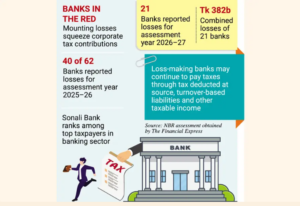
Forty of Bangladesh’s 62 commercial banks reported losses in their corporate-tax returns for the past tax year, reflecting sluggish business activity and a slowdown in private-sector credit growth.
The remaining 22 banks reported profits for assessment year 2025-26, contributing varying amounts of corporate-income tax. However, several of the lenders also experienced deterioration in their financial performance.
An internal assessment by the National Board of Revenue (NBR), obtained by The Financial Express (FE), on corporate-tax collection from the banking sector and its projections reveals the banking and overall economic trends.
However, a senior tax official at the NBR said banks having incurred loss paid taxes too due to turnover tax and tax deducted at source from sales of bonds.
“It does not mean that decline in income means negative tax payment in a particular tax year,” he added.
State-owned Sonali Bank ranked among the top corporate taxpayers in the banking sector, followed by Dutch-Bangla Bank. BRAC Bank ranked among the leading private commercial banks in terms of tax payments.
Pubali Bank, HSBC, City Bank PLC, Eastern Bank, Agrani Bank, Shahjalal Islami Bank, Uttara Bank and Prime Bank were also among the top 10 corporate taxpayers in the sector during the year.
The assessment, however, shows a significant deterioration in the tax-return positions of several banks, with losses deepening over in the 2026-27 assessment year.
One public and some first-generation private commercial banks reported losses in the latest assessment year.
Of the 22 banks that reported profits for assessment year 2025-26, 11 subsequently reported losses in the assessment year, while 21 banks reported losses in assessment year 2026-27, according to the assessment. Bangladesh Krishi Bank’s figure for the latter period was unavailable.
The situation deteriorated further in assessment year 2026-27, when 21 banks reported aggregate losses of approximately Tk 382 billion, excluding Bangladesh Krishi Bank.
The assessment also identifies banks that relapsed from profit into loss, including the state-owned Janata Bank and few private banks.
The deterioration is particularly concerning for lenders that had previously remained profitable, as the shift may indicate mounting pressure on their financial performance.
Despite reporting losses, the banks continued to pay some taxes, partly because tax deducted at source on bond sales is included in their reported tax payments.
Talking to the FE, former commissioner of Large Taxpayers Unit (LTU) income tax Apurba Kanti Das said income from businesses is separate from income from securities for corporate taxpayers.
“This results in payment of taxes despite incurring losses,” he added.
Income tax also imposes tax on provisions of bad loans, he noted.
Regular tax payments remained positive for almost all the banks, suggesting that some payments may reflect minimum or turnover-based tax liabilities rather than taxes on profits.
The figures suggest that weak earnings and mounting losses are affecting a growing number of lenders, potentially constraining their capacity to contribute to corporate income-tax revenue.
Former chairman of Sonali Bank Muslim Chowdhury says unless the banking sector is completely revamped through a major policy shift, particularly in governance and ownership structures, the crisis cannot be resolved.
Two major problems are money laundering and lending without adequate collateral. In many cases, loans were disbursed in the names of projects but the funds were never invested in those projects.
“Instead, the money was siphoned off and laundered abroad,” he says.
“When public confidence in Islami Bank declined, many depositors shifted their money to Sonali Bank. The bank has invested the surplus funds in treasury bills and treasury bonds, generating profits through treasury management,” he explains.
Source: https://thefinancialexpress.com.bd/economy/forty-commercial-banks-report-losses-in-corporate-tax-returns