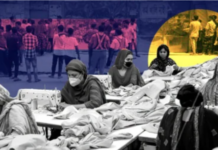
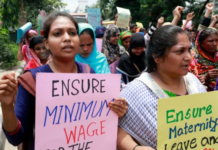
Bangladesh Garment Manufacturers and Exporters Association (BGMEA) President Mahmud Hasan Khan said they are willing to pay workers wages comparable to those in Vietnam if the country can provide similar infrastructure, logistics and other business facilities.
Speaking at a programme “Garment Workers’ Wages: Fairness and Industry Development”, organised by the Power and Participation Research Centre (PPRC) today (22 November), he said Bangladesh’s garment industry operates under less favourable conditions than its competitors.
Highlighting Bangladesh’s disadvantages in logistics and industrial support, he said the country lagged far behind Vietnam in lead times, lacked a deep-sea port and did not have equally strong backward linkage industries or the necessary energy support.
Mahmud also claimed that although the minimum wage for garment workers is Tk12,500, their average actual monthly earnings stand at Tk19,600.
The programme brought together representatives of garment manufacturers, labour organisations and researchers, who highlighted the need for a permanent, transparent and evidence-based wage-setting framework that balances workers’ demands for fair remuneration with the industry’s competitiveness and sustainability.
Bangladesh Institute of Labour Studies (BILS) Executive Director Syed Sultan Uddin Ahmed said, “Workers assume that unless they take to the streets, their concerns will not come up for discussion. We need to overcome this crisis of trust.”
Responding to the observation, Mahmud questioned whether street protests should remain the only way to resolve labour disputes, urging stakeholders to move away from such a mindset.
PPRC Executive Chairman Hossain Zillur Rahman, who chaired the programme, said demonstrations could be understandable as a way to draw attention to workers’ demands, but disorder was undesirable.
Syed Sultan also pointed out that workers in other countries receive various forms of government-backed social protection, while Bangladesh’s system remains largely dependent on factory owners.
He highlighted several weaknesses in Bangladesh’s wage-setting process, including inadequate data, the absence of a national minimum wage, no clear definition of the minimum wage base and a lack of research by the wage board.
Taslima Akhter, president of Bangladesh Garment Sramik Sanghati, opposed including overtime earnings when calculating workers’ minimum wages, saying their regular earnings for standard working hours should be the basis.
Musleh Uddin Ahmed, a member of the minimum wage board, expressed hope that negotiations would produce an effective wage structure for garment workers within this month.
Meanwhile, garment entrepreneur and former BGMEA president Anwar-Ul Alam Chowdhury Parvez, currently president of the Bangladesh Chamber of Industries (BCI), highlighted the challenges facing the garment sector.
https://www.tbsnews.net/economy/rmg/give-us-vietnam-facilities-we-will-pay-vietnam-wages-bgmea-president-1610896