Bangladesh’s GDP growth may get stuck at a low 3.4 per cent in the current fiscal year as decelerators like energy and banking-sector vulnerabilities, weak investment and persistent inflationary pressure subdue economic activity, says the World Bank.
It also lists limited tax reforms, rising current expenditure, and high domestic borrowing as hikers of fiscal pressures for the country.
The Washington-based lender, in its latest Bangladesh Development Update, on Tuesday projected the real gross domestic product (GDP) growth at 3.4 per cent in FY2026-27 for the country, a sharp downgrade from its April forecast by 1.2-percentage points.
The latest projected growth is also significantly below Bangladesh’s average growth of around 5.6 per cent over the past decade, according to the WB report rolled out in its Dhaka office that stresses comprehensive reforms as a remedy.

The shocks will not only dampen the higher economic growth prospect, the poverty rate might also increase in the near term, the WB forecasts.
It expects growth to recover only modestly to 3.9 per cent in the next FY2028, provided energy- supply constraints gradually ease and the government accelerates structural reforms.
The global lender has said Bangladesh’s economic slowdown has become increasingly entrenched since 2023, with persistent structural constraints weighing on investment and economic activity.
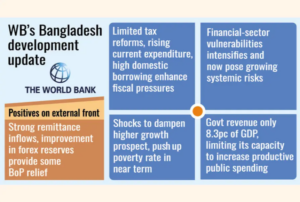
About the banking sector, the WB update says financial-sector vulnerabilities have intensified and now pose growing systemic risks.
Citing the example of higher non-performing loans (NPLs), negative 2.6-percent capital- adequacy ratio against a regulatory minimum of 10 per cent, it says even this figure is overstated-about US$17 billion in loan-loss provisioning has been deferred for undercapitalized banks.
Bangladesh Bank’s uncollateralized liquidity support to weak banks stood at Tk 760 billion (US$6.2 billion) which could create “quasi-fiscal losses if the claims turn bad”.
Criticized also is the reinstatement of a 4.0-percent cap on banks’ interest spread in June 2026, calling it a reversal of market-based rate setting. It urges the removal of the cap, completion of asset-quality reviews, time-bound bank restructuring and an end to regulatory forbearance.
The development financier cautions that continued regulatory forbearance and liquidity support could delay the recognition and resolution of losses rather than repairing banks’ balance sheets.
The banking-sector stress is also affecting credit intermediation. Private-sector credit growth has fallen to around 4.5 per cent-its lowest level in decades-while banks have “increasingly financed the government”.
The weak banks restrict credit to businesses, while heavy government borrowing from banks can further crowd out private investment.
The Development Update says energy shortages have emerged as a major constraint on industrial production and investment.
Declining domestic gas production, disruptions in imported liquefied natural gas (LNG) supplies and rising energy costs have affected industrial operations, resulting in factories closure and below-capacity operation.
The World Bank has said the outlook remains subject to significant downside risks, including prolonged energy constraints and elevated global commodity prices.
“Bangladesh has become increasingly dependent on imported LNG as domestic gas production declines. The energy problem therefore represents more than a temporary supply disruption. It is increasingly becoming a constraint on industrial competitiveness, investment and potential economic growth.”
In WB’s view, the investment activity has softened, while exports have lost momentum.
“High inflation has reduced household purchasing power and raised business costs, while financial-sector weaknesses have undermined investor confidence,” it says, adding that the limited fiscal space is also constraining public investment.
It notes that revenue mobilisation remains particularly weak. Government revenue stood at only 8.3 per cent of GDP, among the lowest levels globally, limiting the government’s capacity to increase productive public spending while simultaneously supporting the banking and energy sectors.
“The combination of weak private investment and constrained public investment is, therefore, creating a major obstacle to a faster recovery.”
Inflation is projected to remain elevated at 8.6 per cent in FY2026-27, before easing to 7.1 per cent in FY2027-28.
As such, the WB sees Bangladesh facing a difficult near-term environment in which weak growth and high inflation coexist.
The WB development update, however, mentions some positive developments in external sector for Bangladesh as it offers some relief.
“Strong remittance inflows and an improvement in foreign-exchange reserves have provided support to the external sector. Remittances increased 17.3 per cent to a record $35.6 billion in FY2025-26, helping contain pressure on the balance of payments.”
The global lender has called for urgent reforms in the banking, energy and domestic revenue sectors to restore investor confidence and create jobs.
In the banking sector, the priority should be to identify the true condition of troubled banks, recognise losses, strengthen capital and improve governance rather than rely on repeated regulatory concessions and liquidity support.
Bangladesh needs to expand domestic gas exploration, improve LNG infrastructure, upgrade transmission and distribution systems, develop renewable energy and ensure greater transparency in energy procurement.
The World Bank has also called for stronger domestic revenue mobilisation to create fiscal space for productive public investment.
“To avert economic downturn and return to an inclusive growth path, driven by private investment, fast and bold reforms are needed in the banking sector, domestic revenue mobilisation and energy sector,” said Jean Pesme, World Bank Division Director for Bangladesh and Bhutan.
Unless these bottlenecks are addressed, the projected rise in growth from 3.4 per cent in FY2026-27 to 3.9 per cent in FY2027-28 could remain a modest recovery rather than a return to the country’s previous growth trajectory.
In a spotlight on the revenue sector, the WB notes that though revenue mobilisation in Bangladesh improved modestly in FY26 but remained significantly below the target.
The improvement, however, was constrained by weak industrial and income growth and subdued consumption amid elevated inflation.
The WB report also has identified low tax compliance, a narrow tax base, weak and fragmented tax administration and high tax expenditures as persistent obstacles to stronger revenue mobilisation.
Tax collection by the National Board of Revenue (NBR) reached only 82.6 per cent of the FY26 target, despite registering 12.0-percent year-on-year growth.
Overall domestic revenue is estimated to have increased from 8.0 per cent of GDP in FY25 to 8.3 per cent in FY26.
It notes that reforms to strengthen tax mobilisation remained limited during FY26. A key institutional reform-the separation of tax-policy formulation from tax administration-continued to face delays.
Progress in implementing the Tax Expenditure Management Policy Framework was also limited, with no comprehensive tax-expenditure report published during FY26 as required under the policy. It recommends stronger institutional capacity, improved compliance enforcement and greater digitisation of tax administration.
Creating fiscal space for development will require a significant increase in revenue collection from its current low level, the World Bank suggests as one of the must-dos.
It has identified a clear separation between tax policymaking and tax administration as a key priority, arguing that this would enable more strategic tax-policy design and more effective implementation.
The report recommends modernising tax administration through greater digitisation, integrated taxpayer databases and better use of data to improve compliance.
It has also called for a review and gradual phase-out of poorly targeted tax exemptions and incentives that reduce government revenue without generating sufficient economic benefits.
“A simpler VAT system with a more uniform structure, broader coverage and modern digital filing and invoicing systems could improve both efficiency and compliance.”
Strengthening the administration of income, corporate and property taxes would also help broaden the tax base, reduce informality and raise revenue without increasing tax rates, according to the report.
It says direct taxes and transfers reduced inequality and poverty but regressive indirect taxes offset part of those gains.
The World Bank has said a stronger and more progressive fiscal system would require better targeting of subsidies and transfers alongside reforms to revenue mobilisation.
Source: https://thefinancialexpress.com.bd/economy/wb-lowers-bangladesh-gdp-growth-to-34pc-for-fy27