
The Daily Star
Hanif Chowkidar, a farmer in Patuakhali’s Galachipa upazila, had planned to cultivate Aman paddy on 5.26 hectares this season. He spent around Tk 22,000 on four maunds (1 maund = 37.32kg) of seed and prepared a seedbed.
But days of relentless rain left the seedbed submerged for about a week, destroying it completely.
“I never imagined facing such a huge loss right at the start of the season,” Hanif told The Daily Star. “I’m now worried about how I’ll plant Aman paddy on all the land. It seems some of it will have to remain uncultivated.”
He said setting up a new seedbed would only add to his costs.
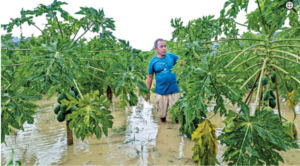
In Rangamati’s Barkal upazila, farmer Jagat Moy Chakma spent Tk 1.40 lakh to plant 872 papaya trees on two bighas (0.268 hectares) of land. He had expected to harvest around 23,000kg of papaya before continuous rainfall inundated the orchard.
“Even though the water has receded, the trees are dying and the fruits are falling off,” he said, estimating his losses at Tk 8-9 lakh.
Like Hanif and Jagat Moy, more than 2.43 lakh farmers across 43 districts have suffered losses from the heavy monsoon rains that lashed Bangladesh between July 7 and July 19, according to the agriculture ministry’s final assessment.
The affected districts include Chattogram, Noakhali, Cumilla, Barishal, Khulna, Rangamati, Khagrachhari, Magura, Patuakhali, Shariatpur, and Sylhet.
More than 1.34 lakh tonnes of crops worth around Tk 478 crore were damaged across 24,138 hectares of farmland — about 3 percent of the more than 8.17 lakh hectares under cultivation.
The damaged crops include Aus paddy, Aman seedbeds, vegetables, ginger, chilli, turmeric, papaya, watermelon, groundnut, jute, banana, sugarcane, cantaloupe, corn, and betel leaf.
Of the affected farmland, 12,783 hectares were under Aus paddy, 1,746 hectares were Aman seedbeds, and around 9,000 hectares were planted with vegetables.
Mohammod Amanul Islam, deputy director of the Department of Agricultural Extension (DAE) in Patuakhali, said 23,000 of the district’s roughly 2 lakh Aman farmers had already received 5kg of seed and 5kg of MoP fertiliser each as part of regular government incentives.
However, no additional assistance has yet reached the district following reports of the latest crop losses.
“We have informed the higher authorities and will distribute the assistance once it is received,” he said.
In Rangamati, DAE Deputy Director Md Maniruzzaman said Baghaichhari and Bilaichhari upazilas suffered the worst damage.
Around 3,675 hectares of farmland were affected in the district, impacting about 11,000 farmers, he said, adding that a list of affected farmers had been sent to the authorities and assistance would be distributed soon.
Md Obaidur Rahman Mondol, director of the DAE’s Field Services Wing, said the government has approved rehabilitation assistance for farmers in seven of the worst-hit districts: Brahmanbaria, Habiganj, Chattogram, Cox’s Bazar, Rangamati, Bandarban and Khagrachhari.
He said around 63,000 farmers in those districts have already received late-variety Aman seed after losing Aus crops and Ropa Aman seedbeds.
Assistance for the remaining affected farmers will be provided ahead of the winter cropping season, he added.
Asked why only seven districts were included despite damage being reported in 43 districts, Obaidur said the government differentiates between affected districts and those that suffered severe losses.
“The seven districts were prioritised because they sustained the heaviest damage, ensuring that the worst-affected farmers received immediate support,” he said.
Speaking at an event on July 11, Agriculture Minister Mohammed Amin Ur Rashid said the government was preparing a list of flood-affected farmers to provide targeted rehabilitation assistance.
Agricultural economist Jahangir Alam Khan said the losses were not significant enough to threaten the country’s food security or disrupt supplies.
“The main concern is market manipulation,” he said, stressing the need for effective market management to prevent unjustified price hikes.
He also recommended cash assistance for affected farmers to repair homes, rebuild poultry farms and restore fish ponds damaged by the floods.
With floodwaters receding and no immediate threat of another flood, farmers can now prepare new seedbeds, replant Aman seedlings and begin cultivating winter vegetables, he added.
[Our Rangamati Correspondent Rikors Chakma contributed to this report]
Source: https://www.thedailystar.net/news/environment/climate-crisis/news/rain-floods-damaged-crops-worth-tk-478cr-4233536