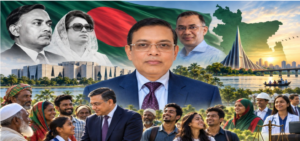
A visual portrait of A.B.M. Ashraf Uddin Nizan’s nationalist leadership—connecting political legacy, sovereign dignity, ethical responsibility, justice, and grassroots service with the aspirations of a new generation of Bangladeshis.
In times when political loyalty is often mistaken for blind loyalty, A.B.M. Ashraf Uddin Nizan presents a far more difficult idea: that political loyalty can go hand in hand with loyalty that goes far beyond the party.
Politicians have always been plentiful in Bangladesh. The problem lies in the country’s inability to nurture a political culture that values principles over opportunism, national responsibilities over personal aspirations, and party loyalty without compromising one’s moral duties. Political leadership is judged not through slogans or through mere closeness to those who hold office, but on the willingness to tell difficult truths, to refuse corruption and excess even in one’s own ranks, and to put national dignity and national interests above everything else. In the kind of political culture described here, loyalty does not come into conflict with conscience; indeed, principled loyalty is a function of the capacity for moral courage.
It was precisely these beliefs and values, along with the firsthand experience I gained during my teaching tenure at North South University (NSU) in Bangladesh, that led me to investigate the political character and leadership qualities of A.B.M. Ashraf Uddin Nizan, MP and BNP Whip in Parliament. The issue that captured my attention was not only related to his political affiliation or status but, more importantly, to the much bigger question of his political life, namely whether it is possible for a politician to be profoundly committed to his political traditions and, at the same time, be able to think independently, criticize the wrong things when they occur even despite their political expediency, to stay close to the people, and act in the interests of Bangladesh as a nation.
Against this background, the political life of A.B.M. Ashraf Uddin Nizan, a BNP member of parliament from the constituency of Lakshmipur-4, must be considered not only in terms of the offices he holds, but also the politics he has. The political identity of Nizan is based on three different yet interlinked pillars: Bangladeshi nationalism linked to President Ziaur Rahman; political strength and determination that are related to Begum Khaleda Zia; and the principle that loyalty can under no circumstances be used as an excuse for extortion, corruption, violence, or any other form of abuse against fellow citizens. In today’s Bangladesh, he sees these values implemented in Prime Minister Tarique Rahman’s administration. Together, these characteristics make Nizan an instructive case for examining the meaning of ethical nationalist leadership. Here is a tighter, more inspiring version that preserves the section’s spirit while sharpening its central argument:
Nationalism as Responsibility, Not a Slogan
For Nizan, nationalism is no mere election cry raised whenever politically expedient; rather, it is a duty to lead one’s life through public service. For Nizan, Bangladesh’s nationalism embodies sovereignty, national pride, democracy, development, and independent decision-making, with Bangladesh’s national interest always taking precedence over private, partisan, or foreign interests. Embedded in this belief is his love for President Ziaur Rahman’s nationalist ideology, which emphasized Bangladesh’s unique identity, sovereignty, self-reliance, and freedom of decision-making. A third quality to be embedded in the political tradition was Begum Khaleda Zia’s resilience, as she remained resolute in her political convictions come what may. Nizan relates to both ideologies: President Ziaur Rahman’s nationalism and Begum Khaleda Zia’s political resilience. By paying tribute to both of them and others among parliamentary leaders at their graves in March 2026, Nizan showed his everlasting political allegiance. However, real political allegiance goes beyond the ceremony of tribute; it means living up to the legacy of political leaders in behavior once they gain power. Nizan’s long association with Khaleda Zia and his reputation within the BNP for loyalty and commitment reinforced this political identity. For him, therefore, the most meaningful tribute to Ziaur Rahman and Khaleda Zia is not simply to invoke their names, but to carry forward the principles he associates with their legacy through integrity, courage, service and an unwavering commitment to Bangladesh’s national interest.
According to National Professor Dr. Mahbub Ullah, “Mr. Nizan’s statements are compelling because they reflect conviction, clarity and a deep understanding of Bangladeshi nationalist politics. What distinguishes him from many other BNP leaders is his ability to articulate nationalism not merely as partisan rhetoric, but as a principled commitment to Bangladesh’s sovereignty, national dignity, independence and national interest. His political voice is therefore distinctive forthright, thoughtful and firmly grounded in the nationalist ideals he believes in.”
Tarique Rahman and Sovereign Equality
Nizan’s politics should therefore also be understood through his alignment with Prime Minister Tarique Rahman’s contemporary interpretation of nationalist politics. In this view, Tarique Rahman’s leadership seeks to adapt the principles associated with Ziaur Rahman and Khaleda Zia to a world defined by economic interdependence, Indo-Pacific strategic competition, relations with India and China, engagement with the United States and Europe, climate vulnerability, migration, technology and the expectations of a younger generation.
At the heart of this worldview is a simple proposition: Bangladesh must be friendly with all, but subordinate to none.
Nizan appears to share the conviction that Bangladesh should pursue constructive relations with India, China, the United States, the European Union, Japan, the Muslim world and other international partners wherever interests converge. But those relationships must rest on reciprocity, mutual respect and sovereign equality. Resistance to hegemony, in this situation, must not involve animosity toward another nation or even its citizens. Nationalism must also not evolve into xenophobia. For instance, Bangladesh and India share geography, rivers, business relations, security problems, and many human connections. Cooperation is necessary, but friendship will last longer with mutual respect. The appropriate foreign-policy orientation is consequently neither anti-India, anti-China, nor anti-American. It is pro-Bangladesh. This can be described as a doctrine of friendship without subordination: cooperate where interests coincide, negotiate firmly where they differ, and retain the sovereign right to say no when an arrangement does not adequately serve Bangladesh. However, sovereignty outside one’s borders cannot be achieved without integrity inside the country. A country plagued by corruption, extortion, politicization of institutions, and abuse of power cannot exercise genuine autonomy.
This is the deeper continuity Nizan sees connecting Ziaur Rahman, Khaleda Zia and Tarique Rahman: Bangladesh belongs to its people; sovereignty cannot be sacrificed for political convenience; democratic legitimacy must come from citizens; and political authority must ultimately serve national rather than personal, partisan or foreign interests.
When Party Discipline Means Disciplining Your Own Party
One of the clearest tests of integrity occurs when alleged wrongdoing involves not political opponents but one’s own supporters. Following the 2026 parliamentary election, reports from Lakshmipur described cases against 26 BNP leaders and activists involving allegations of violence, extortion and armed processions. Nizan publicly adopted a zero-tolerance position, declaring that those seeking to exploit electoral victory for extortion, violence or harassment had no place in the party and that the law should take its course. The significance extends beyond Lakshmipur. Politicians need to understand that political victories do not entitle one to contractual favors, power, influence, or control over institutions. The Democratic Party must not demand accountability from one administration while covering up misbehavior in its own ranks.
It is quite simple: Illegality does not become legality because the criminal is from your party.
By doing that consistently, one will get a clear example of political discipline: loyalty means protecting the party’s values, not the criminals.
Courage to Say What One Believes
Nizan’s political style is also characterized by directness. During parliamentary discussion of the motion of thanks on the President’s address in April 2026, he drew a careful distinction between the presidency as a constitutional institution and the individual occupying that office. He said he respected the constitutional office but could not personally extend thanks to President Mohammed Shahabuddin, referring to commitments made to families of those killed during the July uprising. Whatever one’s view of that position, the democratic principle is important: respect for an institution does not require unquestioning approval of its officeholder. A mature democracy must allow citizens to respect Parliament while criticizing parliamentarians, defend judicial independence while questioning judgments, and honor the presidency while criticizing a president. That is constitutional respect without compulsory personal allegiance.
Remembering Democratic Sacrifice
Nizan has also argued in Parliament for recognition of intellectuals, human-rights advocates, civil-society figures and political activists who participated in Bangladesh’s pro-democracy struggle, including rehabilitation for those who suffered persecution. The connection between Nizan and the July movement is a pre-coup attempt. “Delegates from BNP and leaders of the students met in August 2024,” according to BNP Secretary General Mirza Fakhrul Islam Alamgir in an interview in 2026. This may be why he felt any democratization process should take into account those affected. Experience, as he said, is not only of the leaders but of the citizens too.
Ethics in Practice: Duty, Consequences and Character
Nizan’s political activities can be analyzed through three principal streams of normative ethics: deontological ethics, consequentialism, and virtue ethics. Deontological ethics focuses on duties. Some of these must be considered to be non-negotiable: do not plunder public property, do not lie to the citizens, do not cover up criminals simply because they are members of your political party, do not undermine constitutional institutions, and abide by the law. Nizan’s strict adherence to a zero-tolerance policy toward criminal behavior in his political party may serve as an example.
Consequentialism considers the effects of political action: Does it make life better for human beings? A good intention is insufficient in itself. Law and order, jobs, education, health, infrastructure, economic opportunity, and safety for the weak are tangible standards for judging government effectiveness. The bottom line in Nizan’s politics is whether Ramgati, Kamalnagar, and other areas have really gained anything.
Virtue ethics examines who holds political power. Political virtues linked to virtue ethics include honesty, courage, justice, prudence, humility, and integrity. Courage does not necessarily mean being louder than your competitors. Sometimes, courage means telling your people they are wrong. All three traditions come together in a challenging prescription: do the right thing, produce good for the community, and be a person of character while wielding power.
Twenty Perspectives: A Reputation Tested Across Society
Public perception of Nizan does not come from a single partisan viewpoint but from multiple communities that evaluate him as their leader. While in Ramgati and Kamalnagar, followers praise accessibility, connectedness, and sensitivity to daily problems; lower-level BNP activists demand loyalty but not impunity for their wrongdoings; higher-level associates and young nationalists appreciate honesty, integrity, and principles before anything else. Democracy advocates and July movement families define a good leader through his appreciation of sacrifice, farmers through consideration of rural needs, businessmen through respect for the rule of law and security from political influence, teachers through integrity and sense of civic duty, journalists through the ability to speak one’s mind through deeds and not just words, members of civil society and legal professionals through independence and equality under the law, and religious and community leaders through awareness that a position of power comes as a gift an Amanah. Women and family groups need access beyond the political elite, youth need equal access to opportunities on meritocracy principles, and civil servants require institutional respect.
Perhaps the most difficult choices come from political opponents and non-aligned citizens, for whom integrity means disagreeing without anger and judging performance rather than the political affiliation of those in power. Another complication arises from the Bangladeshi diaspora community the idea that nationalism implies dignity abroad and integrity at home.
Taken together, however, these different approaches have far greater value as genuine arenas in which political character must always be validated rather than as artificial endorsements that protect one’s reputation. A reputation for honesty cannot be maintained solely by one’s reputation, integrity cannot depend merely on one’s party affiliation, and humility must go beyond mere words. The distinctive feature of the down-to-earth person lies in the ability to stay accessible after victory, listen despite hard criticism, hold his supporters responsible, respect political opponents, and understand that for the politician the office is provisional, whereas for the citizens it is permanent. Therefore, it is not just a matter of preserving Nizan’s reputation;it is a matter of proving it daily through his actions. While power can isolate you from people, principled leadership removes that isolation. When elections may give you political power, only integrity, modesty, courage and service can bring you sustained trust. And in politics, trust built across people, professions, communities, and generations cannot be inherited, demanded, or constructed.
Integrity Must Also Accept Scrutiny
The analysis of ethical leadership must not be hagiography. Nizan is also a businessman; therefore, transparency is especially important where his business interests intersect with his public responsibilities. He has been reported to be the chairman of Cosmos Enterprise, which was among the consortium applying for the New Mooring Container Terminal project at Chittagong Port. That fact alone establishes no wrongdoing. But precisely because Nizan presents a politics of integrity, such matters should be addressed through transparency, disclosure and avoidance of conflicts of interest. The same ethical standard must apply to everyone, including oneself. Nizan has also participated in parliamentary accountability mechanisms, including leading an inquiry into allegations concerning Parliament Secretariat camera procurement and serving on the Public Accounts Committee. Scrutiny builds character, rather than destroys it.
Beyond Dirty Politics: Loyalty, Not Blindness
The task of democracy in Bangladesh also involves ending a system of patronage, threats, blackmail, political protection, character assassination, and the notion of power giving impunity.
Nationalism cannot therefore mean only resisting external domination. Bangladesh also needs ethical nationalism: protection from corruption, institutional decay, and abuse of power from within. A politician who loves his country must protect its treasury as carefully as its territory.
This requires distinguishing principled loyalty from blind loyalty. Blind loyalty says: My party is always right. Principled loyalty says: I support my party because I believe in its principles, and therefore I must oppose conduct that violates those principles. For Nizan, that means being prepared to say no to extortion, corruption, political revenge, abuse of authority, sycophancy, and opportunism masquerading as nationalism.
The Harder Test Comes with Power
Political integrity is easiest to proclaim in opposition. Its real examination begins after victory.
Can a politician who demanded accountability yesterday tolerate scrutiny today? Can he oppose corruption by an ally? Defend an opponent’s democratic rights? Accept criticism from journalists? Reject improper favors from influential supporters? Remain accessible after acquiring power? These questions, not slogans or ceremonial speeches, will determine the historical judgment of Nizan and every contemporary political leader.
His public record offers examples of directness, institutional engagement, and a willingness to speak out against alleged wrongdoing within his own political camp. But ethical leadership is never a title permanently earned. It must be renewed with every exercise of power.
The future of democracy in Bangladesh cannot just be attained by moving from one political party to another. What is needed is a fundamental change in the culture of power itself, so that public office is a duty, not a right. For Nizan, the strongest tribute to Ziaur Rahman, Khaleda Zia, and the nationalist leadership of Tarique Rahman will therefore not be repeating their names.
The Measure of a Political Life
Ultimately, the basic principle of A.B.M. Ashraf Uddin Nizan’s politics is simple enough to be stated, yet incredibly hard to put into practice. Loyalty and integrity do not have to conflict in politics. Friendship and sovereignty do not have to conflict in nationalism. Strength and humility do not have to conflict in leadership. Finally, service to a political party should never come above service to one’s nation.
Political offices are temporary. Titles change, governments come and go, parliamentary seats are won and lost, and the applause surrounding power eventually fades. What remains is character—and the memory of how power was exercised when one possessed it.
In the event that Nizan succeeds in translating his ideals into actions through speaking the truth despite its inconvenience, refusing to be corrupt even at the cost of losing from one’s own side, protecting the interest of Bangladesh without making nationalism synonymous with antagonism, respecting his opponents without compromising his beliefs, and maintaining accessibility among the common people despite attaining power, the political relevance of his life could transcend the boundaries of Lakshmipur-4 or the post of parliamentary Whip.
A politician’s greatest achievement is not simply winning an election. It is to win trust and remain worthy of it. Trust cannot be legislated into existence. It cannot be purchased through publicity, inherited from a political party, or permanently secured by a landslide victory. It is accumulated quietly in promises kept, temptations resisted, uncomfortable truths spoken, ordinary people treated with dignity, opponents treated with fairness, and principles defended when abandoning them would have been easier. There, political leadership becomes moral leadership.
To Nizan, then, the future holds a challenge as well as an opportunity: to prove that the nationalist ideals of Ziaur Rahman, the strength of character of Khaleda Zia, and the modern-day leaders that he recognizes in Tarique Rahman can all be best expressed through the practice of good governance, rather than through mere slogans. Bangladesh needs such a political culture more than it needs another generation of personalities. It needs leaders who understand that sovereignty abroad begins with integrity at home; that national interest must rise above personal interest; that political opponents are not enemies of the state; and that the authority entrusted by citizens is an Amanah a responsibility to be honored, never a possession to be exploited.
In the end, the history books will not care about how close he was to power; they will care about what he did with the power, who he did it for, what he was unwilling to sacrifice, and whether the average citizen would even recognize him anymore. For Nizan, preserving that authenticity and trust may become his most consequential political legacy. For Bangladesh, however, the question is larger than Nizan or any single politician. It is whether a new political generation can transform victory into responsibility, nationalism into service, authority into accountability, and power into a force for human dignity.
Former South African statesman Nelson Mandela put the challenge of leadership into context in words of great clarity: “What makes life meaningful is not the mere fact that one has existed. It’s about the difference one can make to other people’s lives.”
Perhaps nowhere is such a legacy more important than in politics.
Dr. Serajul I. Bhuiyan
Dr. Serajul I. Bhuiyan is Professor and Former Chair, Department of Journalism and Mass Communications, Savannah State University, USA.
Source: https://southasiajournal.net/post/bangladesh/61704/the-politics-of-principle-ashraf-uddin-nizan-and-the-ethical-meaning-of-nationalist-leadership