
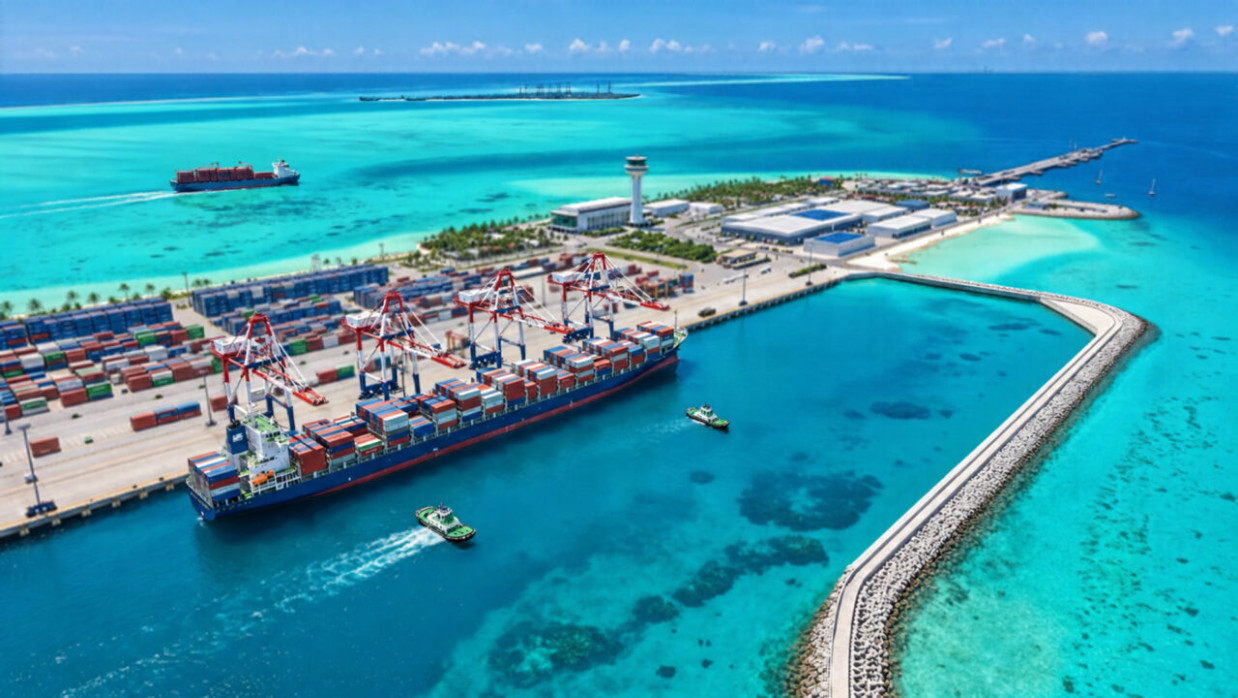
Maldives and SERH Group, of Abu Dhabi to develop a port in Ihavandhippolhu, in the extreme north of the Maldives.
The Maldives, an archipelagic nation better known for its luxurious resorts, turquoise lagoons, and pristine coral reefs, is quietly pursuing an ambition that could fundamentally transform its economic and strategic importance. Situated astride some of the world’s most important maritime trade routes, the island nation is seeking to convert its geographical advantages into a major international shipping, logistics, and maritime services hub. If successfully implemented, this strategy could diversify an economy heavily dependent on tourism and fisheries while establishing the Maldives as an important commercial gateway in the Indian Ocean.
This would be important on a much wider scale than a small island state and relatively small internal market would suggest. A very large volume of world trade passes by or across the Indian Ocean, between producers in East Asia; oil producers in and around the Persian Gulf; the largely developing countries of Africa; and the western trading nations. All types of major cargo vessels, including container ships, oil and dry bulk tankers, and LNG vessels, use this area of the ocean. This is largely due to existing facilities in places such as Singapore, Colombo, and the various Indian ports that service this volume of shipping.
Given its location in the middle of the Indian Ocean, the Maldives could be very well placed. The 1,190 or so islands stretch over 900 km from north to south, so the sea area under its control is very sizeable. The landmass is tiny, but it has a very large Exclusive Economic Zone and other surrounding waters.
The Eight-Degree Channel is particularly important, situated between the northern Maldives and India’s Minicoy Island. This passage lies along an important shipping corridor connecting the Arabian Sea and the wider Indian Ocean. Vessels traveling between the Strait of Hormuz, the Red Sea approaches, South Asia, and Southeast Asia can pass through or near the region. The Maldives therefore possesses something that infrastructure investment cannot manufacture: proximity to international maritime traffic.
A favorable location does not guarantee enough shipping to ensure viability. All manner of factors will enter into the business judgments of shipping lines as to whether it is worthwhile to divert to a particular port, including costs, volume of goods available to load or discharge, efficiency of port operations and scheduling considerations. Therefore, the Maldives will need to offer an attractive package of economic incentives and benefits to shipowners and shipping and other logistics interests.
In November 2026, an agreement was therefore concluded between the Government of the Maldives, the State Trading Organization of Maldives and SERH Group, of Abu Dhabi, for development of a range of facilities to form part of the Maldives Economic Gateway and Integrated Development Project, on Ihavandhippolhu, in the extreme north of the Maldives. These comprise an international seaport, associated marine logistics and other industry, power generation and other related facilities.
Development of Ihavandhippolhu for this or similar purposes has been contemplated for many years under several different Governments. Various schemes over time appear to have failed to generate sufficient interest from potential investors to reach the stage of actual development. Clearly, there is considerable interest at present, but nothing public about the sources and terms of finance, the precise program of works, or the levels of commercial undertaking.
Vessels using the Eight Degree Channel would all benefit from the opportunity to bunker, resupply, obtain various forms of assistance and repairs, change crews, and so on, with little or no material diversion. There would also be a case for establishing facilities to store and supply various fuels and other consumables, receive ships’ waste, and generally service passing ships.
All these would be useful functions and would provide a basis for developing other marine-related commerce. None of them has the high-volume requirements or the need for very costly plant and equipment of, for example, a trans-shipment container port, so all could be developed as requirements arose. Bunkering offshore of Maldivian ports began in September 2024, by the State Trading Organization and Vitol.
Clearly, the goal would be for the Maldives to become a transshipment point, with containers unloaded from large ships for onward carriage to other, smaller destinations, and brought in from similar ports by smaller “feeder” ships for loading onto mainline services. Many ports, most notably Singapore and Colombo, have prospered substantially as focal points for such activities.
Many different types of jobs would presumably be generated in operating ports and related services such as shipping and forwarding agents, storage, customs, and ship repairs. Further investment might be attracted in a variety of industries, including free trade areas and cold storage plants, fish processing and other suitable manufacturing for export.
Economic spin-offs would be especially welcome in the northern atolls, which have relatively few other sources of jobs and industry. A range of related commercial, training, transport, and other opportunities would likely develop, spreading economic development away from Malé and other main resort areas.
It is also proposed to move Malé Commercial Harbor to Thilafushi and substantially upgrade and expand it. This would more directly benefit the Maldives’ current trading requirements as a whole, compared with the largely foreign shipping targeted for Ihavandhippolhu. Around 60 hectares of land is proposed for various associated uses, with the port move to be completed by November 2027. More adequate facilities to receive, store, and dispatch containers around the country would all be beneficial and ease the current crowding at various points in and around Malé.
However, considerable existing and potential competition comes from other ports in the region. Colombo can offer a wide range of feeders and other lines to ship cargo to and from, and is well established as a major trans-shipment point. The new port at Vizhinjam on the Indian coast also has an attractive position relative to existing east-west routes, and will be a major port when fully developed. All would benefit from large cargo volumes to consolidate and disperse, and from proximity to the large markets of the Indian sub-continent.
It would be unrealistic for the Maldives to attract significant diversion of this traffic simply with well-built, well-equipped port facilities. It seems more likely that it could offer certain specialized services and induce some trans-shipment, building up an effective web of links to and from other ports.
In addition, it is clearly an area of great strategic interest to at least India and China, and apparently now also some Gulf countries. It would be surprising if India did not consider the whole area within its sphere of maritime interest; China’s commercial presence around the Indian Ocean is well known; and it is also significant that a UAE company is involved in developing part of Ihavandhippolhu. All these interests must be carefully weighed against the desire to retain Maldivian ownership and control.
The level of existing government and government-guaranteed debt, assessed at 129.7% of GDP at 2025 by the World Bank in its report due out in 2026, is also highly relevant, and much expenditure on land creation, harbors and plant and equipment would be difficult to justify.
The obvious impact of works on surrounding coral, together with general concerns about rising sea level and other exposure, would all need to be very thoroughly investigated.
Accordingly, gradual development according to the findings of appropriate studies, with maximum involvement and financing from the private sector, preferably with pledges from operators to use any facilities, seems most appropriate, rather than development based on numbers of vessels likely to call.
There is clear scope to take advantage of its unique location, provide attractive facilities and services, finance them appropriately and minimize environmental damage, to become a significant provider of a range of sea-related services. Much will depend on its ability to attract enough of the many ships sailing past to call, load and unload cargo, or provide other services.
Building on its present almost exclusively tourism-based trade to become a significant provider of maritime-related goods and services would be a major task. However, its location lends itself greatly to such further development.
Link: https://southasiajournal.net/post/maldives/61974/maldives-ambition-to-become-an-indian-ocean-maritime-hub-strategic-geography-economic-opportunity-and-regional-competition