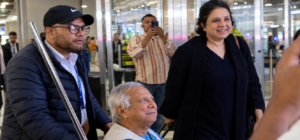
An airport concourse is no place for political humiliation. The recent incident in which Nobel Laureate Professor Muhammad Yunus was harassed at John F. Kennedy International Airport in New York calls for unqualified condemnation irrespective of the quality of leadership he offers. Citizens are entitled to question and criticize any leader’s actions. However, confronting an elderly person who is widely respected while he is seated in a wheelchair by screaming insults is neither productive nor dignified.
It is important to note that Bangladesh’s Foreign Ministry condemned this act and stated that the perpetrators could be suspected to be Awami League members. While this may be true, it should not affect the findings on the organization’s involvement in such acts. Any claims that Sheikh Hasina or other political leaders have been behind the harassment call for concrete evidence.
Despite Yunus’s international prominence, he cannot escape democratic accountability. Similarly, his prominence should not let him avoid the responsibility he took on during an extraordinary period in Bangladesh. In fact, his role in building a civilian system in the vacuum of political power after August 2024 is an achievement that can be seen as a factor in avoiding further conflict. Bangladesh must recognize Yunus’s service, his strengths, his weaknesses, and his humanity. The basic question is whether Bangladesh can hold its people accountable without revenge.
Why Political Defeat Becomes Personal Vengeance
Social Identity Theory, developed by Henri Tajfel and John Turner, can help explain this kind of hatred. Individuals form their identity and self-respect partly from the groups they belong to. If political affiliation becomes central to their identity, then their party’s failure becomes their own. The opposition stops being people they compete with and becomes a symbol of shame.
Applied to Bangladesh, this theory offers a potential cause rather than an actual cause of individual behavior. For the Awami League members, Hasina’s loss was not only the loss of power but the loss of a political ideology, leadership, and entitlement. Yunus symbolized a new leadership model. Thus, assaulting him can be considered a defense of the group identity that has been harmed.
This explains why Yunus, who did not start a crisis, is considered its creator. A long period of repression, public dissatisfaction, institutional degradation, and leaders’ miscalculations can be reduced to a single enemy to blame.
This may be amplified in the diasporic context. Closeness to Bangladesh is not necessary for political activity. Social media helps maintain grievances, while confrontation helps gain visibility and recognition within partisan networks. The airport becomes the place, and the video becomes the proof of their devotion. This performance may help the performers in their own network but turn off everybody else. Yet the need for an explanation does not equal exoneration. Nor should this mean that all supporters of the Awami League believe in intimidating critics. This message is just as applicable to those who support Yunus.
He Inherited the Rupture
Yunus did not lead the government responsible for the brutal crackdown on the 2024 uprising. After Hasina left, Yunus inherited a government facing an unusual political collapse. According to the UN human rights investigation, as many as 1,400 people were likely killed between July 15 and August 5, 2024. In addition to that, it pointed out the human rights violations linked to the former government’s security forces and the violence against Awami League activists.
The party cannot reasonably justify its defeat by citing the work of a Nobel laureate who later became the leader of the government. The uprising stemmed from unresolved grievances and government repression. That distinction matters because, to recover politically, the party must reflect on itself. The party must answer how and why it lost the people’s support, how it lost credibility, and how its leaders’ decisions led to the tragic results described above.
The readiness to serve on Yunus’s part must be interpreted considering this perilous legacy. He could have continued as an international figure advocating poverty alleviation. Instead, he took on an assignment where every complaint would come knocking at his door.
How He Helped Contain the Risk of Civil Conflict
The strongest defensible argument is that Yunus helped steer Bangladesh away from a potentially escalating national confrontation. Saying he alone “saved the country from civil war” goes beyond what the evidence can establish. No historian can prove precisely what would have happened if someone else had taken office. Civil war was a feared possibility, not an inevitable outcome. Nonetheless, it is worth recognizing the stabilizing logic of his appointment. After such upheavals, different groups need a neutral focal point through which they can coordinate their efforts without immediately submitting to one another. The international standing and recognition by student leaders made Yunus a credible mediator in an environment of political contestation for control of political parties. The resulting interim regime provided some space between the ousting of the old regime and the appointment of the new one. It provided a mechanism to negotiate political differences rather than resolve them immediately through power struggles. His calls for moderation rested on a moral authority many partisan politicians lacked. In addition, his international standing mattered greatly. At the time, international partners could see only the upheaval. Yunus’s standing made it possible to continue the dialogue while the nation was trying to find its feet again. Those achievements resulted from the joint efforts of students, civil servants, political figures, security forces, and ordinary people. Yunus’s involvement in the process must not overshadow that fact.
Reform and the Return to Elected Government
Efforts to move beyond emergency governance included creating various commissions to address institutional weaknesses. According to Human Rights Watch, commissions examined the judicial system, the electoral system, the police, the constitution, women’s rights, and labor rights, and one investigated enforced disappearance. These efforts aimed to address structural weaknesses that persisted even as regimes succeeded in one another. Their significance lay in the questions they asked. How can executive power be controlled? How could victims get justice? How could the elections become credible and law enforcement answerable to citizens? Recommendations cannot be assumed to be followed automatically, but putting such reforms up for discussion is no small task.
The transition process itself needs to be considered. In 2026, Bangladesh held parliamentary elections on February 12. After that, the leader Tarique Rahman took office on February 17. From here, we can say that the Yunus government transferred power to the newly elected government. Passing power to the interim government through elections is definitely an achievement. But this too has its demerits.
The World Recognizes His Ideas
The international recognition of Yunus predated his interim appointment. In 2006, he and the Grameen Bank won the Nobel Peace Prize for their contributions towards promoting social and economic development through bottom-up processes. The prize was granted in recognition of the model of development that sought to counter the marginalization of the poor from formal finance and emphasized their economic agency. Social business, another aspect of his international campaign, asks whether organizations can organize their activities around solving social problems rather than generating profits alone. Whether the projects succeed or fail, the concept has certainly expanded the international debate over the purposes of business and the interaction between the market and human wellbeing.
The United States awarded him the Presidential Medal of Freedom in 2009 and the Congressional Gold Medal in 2013. These honors provide concrete evidence of international recognition. They are more persuasive than claiming that everyone, everywhere admires him—an assertion no public figure could sustain. Micro-credit and social enterprise should never be immune to criticism. Questions about interest rates, debt, implementation, and results will persist. But controversies over the economic theory cannot invalidate the ideas’ contribution to putting Bangladesh on the map for poverty reduction and entrepreneurship. Thus, his reputation is part of Bangladesh’s international goodwill. Political enmity will make him a caricature at the expense of an affiliation that Bangladeshis have held with pride.
A Difficult Transition and the Work of Restoring Order
Any analysis of Professor Muhammad Yunus’s tenure must consider the unique way he came to power. Professor Yunus found himself in an extremely chaotic society, with an unstable political regime and widespread anger after the August 2024 disturbances. Having power did not necessarily mean being effective. This does not mean Professor Yunus should not face criticism, but it helps distinguish the interim government’s problems from the circumstances in which it operated. In its 2026 World Report, Human Rights Watch mentions mob violence and delays in implementing the reforms. This needs to be discussed, but it also needs to be said that Professor Yunus attempted to implement reforms under difficult circumstances.
Violence against religious minorities, vandalism of Sufi shrines, historical monuments, and memorials indicated just how difficult the task of establishing stability had become. The desecration of the body of spiritual leader Nurul Haque in Rajbari in September 2025 was especially appalling. Such acts cannot be condoned on political grounds or out of religious conviction. The attack on The Daily Star and Prothom Alo newspapers in December 2025 showed how easily public fury can get out of hand. As cited by Reuters, the attacks took place against the backdrop of civil unrest after the death of youth leader Sharif Osman Hadi. Based on what is known, there is no guarantee that Yunus was behind the attacks or that the complaints were unrelated to the newspapers’ actions during the 2007 political change. The Yunus administration condemned the attacks on the journalists and vowed to give justice to them. However, their failure to protect journalists is a valid accusation, since democracy cannot be restored without that protection.
It is not entirely accurate to claim that Yunis has never spoken on extremism. In September 2024, his administration condemned the assaults on the Sufi shrines and even gave ways of protecting such places. It all depends on whether this condemnation can be used to protect the victims.
Those responsible for individual acts of violence need to be identified with the help of evidence too. Attacks that involve Jamaat members or any other religious-political organizations need to be investigated and not attributed collectively to all. The democratization process becomes credible only if similar justice is meted out to every criminal, regardless of affiliation.
They have raised expectations that no transitional government would ever meet. We need to listen to this voice with reverence, while recognizing Mr. Yunus’s attempt to re-establish institutions. His government’s failures have taught us important lessons for the future; effective institutions must back the moral high ground.
Accountability Without Degradation
The criticism of Yunus, however justified, cannot be dismissed simply because an Awami League member expresses it. Arguments must be tested on the basis of facts, not on who is making them. Similarly, anger does not validate baseless accusations or intimidate anyone in the name of democracy.
Protesting peacefully outside one’s own country is a valid form of political expression. It cannot be argued that the dignity of the country requires protecting its former leaders from awkward questions. The pertinent line lies in behavior: threatening, hindering, intimidating, or degrading behavior is not accountability.
This theoretical insight also points to a solution. As hostilities grow because partisanship supersedes civic unity, a system is needed that makes political defeat bearable. Members of the opposition need to be assured of legal protection, equal access to justice, and opportunities for peaceful participation. Victims of the previous regime need to be given justice without expecting them to trade immunity for peace. These two conditions go hand-in-hand. As long as citizens are certain that political defeat does not translate into legal defeat, the motivation to treat each regime change as a battle for survival will diminish. In this case of the airport, therefore, more is needed than just party politics. Leadership should not be threatening; leaders need to keep the facts clear, and the media should avoid inflammatory talk without sufficient background. His followers need to appreciate the need to criticize the government while also praising him.
Bangladesh needs a political culture that can admire without revering and criticize without being brutal. Yunus made an invaluable contribution to leading the country through a difficult transitional period, and his mistakes were part of the process. Neither cancels out the other. Only when the country can honor both can it be considered worthy. Humiliating a political adversary might bring temporary satisfaction. Building such institutions that would protect the dignity of every citizen is truly a patriotic endeavor.
A Nation Should Remember
Within two years, Professor Muhammad Yunus was entrusted with the mission of steering Bangladesh through an exceptional period of national crisis, mitigating the threat of escalating conflict, introducing reforms in governance institutions, and enabling the transition back to democracy. While it is important to examine what remains to be done by his administration, one must not forget his courage and willingness to lead Bangladesh at a critical juncture in its political evolution.
The people of Bangladesh may appreciate his contribution without endorsing his decisions in full. A nation’s pride lies in its ability to appreciate those who have contributed to it, and to accept their mistakes without humiliating anyone.
Yunus’s legacy also extends beyond politics. Through his thinking, he has pushed the world to consider possibilities beyond poverty. “I believe that we can create a poverty-free world because poverty is not created by poor people,” he said in his Nobel Lecture.
Long Live Professor Muhammad Yunus. Keep changing the world with your ideas, creating opportunities, and reminding us all that dignity is universal.
Dr. Serajul I. Bhuiyan
Dr. Serajul I. Bhuiyan is a Professor and Former Chair, Department of Journalism and Mass Communications, Savannah State University, USA.
Source: