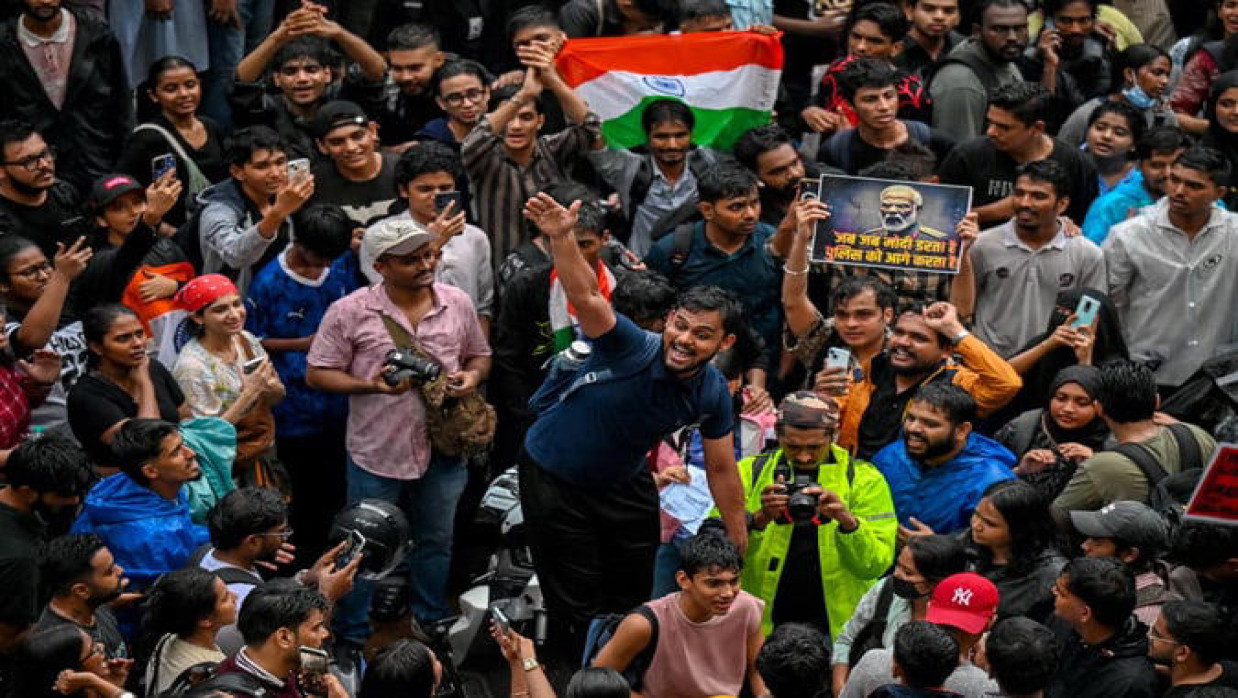
India witnessed one of its most dramatic confrontations between citizens and the state this week as the Cockroach Janta Party (CJP) and thousands of young demonstrators attempted to gather in New Delhi to protest the alleged mass deletion of voters from electoral rolls and demand the resignation of Chief Election Commissioner Gyanesh Kumar. What unfolded was not simply a clash at a protest site, but a revealing moment about the shrinking democratic space in Modi’s India and the government’s increasingly securitized response to dissent.
The immediate trigger was the Delhi Police’s abrupt decision to de-notifyv Jantar Mantar as an authorized protest venue. For decades, Jantar Mantar has been the symbolic home of peaceful dissent in India, a place where students, farmers, workers, and civil society groups could gather without fear. Its removal from the list of designated protest sites was not a minor administrative adjustment; it was a political earthquake. Authorities replaced it with distant, permission-based venues such as Ramlila Maidan, Burari Ground, and CBD Ground. The sudden change sparked a legal and political storm, prompting the Supreme Court of India to demand explanations from the Centre and Delhi Police. The Court’s intervention underscored the seriousness of the matter: restricting protest venues strikes at the core of constitutional freedoms and signals a government increasingly intolerant of spontaneous citizen mobilization.
Despite the restrictions, CJP leaders attempted to enter Jantar Mantar to assert their right to peaceful assembly. Saurav Das and Ashutosh Ranka scaled police barricades and waved the Indian flag—a symbolic act of reclaiming democratic space. They were immediately arrested and charged with criminal trespass, breach of bond, and disobedience, and remanded to five days of judicial custody. Their arrest galvanized supporters across the city. Thousands of student activists, political workers, and ordinary citizens attempted to gather at Jantar Mantar, only to face preventive detention. Delhi was placed under a sweeping security lockdown: more than 26,000 paramilitary personnel and 6,000 Delhi Police officers were deployed across central Delhi. Central Park in Connaught Place was shut down, and entry and exit at eleven major Metro stations—including Rajiv Chowk and Janpath—were restricted. Roads were barricaded, and movement across the city was tightly controlled.
Barred from Jantar Mantar, CJP founder Abhijeet Dipke and opposition figures called for a massive “Lehra Do Tiranga” march at Connaught Place’s Central Park. The symbolism was deliberate. Waving the national flag is an act of patriotism, not defiance, yet the state responded with sweeping restrictions, sealing off the park and surrounding areas. The atmosphere resembled an Emergency-era lockdown, with protesters describing the city as a fortress designed to prevent democratic assembly. The government’s response made clear that dissent, especially when youth-driven and politically disruptive, is now treated as a threat rather than a democratic right.
At the heart of the protests lies the Special Intensive Revision (SIR) of electoral rolls, which allegedly resulted in the deletion of up to 130 million voters. Opposition parties argue that the revision disproportionately removed voters in constituencies where the ruling Bharatiya Janata Party (BJP) is weaker. Independent analyses — including one by DeKoder — suggest troubling patterns: women accounted for nearly half of the deleted names, and Muslim voter deletions were significantly higher (52%) than those of non-Muslims. The Election Commission denies any political motive, but the opacity of the process has eroded public trust. When millions of names disappear without transparent criteria or verification, the credibility of the entire electoral process is called into question.
During my interview on Asia One TV’s “Perspective with Tom Philpot,” I emphasized that these allegations strike at the heart of electoral legitimacy. I also stated plainly that the BJP, as part of the Sangh Parivar, is a fascist organization that weaponizes religion and will not allow the success of public dissent. They are in the business of crowd control by any means available. This is not hyperbole; it is an observation grounded in the government’s response. The sweeping detentions, the sealing of public spaces, and the criminalization of peaceful assembly reveal a state increasingly intolerant of citizen-led mobilization. Fascist regimes do not tolerate dissent, and they do not permit freedom of expression that challenges their ideology. The events in Delhi fit this pattern with disturbing clarity.
The Election Commission’s denial of political motive does little to restore confidence because the process itself has been opaque. To rebuild trust, India needs independent safeguards. A forensic audit of deletions by a non‑partisan body is essential. The algorithms and criteria used to identify “duplicate” voters must be publicly released. Door‑to‑door verification should be mandatory before any mass deletion. Judicial oversight is necessary, especially when revisions exceed normal historical patterns. Without these safeguards, the electoral process risks losing its legitimacy in the eyes of millions.
The challenge, of course, is balancing accuracy with inclusion. India’s voter rolls do need periodic cleaning—people migrate, pass away, or appear multiple times due to clerical errors. But when tens of millions of names are removed in a short period, the risk of wrongful disenfranchisement becomes enormous. No name should be removed without physical or digital confirmation that the voter is ineligible. The Election Commission must publish the exact parameters used to flag “duplicates,” especially if algorithmic tools are involved. And voters must have simple, fast mechanisms to restore their names, including mobile registration units and online appeals. Cleaning rolls must never come at the cost of excluding legitimate voters, especially marginalized groups who already face barriers to participation.
India does have institutional pathways to investigate concerns about electoral fairness, though their effectiveness depends on political will. High Courts and the Supreme Court can order independent audits or stay electoral processes if credible evidence of wrongdoing emerges. Parliamentary committees can summon Election Commission officials and demand explanations. The Election Commission itself can initiate internal inquiries, though critics question its independence under current leadership. Civil society groups like the Association for Democratic Reforms (ADR) and independent media analyses provide crucial documentation that can trigger legal action. Ultimately, restoring trust requires an investigation that is transparent, time‑bound, and insulated from political influence.
The seriousness of the SIR controversy becomes even clearer when examining the data compiled by DeKoder’s co-founder Prannoy Roy. His analysis of the 2026 West Bengal results shows that the BJP’s landslide victory rode an eight‑point swing, while the TMC fell by about seven points. Crucially, the swing was deepest in constituencies where the SIR deletions were highest. In the twenty‑five seats with the largest number of deletions, the swing against the TMC was 10.5 percent. In the twenty‑five seats with the lowest deletions, the swing was only 5.3 percent. Higher deletions correlated with a larger swing toward the BJP — that is the trend line.
The voter roll was roughly half women, but the deletions were not. Women accounted for 62 percent of the names struck off, compared to 38 percent for men. Women had backed the TMC by about thirteen points over the BJP. Muslim voters were cut at a rate 52 percent higher than others. If Muslims had been deleted at the same rate as everyone else, the number would have been 1.98 million. Instead, it was 3 million. Muslim support for the BJP sits around seven to eight percent; for the TMC, it is about seventy‑five percent. Even Prannoy Roy’s own name was reportedly removed from the roll.
Former Chief Justice of India Rohinton Nariman has already raised concerns about the exercise. And this appears to be the template heading into Uttar Pradesh and Punjab. Draft‑roll cuts have already been reported near thirty‑three percent in Delhi, twenty‑one percent in Maharashtra and Telangana, and twenty percent in Karnataka. These numbers deepen the suspicion that the SIR was not a routine administrative clean‑up but a politically consequential exercise with measurable electoral impact.
One of the most striking aspects of the CJP movement is the role of Gen Z. Young Indians—digitally savvy, politically aware, and impatient with institutional failures—have emerged as the driving force behind the protests. Their irreverent style, including the satirical “cockroach politics,” reflects a generational shift in political expression. They have conquered fear. They are no longer content with symbolic protest; they demand structural accountability. Their mobilization across states, despite detentions and restrictions, signals a deeper erosion of trust in established institutions.
Yet the government’s response has raised serious concerns about civil liberties and press freedom. Thousands of protesters and journalists were detained nationwide. Preventive policing replaced facilitation of peaceful assembly. Internationally, these actions damage India’s democratic reputation. Images of police using force, shutting metro stations, and detaining youth activists challenge the narrative of India as a vibrant democracy with robust protest traditions.
The future of the CJP movement depends on several factors. It has momentum, a clear message—“protect your vote”—and a large youth base. Its decentralized, digital organization allows rapid mobilization. But challenges remain. State restrictions make sustained protest difficult. Political fragmentation may dilute unity. Youth-led movements often struggle with long-term strategy and resources. If the movement can broaden its coalition—students, civil society, opposition groups—and maintain non-violent discipline, it could evolve into a significant national force.
However, as I cautioned during my interview with Asia One TV (Perspectiva Program), protest size matters. Harvard political scientist Erica Chenoweth, after examining more than 300 nonviolent and violent campaigns between 1900 and 2006, demonstrated that successful nonviolent movements almost always cross a critical mass threshold of roughly 3.5 percent of the population. Only when participation reaches that scale do movements historically achieve their maximalist political goals. India is a nation of 1.42 billion people. Even if the CJP mobilizes hundreds of thousands, that represents less than 3.5 percent of the population. I do not imagine that the current size is sufficient to topple the Modi government, no matter how authoritarian or fascist his regime has become. Mass movements require scale, sustained pressure, and broad-based participation. The CJP has ignited a spark, but whether it becomes a transformative national force remains uncertain.
India stands at a democratic crossroads. The de-notification of Jantar Mantar, the mass voter deletions, and the government’s heavy-handed response all point to a nation where democratic space is narrowing. The youth have entered the political arena with unprecedented energy, demanding a democracy that works for all. Whether their movement becomes a catalyst for reform or is contained by state power will determine the future of India’s electoral integrity and civil liberties.

Dr. Habib Siddiqui
The author was born to Bangladeshi parents and studied in Bangladesh, Canada, and the USA. He lives in suburban Philadelphia. He has over three decades of experience in peaceful activism, especially in defense of the rights of displaced people.
Source: https://southasiajournal.net/post/india/61849/the-battle-for-indias-democratic-space