Ten years after joining China’s Belt and Road Initiative, Bangladesh stands at a defining moment. Chinese financing has helped reshape its transport networks, energy infrastructure and investment landscape. The next phase of cooperation must therefore move beyond building infrastructure and toward strengthening industrial capacity, expanding exports and securing sustainable economic growth.
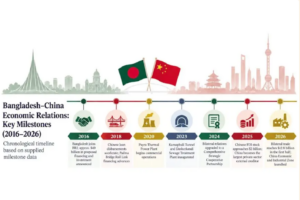
A decade ago, Bangladesh embarked on one of its most consequential development partnerships, opening a new chapter in its economic relationship with China. When Chinese President Xi Jinping visited Dhaka on October 14, 2016, Bangladesh formally joined the Belt and Road Initiative (BRI), positioning itself among South Asia’s earliest participants in China’s ambitious connectivity framework. The visit elevated bilateral relations to a strategic partnership of cooperation and generated approximately $40 billion in proposed financing and investment commitments.
Ten years later, the most important question is not simply how much China has invested, but how effectively that cooperation has strengthened Bangladesh’s economic foundations.
The BRI’s first decade has delivered substantial progress in physical connectivity and energy infrastructure, while exposing critical gaps between financial pledges and implementation, rising trade imbalances, and the need for greater investment efficiency. These achievements and limitations deserve equal consideration as Bangladesh plans its next decade of cooperation, shaping the priorities ahead.
The economic ambition underpinning Bangladesh’s BRI participation was considerable. The 2016 commitments included approximately $26 billion for infrastructure and development projects and another $14 billion for joint ventures. Transport, electricity, telecommunications and industrial connectivity dominated the proposed investment portfolio.
However, financial commitments should not be confused with actual disbursements. According to an assessment published by a news outlet, outgoing Chinese Ambassador Yao Wen reported that $4.45 billion had been disbursed for 35 BRI projects by 2023. The assessment noted that comprehensive and updated BRI-specific disbursement figures remained unavailable, limiting independent evaluation of implementation progress.
The central challenge not merely mobilising additional financing, but ensuring timely implementation, transparent procurement and manageable repayment obligations. These policy choices will determine whether cooperation strengthens Bangladesh’s economic foundations. This challenge also sets the stage for the shift from funding to trade and investment.
Trade and investment have become central pillars of Bangladesh–China cooperation. China has remained Bangladesh’s largest trading partner for 16 consecutive years, from 2010 through 2025. According to figures published by the Chinese Embassy in September 2026, bilateral trade reached $12.8 billion in the first half of 2026, up 10.6 percent year on year.
Chinese machinery, industrial equipment, raw materials and intermediate goods support Bangladesh’s manufacturing industries, particularly ready-made garments, leather and electronics. However, the persistent imbalance between imports and exports highlights the need to strengthen Bangladesh’s export capacity. Rather than restricting productive imports, Bangladesh should work with Chinese investors and buyers to expand exports of agricultural products, processed food, seafood, leather goods, pharmaceuticals, home textiles, light engineering products and digital services.
Realising this potential requires more than market access. Bangladesh must improve logistics, product quality, international certification, technology transfer and industrial linkages to diversify beyond its heavy reliance on ready-made garments. China’s zero-tariff market access for eligible Bangladeshi products and the prospect of a bilateral free-trade agreement offer opportunities to advance this agenda.
The priority for the next decade should therefore be to transform the trading relationship into a more balanced and mutually beneficial partnership — one that strengthens domestic industries, creates employment and expands competitive, higher-value exports while gradually narrowing the bilateral trade gap.
Investment trends are particularly noteworthy. China’s foreign direct investment stock reportedly increased from $241 million in 2016 to nearly $2 billion by the end of 2025, representing approximately 700 per cent growth. China became Bangladesh’s third-largest source of FDI stock and its second-largest source of annual net FDI inflows in 2025, contributing $321.15 million.
China has also emerged as Bangladesh’s largest private-sector external creditor. Its share of private-sector long-term external debt reached 34.2 percent in 2025, equivalent to $3.37 billion, compared with $422 million in 2020. This reflects growing financial integration, but also strengthens the case for prudent debt management.
A promising development is the China Economic and Industrial Zone in Anwara, Chattogram, formally launched in July 2026. The zone aims to attract manufacturing investment in textiles, machinery, electronics, and green industries. Such initiatives could transform Chinese engagement from predominantly infrastructure construction into long-term industrial production, employment generation and technology transfer.
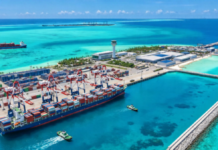
Infrastructure remains the most tangible outcome of BRI cooperation. Chinese companies have participated in landmark projects including the Padma Bridge Rail Link, Karnaphuli Tunnel, Chattogram-Cox’s Bazar railway, Chattogram Elevated Expressway, and Dasherkandi Sewage Treatment Plant.
The Padma Bridge Rail Link has strengthened railway connectivity between Dhaka and southwestern Bangladesh, opening opportunities for trade, transportation and regional development. The Karnaphuli Tunnel, inaugurated in 2023, represents another engineering milestone, creating an underwater road connection intended to support Chattogram’s industrial and logistics expansion.
The Padma Multipurpose Bridge, constructed by a Chinese contractor but financed by Bangladesh itself, also demonstrates the wider role of Chinese engineering expertise.
Energy cooperation has similarly contributed to expanding electricity-generation capacity. The 1,320-megawatt Payra Thermal Power Plant, developed through a Bangladesh-China joint venture, stands among the most significant examples. Chinese financing and technical expertise have also supported electricity transmission and other energy projects. However, growing generation capacity must be accompanied by reliable fuel supplies, efficient transmission networks and greater investment in renewable energy.
The achievements of the past decade are significant, but infrastructure alone cannot guarantee sustainable development. The next phase of Bangladesh–China Belt and Road cooperation must focus on converting connectivity into productivity, investment into industrial capacity, and economic partnerships into tangible benefits for businesses and citizens.
Bangladesh should prioritise commercially viable investments, transparent procurement, prudent debt management and stronger domestic industrial participation. Infrastructure projects must be linked to export-oriented manufacturing, renewable energy, technology transfer and skills development to generate quality employment, strengthen local supply chains and increase domestic value addition.
Equally important is establishing clear mechanisms for accountability. A public dashboard tracking project financing, implementation progress and economic outcomes, complemented by independent assessments of value for money, would help ensure that investments deliver measurable benefits.
Bangladesh must also maintain diversified international partnerships, ensuring that cooperation with China complements its relationships with India, Japan, the European Union and multilateral development institutions. Such an approach would preserve policy flexibility while enabling Bangladesh to pursue mutually beneficial investment and trade opportunities.
The central objective for 2027–2036 should be to build stronger domestic industries, diversify exports, develop a skilled workforce and improve Bangladesh’s position in regional and global value chains. Ultimately, the success of the next decade will depend not on how much infrastructure is built, but on how effectively it supports competitive businesses, sustainable growth and inclusive economic prosperity.
The first decade strengthened connectivity; the next must deliver competitiveness. Bangladesh’s greatest achievement will be measured by what it can produce, export and sustain—not simply by what it builds.
Mohammad Saiyedul Islam, PhD, is a Senior Lecturer and Researcher in the School of Overseas Education at Sanming University in China’s Fujian Province.
Professor Mohammed Masum Iqbal, PhD, is a Pro-Vice Chancellor at Daffodil International University.
Source: https://thefinancialexpress.com.bd/columns/ten-years-of-bri-infrastructure-ambitions-to-economic-transformation