Thousands of Bangladeshi migrant workers have been unable to join their jobs in Saudi Arabia amid intensified Houthi attacks this month, raising concerns over the country’s remittance inflows and economic stability.
With Bangladesh heavily dependent on overseas earnings, economists, migration experts and government officials are calling for diversified labour markets, a stronger domestic economy and a greater focus on skills development to cushion the impact of recurring conflicts in the Middle East.
The migrant workers have been waiting to travel to the kingdom to take up their jobs, hoping the situation will improve. Many others, however, fear they may lose their employment opportunities as their visas approach expiry.
Those already working in the region also face the risks associated with the conflict.
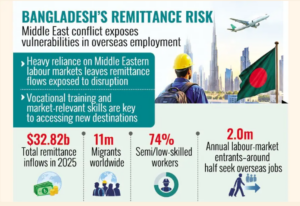
According to the International Organization for Migration (IOM), Bangladesh is the sixth-largest migrant-sending country, with more than 11 million Bangladeshis working abroad.
Of them, up to 74 per cent are semi-skilled or low-skilled workers, according to the Refugee and Migratory Movements Research Unit (RMMRU).
Bangladesh received US$32.82 billion in remittances in 2025. Saudi Arabia was the largest source of remittances, while an estimated 8.0 million Bangladeshi migrants work across the Middle East.
Against this backdrop, economists, migration experts and government officials have called for expanding domestic economic capacity, diversifying overseas employment destinations and developing skilled manpower.
They warn that recurring conflicts and disruptions in the Middle East directly affect Bangladesh’s economic stability and employment prospects.
Migration expert and RMMRU Executive Director Prof Tasneem Siddiqui told the FE that Bangladesh’s heavy reliance on overseas employment in the Middle East leaves the economy vulnerable, as remittances are one of its main pillars.
“We suggest that overseas employment should focus on 10-12 countries and regions so that the country will not have to be heavily dependent on a single country or region,” she explained.
Bangladesh has faced similar challenges in the past and subsequently recovered, including during conflicts and the Covid-19 pandemic. Migrant outflows tend to increase once such disruptions subside.
“However, this trend will not last in the next decade. This market will shrink and we will certainly fall in crisis,” she added.
The government has previously attempted to diversify overseas employment destinations. Romania, for instance, was among the countries explored for this purpose.
However, when Bangladesh sent hundreds of workers there, only a few remained, while the rest left for other EU countries, creating a negative impression of Bangladeshi workers in destination countries.
Nepalese workers are now taking advantage of employment opportunities in Romania.
The RMMRU chief explained that irregular migration not only puts workers’ lives at risk but also damages the country’s image and undermines its prospects of sending workers to other destinations.
Experts also said Bangladesh could not overcome its skilled manpower shortage immediately. It should, therefore, focus on semi-skilled employment and vocational education.
They also recommended diversifying destinations and occupations, exploring remote job opportunities and expanding the freelancing sector to increase remittance earnings.
Former chief economist of the World Bank’s Dhaka office Zahid Hussain told the FE that “if the situation continues then it will impact both the remittance and the migration.”
“We are witnessing a critical world situation that the world experienced after the first and second world wars – conflict within and between nations. France and Italy outside the Middle East are also in chaos. There are questions if the conflict ends soon and peace sustains,” he said.
Director General of the Bangladesh Institute of Development Studies (BIDS) Prof A. K. Enamul Haque does not expect Bangladeshi workers already in the Middle East, including Saudi Arabia, to return immediately to avoid the risks unless the conflict becomes more prolonged and widespread.
These include plans to send 3,000 skilled workers to Italy by 2027 with support from the International Labour Organization (ILO). It has already trained 700 people for overseas employment through legal channels.
The ministry has also launched a project to establish 50 additional training centres across the country by 2028, adding to its existing network of 110 centres.
A recycling training centre has been established in Chattogram with support from South Korea. An Australian delegation also recently met ministry officials to discuss recruitment from Bangladesh in four sectors: caregiving, nursing, electronic engineering and construction, according to a ministry official.
Salahuddin Ahammad, joint secretary (planning) at the ministry, told the FE that several projects had been undertaken to diversify overseas employment destinations, improve certification processes and strengthen the skills of workers sent abroad.
“We are considering third parties, like private language training institutes, Madrasahs for Arabic language training, and financial literacy for migrant workers-to enhance the potential for bigger remittance inflows through legal channels,” he added.
Source: https://thefinancialexpress.com.bd/economy/middle-east-conflict-threatens-bangladeshs-remittance-lifeline