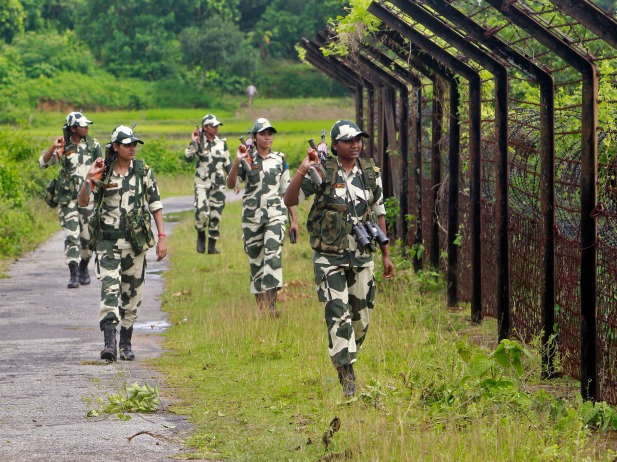
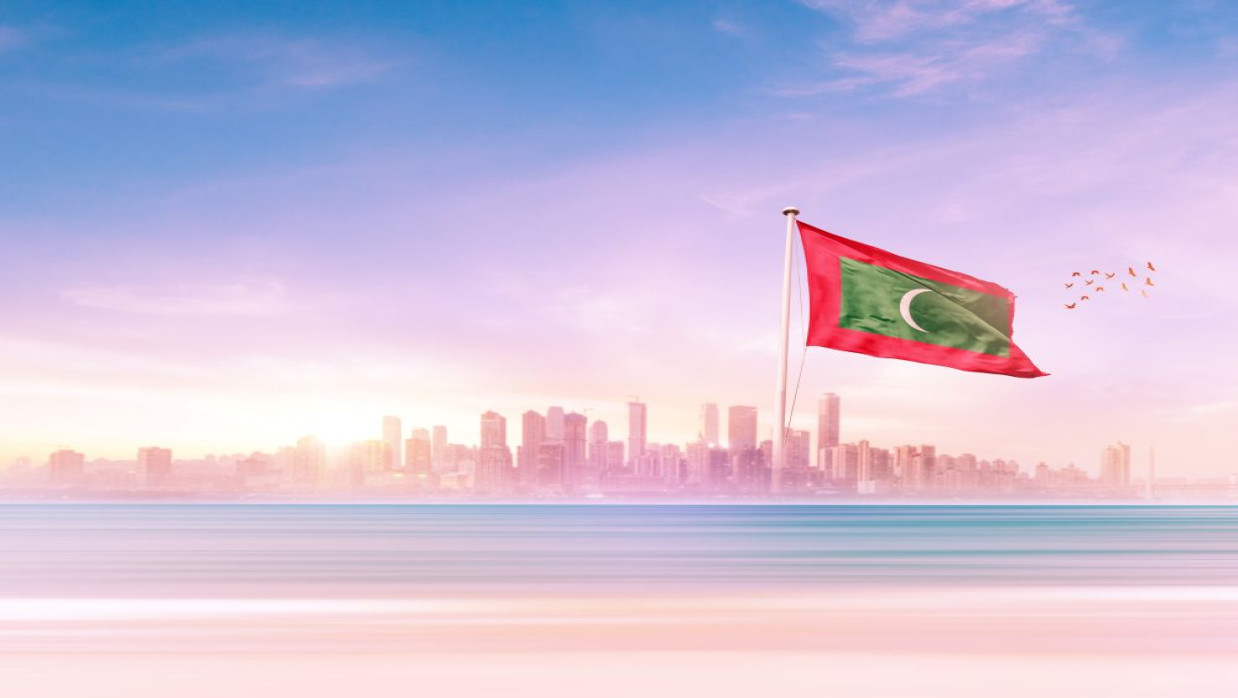
Under the new administration led by Mohamed Muizzu, the Maldives has been working to expand its military and strengthen its defense capabilities. The country is trying to avoid falling under the influence of neighboring countries with interests in the Indian Ocean region.
The Geopolitical Importance of the Maldives
Located in the central Indian Ocean, the Maldives has gained significance as it sits between India and China’s ever-growing rivalry. Although small in population and size, the country plays a major geopolitical role because of its proximity to major shipping lanes. The Maldives has long played a role in trade between Asia, Africa, and the Middle East. Today, its position along these major shipping lanes has allowed it to influence the economies, diplomatic relations, and national security of many nations.
Since becoming president in November 2023, Mohamed Muizzu has tried to rebuild Malaysia’s defense and foreign policy. He wanted to distance the country from India while increasing its military capabilities. Forming alliances with countries such as China, Turkey, the USA, Australia, and Japan.
Many see this as an India-China issue, but another factor could be the desire to protect its waters and foreign policy.
The central challenge confronting Malé is whether a small state can achieve genuine strategic autonomy without becoming entangled in larger powers’ rivalries.
From India’s Traditional Influence to Strategic Diversification
India has historically been the Maldives’ principal security partner. Its military intervention during the 1988 attempted coup, known as Operation Cactus, established New Delhi as a key guarantor of Maldivian stability.
Subsequently, India supplied helicopters, surveillance aircraft, coastal radar systems and military training. Indian assistance also extended to medical evacuations, maritime search-and-rescue operations and disaster relief.
During the Presidency of Ibrahim Mohamed Solih (2018-2023), India-Maldives ties grew very cordial through the adoption of the “India First” policy.
This also sparked controversy domestically. The opposition argued that deploying Indian troops and signing multiple defense pacts undermined Maldivian sovereignty.
Muizzu used this as a campaign point when running for president in 2023 and promised to preserve the nation’s sovereignty.
After winning the presidency, he ordered all Indian military personnel in the Maldives who were piloting aircraft that were gifted by India to leave. In May 2024, the entire Indian Military left, and civilians took over their posts.
This made Muizzu feel successful, but it is still clear that they need India’s help in that regard.
This did not end the relationship between India and the Maldives. When President Muizzu visited India in October 2024, the two countries established a joint framework on the economy and maritime security.
China’s Expanding Strategic Footprint
China has become an increasingly influential economic and defense partner for the Maldives.
Beijing’s involvement accelerated through the Belt and Road Initiative, which financed infrastructure projects, including the China–Maldives Friendship Bridge connecting Malé with the airport island.
Muizzu visited China in Jan 2024, and the two countries became comprehensive strategic cooperative partners for 2024 to 2028.
As of March 2024, China has offered to supply the Maldives with military supplies free of charge. The offer includes unspecified items, but it is assumed that non-lethal equipment will be provided alongside military training.
The arrival of Chinese research vessels, particularly Xiang Yang Hong 03, has also generated concern in India.
Chinese authorities describe such vessels as platforms for scientific research. Nevertheless, sophisticated oceanographic surveys can possess military applications, including collecting information relevant to submarine navigation and underwater operations.
Consequently, India views expanding Chinese maritime activities near its southern approaches with considerable apprehension.
Some strategic analysts interpret Beijing’s regional infrastructure investments through the controversial “String of Pearls” concept, suggesting that China seeks a network of commercial and potentially military facilities across the Indian Ocean.
However, commercial infrastructure investments do not automatically signal military intent, and China has no publicly established naval base in the Maldives.
For Malé, Chinese cooperation offers an opportunity to obtain financing, technology, and defense equipment while reducing dependence on a single regional power.
The danger is that replacing excessive dependence on India with comparable dependence on China would merely exchange one strategic vulnerability for another.
Building an Independent Defense Capability
Muizzu’s most consequential initiative may be modernizing the Maldives National Defense Force (MNDF).
Despite possessing an extensive exclusive economic zone of approximately 900,000 square kilometers, the Maldives has historically maintained limited maritime surveillance and enforcement capabilities.
Its Coast Guard must address illegal fishing, narcotics trafficking, maritime accidents, environmental threats, and search-and-rescue emergencies across widely dispersed islands.
Establishing an Air Corps in 2024 marked a significant institutional development.
Acquiring Turkish Bayraktar TB2 unmanned aerial vehicles has strengthened surveillance capabilities and introduced technology that could reduce dependence on foreign-operated aircraft.
Türkiye has also provided military training and transferred a fast-attack vessel, further expanding the Maldives’ defense partnerships.
The Government also increased spending on modernizing its military forces. A study by the Observer Research Foundation stated that, as of 2026, the Maldives will spend around US$185 million on defense. This accounts for almost 6% of the government’s total budget.
This transformation includes new patrol vessels, air stations, military infrastructure, and national service programs.
Nevertheless, acquiring military hardware is far easier than developing the personnel, maintenance systems, and operational expertise needed to sustain it.
The Maldives must also confront the financial burden of sophisticated defense technology at a time when its economy faces substantial fiscal and external debt pressures.
The United States and Other Security Partners
Although China and India dominate the geopolitical discussion, the Maldives has increasingly pursued relationships with other countries.
The United States maintains a defense and security cooperation framework with Malé, emphasizing counterterrorism, maritime awareness, disaster preparedness and military training.
Australia has expanded defense consultations and provided maritime assistance, including a Guardian-class patrol boat in 2026.
Japan has contributed patrol craft, communications equipment and maritime security assistance.
These partnerships offer Malé alternative sources of equipment, expertise and institutional support without requiring exclusive alignment with either India or China.
They also demonstrate that the Maldives’ foreign policy cannot accurately be described as simply pro-Chinese or anti-Indian.
Rather, the government is pursuing a diversified security architecture designed to maximize diplomatic flexibility.
However, diversification must not invite competing foreign powers to turn Maldivian territory and surrounding waters into an arena of strategic confrontation.
India’s Security Dilemma
For India, the Maldives represents considerably more than a neighboring tourist destination.
Its proximity to Lakshadweep and important Indian Ocean shipping routes makes developments in the archipelago directly relevant to India’s maritime security.
New Delhi has strengthened its naval infrastructure in Lakshadweep, including the commissioning of INS Jatayu on Minicoy Island in March 2024.
Although India’s security concerns are understandable, its response must recognize an essential principle: the Maldives is an independent sovereign state, not an extension of India’s strategic territory.
A policy that expects unquestioned regional deference could encourage the very external partnerships India seeks to discourage.
India would achieve more through transparent defense cooperation, competitive development assistance, respectful diplomacy and timely delivery of agreed projects.
Equally, Malé must acknowledge that geographical proximity creates enduring security interdependence. India remains a natural partner for emergency response, maritime surveillance, trade and regional stability.
Neither country benefits from converting legitimate differences into permanent hostility.
The Chagos Dispute and the Wider Indian Ocean
The Maldives’ growing strategic confidence is also evident in its renewed territorial assertions concerning the Chagos Archipelago.
President Muizzu has objected to the UK transferring sovereignty of the Chagos Islands to Mauritius and claimed they belong to the Maldives because of their geographical proximity and historical claim.
It is significant that a US military base is located on Diego Garcia.
But proximity alone doesn’t automatically grant rights to a maritime boundary. Sovereignty over landmass and maritime boundaries are two different things.
Nevertheless, the controversy illustrates how small island states increasingly question colonial-era arrangements and demand greater participation in shaping the future of the Indian Ocean.
Sovereignty Must Be Accompanied by Accountability
The pursuit of strategic autonomy is legitimate, but national independence cannot be measured solely by the withdrawal of foreign troops or the acquisition of military equipment.
True sovereignty also requires financial sustainability, democratic accountability, institutional competence, and transparency in defense procurement.
Confidential military agreements, discretionary contracting and foreign-financed security infrastructure can create long-term obligations that remain concealed from public scrutiny.
The Maldives must therefore ensure that defense modernization strengthens national institutions rather than creating new dependencies or enriching politically connected interests.
Its security strategy should prioritize maritime surveillance, environmental protection, disaster preparedness, fisheries enforcement, and population safety.
These objectives are particularly urgent for a country confronting rising sea levels and increasingly severe climate-related vulnerabilities.
Opening The Door to A World Without Great Power Competition
As the Maldives open up to the world, this will continue to shift South Asia’s political dynamics. Many small nations no longer want to be pinned down by others’ spheres of influence. They want more control over their foreign relations.
While Muizzu has pushed for this change, he may not be able to sustain it.
India needs to understand that proximity does not grant it rule over other countries. China needs to realize it is not above others just because it invests in them. Other Western powers should follow suit.
For the Maldives, the wisest course is neither alignment with Beijing nor subordination to New Delhi, but a carefully calibrated policy of constructive engagement with all.
Its greatest strategic asset is not its military strength but its geographical importance, diplomatic flexibility and sovereign legitimacy.
Ultimately, it will be about ensuring the Maldivian Islands can keep benefiting their country without becoming a focal point for great-power rivalry.

Ghulam M. Suhrawardi
Ghulam M. Suhrawardi is the Publisher of South Asia Journal.
Source: https://southasiajournal.net/post/maldives/61823/maldives-at-the-crossroads-of-power