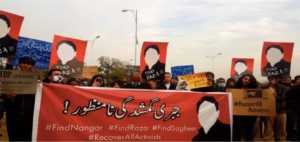
There are challenges faced by the counter-terrorism strategy of Pakistan in regard to the balancing act between national security and following the rule of law, human rights and accountability. There have been disputes regarding enforced disappearances and the issue of missing persons in Balochistan which have become a major topic of public interest. There should be a clear distinction made between legal arrest and illegal disappearance and the suspected terrorists should either be convicted or acquitted of their charges.
The main issue with Pakistan’s war on terror has been the lack of effective investigations into radicalisation networks, witness protection, and electronic/intelligence evidence, which have hindered successful prosecutions. Statistics from Pakistan’s counterterrorism discourse show that over the last 20 years, the conviction rates for terrorism-related charges have been particularly low. This has raised questions about the credibility of military courts and given way for militant groups to portray Pakistan’s security apparatus as unfair and unjust.
The Pakistan Anti-Terrorism Act (ATA) 1997 acts as the main legislation in dealing with crimes of a terrorist nature. Taking into account the current threat posed by Pakistan Taliban (TTP) and Balochistan militants, there is a requirement for better investigation and judicial measures against the terrorist networks prevailing in the region. The incorporation of section 11-EEEE under the provincial amendments of the ATA legislation intends to serve as a temporary detention process for investigation for up to 90 days. This new development in the legislative system strives to provide sufficient time for investigation against the terrorists.
The Anti-Terrorism (Balochistan Amendment) Act 2025 adopted the preventive detention for inquiry with a view to introducing Faceless Courts and witness/judicial protection measures. Punjab Counter-Terrorism Act 2026 also included Section 21-AAA in addition to preventive detention for inquiry provisions that target enhanced security measures for courts, prosecutors, and witnesses. Faceless Courts mechanism, if properly resourced and aligned with investigative and prosecutorial protocols, will serve as an effective tool for dealing with Pakistan’s terrorism problem.
Preventive Detention for Inquiry safeguards the rights of the innocent by putting an end to indefinite detentions and giving way for prosecutors to present concrete evidence in court. It is also important to note that preventive detention should not be construed as a guarantee of freedom. The accused person is still to be brought before a competent court for a fair trial in line with Pakistan’s legal and judicial procedures. To make the preventive detention framework relevant to the missing persons issue and protect the rights of the detainees, family members should be informed of the detainee’s whereabouts, offered legal aid, and given the right to seek justice. A time-bound release mechanism should also be considered to prevent misuse of the system.
It is worth noting that the preventive detention framework affords protection to justice system players and ordinary citizens. In Pakistan, terrorism suspects are often targeted for abduction, assassination, and harassment. Terrorist groups have in the past targeted members of the judiciary in an attempt to undermine the rule of law and due process. For instance, Justice Muhammad Noor Meskanzai was shot dead in 2022. In addition, judicial officers in Mastung were reportedly abducted in July 2026. In addition, police investigators conducting terrorism-related investigations are also targeted for assassination or abduction. Preventive Detention for Inquiry and Faceless Courts will offer protection to these justice system players from the wrath of terrorist groups.
Faceless Courts can be considered as a complementary initiative to Pakistan’s counterterrorism strategy. The mechanism allows for the concealment of identities of terrorism suspects and key witnesses. In practice, Faceless Courts will ensure that judges and prosecutors are appointed through the recommendation of the High Court Chief Justices while keeping their identities private throughout the proceedings. In addition, additional security measures will be put in place to ensure the safety and security of the judges and prosecutors. Faceless Courts can adopt measures such as restricted documentation and witness anonymity to guarantee protection. In an ideal situation, the Faceless Court structure should allow for the free expression of opinions by the accused persons and witnesses without fear of reprisal from terrorism organisations.
In international law, the jurisprudence of anonymity and faceless courts has been informed by the need to protect civilians, judges, and prosecutors from the threats of terrorist organisations and criminal syndicates. Colombia’s faceless judges were at the forefront of adjudicating cases involving cartel-related violence, serial kidnappings, and organised crime. The UK allows witness anonymity orders as a procedural mechanism for dealing with vulnerable and family unification in the wake of domestic violence and sexual assault. Spain’s Organic Law 19/1994 protects witnesses and experts from witness intimidation, especially in high-profile cases involving terrorism, organised crime, and domestic violence. Similar provisions also exist in France and the Netherlands for testifying witnesses. Italy’s success in prosecuting mafia-related indictments is partly due to its robust witness protection laws that shield them from pre-trial harassment.
An analysis of the above-cited jurisdictions’s counterterrorism and organised crime litigation reveals important lessons for Pakistan’s implementation of Faceless Courts and witness protection framework. First, it is paramount to guarantee the judiciary independence and separateness from the executive branch of government. Second, an effective counterterrorism court should afford fair trials to the terrorism suspects in line with Pakistan’s legal provisions for the protection of the rights of the arrested persons. Third, the Faceless Court mechanism should guarantee the protection and concealment of the vulnerable witnesses’ identities to guarantee their safety and security. Fourth, the confidentiality measures should be in place to ensure the protection of the accused persons from unfounded allegations and unfettered investigations.
According to the statistics released regarding the implementation of the preventive detention framework in Balochistan, 5 out of 90 detainees were released on grounds that no sufficient evidence was presented before the court. In addition, 40 persons were sent to Faceless Courts for prosecution. If the statistics are indeed public, they signify that the preventive detention framework has helped investigations to transition from investigation to prosecutions. The statistics also raise questions regarding the need for enhanced transparency in the release and prosecution of the terrorism suspects to enhance public confidence.
In conclusion, Pakistan’s war on terror will only be successful if it is able to balance national security imperatives with the rule of law and human rights. As much as the government needs to protect the informants and witnesses, it must guarantee accountability for terrorism suspects. To that end, the government should invest in a functional and reliable justice system that is able to deliver reliable judgments that are devoid of favouritism. The government should guarantee due process in all terrorism-related investigations and prosecutions while allowing family members of the detained persons to exercise their right to information and access to justice. In the event that these procedural safeguards are unduly violated, families of the detained persons should have recourse to justice.
Source: https://southasiajournal.net/post/pakistan/61848/legal-reforms-in-pakistan-try-to-tackle-issues-of-enforced-disappearances