Bangladesh and Japan did not discuss the inclusion of any third country, including India, when they endorsed the Bay of Bengal Industrial Growth Belt (BIG-B) initiative during Prime Minister Tarique Rahman’s Tokyo trip.
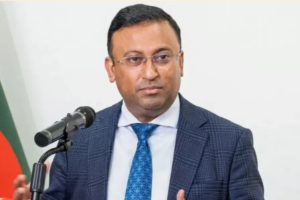
State Minister for Foreign Affairs Humaiun Kobir made the observation Friday while elaborating on what comes of the prime minister’s busy four-day tour of Japan aimed largely at promoting trade and investment.
Briefing reporters at the Ministry of Foreign Affairs in Dhaka on the outcome of the prime minister’s visit, Kobir dispelled concerns that the initiative could involve arrangements affecting Bangladesh’s sovereignty or regional interests.
Asked whether Bangladesh’s endorsement of BIG-B amounted to accepting Japan’s vision of bringing India’s seven northeastern states and Nepal into regional supply chains through the Matarbari deep-sea port, the state minister said discussions between the two countries had remained strictly bilateral.
Neither the BIG-B framework nor the joint statement issued during the visit did contain any reference to a third country or to the Bay of Bengal as part of a wider geopolitical arrangement, he said.
“If you read the joint statement, you will see there is no reference to any third country. We will not discuss a third country in our discussions. That is clear and direct,” Kobir said.
He also refuted allegations raised by Jamaat-e-Islami that the initiative could undermine national interest, urging political parties to examine the joint statement before making such claims.
“Please read the joint statement. If you read it, you will understand that there is nothing of this sort. Making claims without seeing, understanding or reading the document makes such arguments ridiculous,” he said.
Kobir stressed that Bangladesh was mindful of its responsibilities and would not discuss matters involving other countries outside appropriate multilateral or regional forums.
“There is no reference to the Bay of Bengal either. If we have to discuss such matters, we need the respective forums. No such discussion took place,” he added.
His remarks come amid growing political scrutiny of Japan’s expanding economic and strategic engagement with Bangladesh, particularly the BIG-B initiative, which seeks to promote industrial development, infrastructure and connectivity around the Bay of Bengal.
The state minister also ruled out any discussion of alternative maritime routes or broader regional-connectivity arrangements during the visit.
Asked whether Bangladesh’s geographical position between South and East Asia could make it central to Japan’s maritime-and regional-connectivity plans, including the proposed Sea Open Initiative 3.0, Kobir said these issues had not featured in the bilateral discussions.
“We did not want to discuss the Bay of Bengal route or sea routes. Apart from specific bilateral issues, we did not discuss these matters. If we have to discuss them, we need other states, because the Bay of Bengal does not belong to Bangladesh alone.”
He insisted that any future agreements would be pursued transparently and in accordance with the country’s interests.
“Whatever this government does will be transparent and accountable. If there is anything sensitive, it will be discussed in parliament. There is no scope for doing anything behind the scenes,” he said.
Kobir added that the government, having secured a two-thirds majority in the national elections, had a responsibility to protect the interests of the people.
He also defended the joint statement issued during the visit, describing it as the product of negotiations between the two governments rather than a document prepared unilaterally by Japan.
Turning to the economic outcome of the visit, Kobir said Japan committed to mobilising more than $6.3 billion in private-sector investment in Bangladesh over the next five years.
A Japanese economic mission is expected to visit Bangladesh soon to discuss the implementation of proposed projects.
The two governments agreed at their joint ministerial meeting to arrange the visit at the earliest opportunity, he said.
He wouldn’t, however, specify when the mission would arrive or provide a detailed timetable for implementing the proposed investments.
The state minister said attracting foreign direct investment has become one of the government’s principal priorities, with the aim of accelerating economic growth and generating employment.
He said the two prime ministers welcomed the prospect of Japanese private investment of up to one-trillion yen in Bangladesh over the next five years, potentially creating about 200,000 jobs.
Prime Minister Tarique Rahman outlined his government’s recent initiatives to encourage investment and expand economic exchanges between the two countries. He also pledged to make the business environment more investor-friendly by improving policy formulation and transparency in taxation, customs clearance, remittances and licensing procedures.
The leaders welcomed several cooperation agreements and memorandums of understanding, including one between Japan’s Ministry of Economy, Trade and Industry and Bangladesh’s Economic Relations Division, to strengthen economic relations and improve the business environment.
Two further cooperation agreements were signed between Japan’s Ministry of Agriculture, Forestry and Fisheries and Bangladesh’s ministries of agriculture and fisheries and livestock.
Asked whether Bangladesh had discussed the financing terms of Japanese loans, whose interest rates have reportedly risen to about 3.0 per cent, Kobir said the government would assess available options on the basis of affordability and national economic interests.
He said Bangladesh’s relationship with Japan was evolving from one largely centred on concessional development assistance towards a partnership based on investment and commercial cooperation.
“Bangladesh was dependent on concessional money 15 or 20 years ago. We are now moving beyond that dependency towards investment and business. This is a respectful economic partnership where neither side is a subordinate partner,” he explained.
The government would prioritise investments that generate employment and deliver tangible economic benefits, while comparing the costs and terms of different financing options, he added.
On the possibility of importing liquefied natural gas (LNG) from Japan, Kobir said the prime minister’s visit to a Japanese LNG terminal was primarily intended to understand its technology and operational arrangements rather than to negotiate a specific supply agreement.
Bangladesh is under increasing pressure to secure reliable energy supplies as domestic gas production struggles to keep pace with demand.
During the visit, Tarique Rahman toured a state-of-the-art LNG terminal and power facility operated by JERA in Futtsu, where he was briefed on its operations and technology.
Kobir said the visit offered an opportunity to examine how Bangladesh could draw on Japan’s experience in developing its own LNG infrastructure.
“The prime minister visited the LNG terminal to see how it works. It is a state-of-the-art terminal. We wanted to gain an understanding of how we could establish an LNG terminal in Bangladesh,” he said.
His remarks did not suggest that the two countries had reached an agreement on LNG import or any specific supply arrangement.
The joint statement also highlighted cooperation on maritime security in the Indo-Pacific, including Japan’s plan to provide Bangladesh with a patrol vessel to strengthen its maritime-security capabilities.
On regional security, Kobir said Bangladesh urged Japan to play a more active diplomatic role in resolving the Rohingya crisis, including encouraging Myanmar to create conditions for the refugees’ return.
He described the crisis as a major national-security and-foreign-policy concern, adding that Dhaka would continue to raise the issue in bilateral and multilateral forums.
The discussions also covered regional peace and stability, including the situation in Myanmar and the need for sustained international engagement to facilitate the safe and sustainable repatriation of Rohingya refugees.
“We have called upon Japan to play a role in this matter. Both countries believe in regional stability and can contribute to it,” he said.
The two prime ministers also discussed a wider range of international issues, including the peaceful settlement of disputes, freedom of navigation and overflight, peace and stability in the Middle East, uninterrupted trade and supply chains, reform of the United Nations Security Council and the goal of a world free of nuclear weapons.
Against the backdrop of growing geopolitical uncertainty and conflicts, both leaders pledged to work together to strengthen international peace and stability.
Source: https://thefinancialexpress.com.bd/trade/induction-of-any-third-country-into-big-b-not-discussed-state-minister