
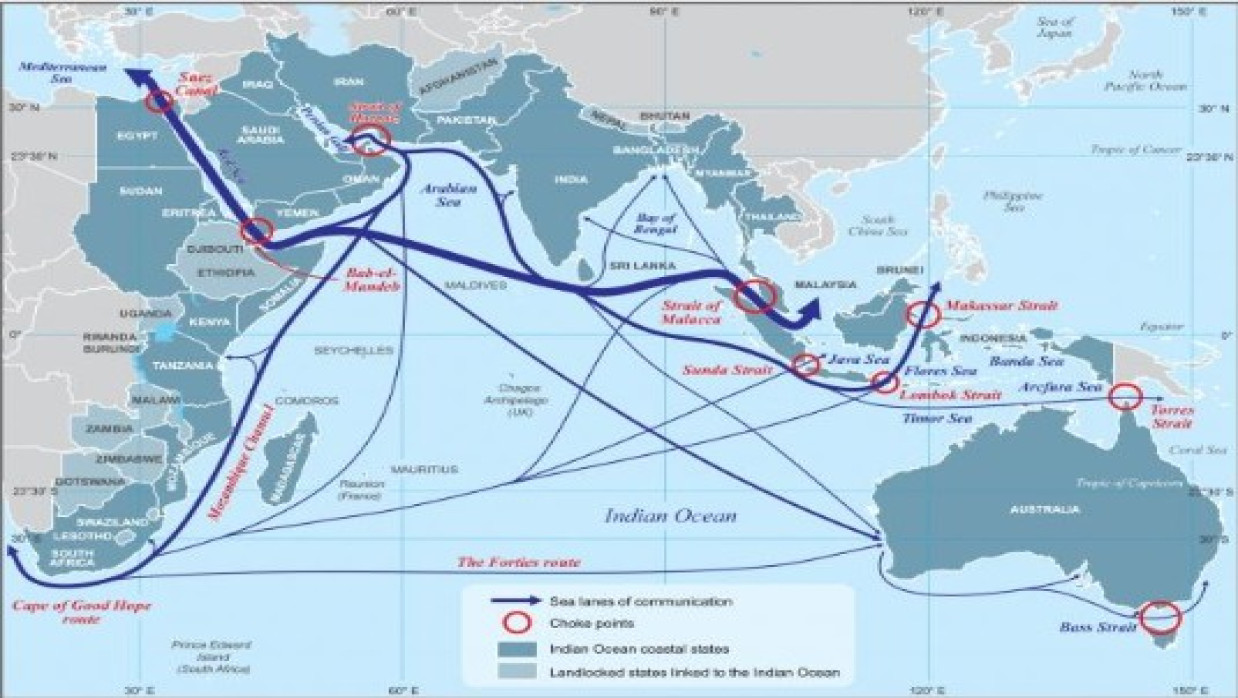
As global chokepoints face rising threats, India is becoming the stabilizing force keeping trade routes open and shaping Israel’s and the West’s security future. For decades, global security debates have focused on control of the world’s major maritime chokepoints: the Strait of Hormuz, Bab el-Mandeb and the Strait of Malacca. These narrow waterways connect Middle Eastern energy resources, Asian manufacturing centers and Western consumer markets. In the coming decades, however, the central question may be less about who controls these passages than who possesses the capacity and credibility to keep them open.
India is increasingly positioned to perform that role.
For Israel, the United States and Europe, India is no longer merely a rapidly growing economy or an emerging military power. It is becoming an important strategic partner capable of strengthening the maritime system at a time when trade routes, energy supplies and commercial shipping face mounting pressure.
India’s principal advantage is geography. Situated at the center of the Indian Ocean, it lies between the energy-producing Gulf, the developing economies of Africa and the manufacturing centers of East Asia. Its western coastline faces shipping routes connecting the Persian Gulf and Red Sea. At the same time, the Andaman and Nicobar Islands overlook the approaches to the Strait of Malacca, the principal maritime gateway between the Indian and Pacific oceans.
Few countries are so naturally placed to influence international trade.
This geographical position has become more consequential as regional conflicts expose the vulnerability of global supply chains. Houthi attacks on commercial vessels in the Red Sea demonstrated how violence in one location can increase freight and insurance costs, delay deliveries and disrupt markets thousands of kilometers away. Continued tensions around the Strait of Hormuz similarly threaten global energy prices and economic stability.
India’s economic and military capabilities are also maturing in tandem. As the world’s third-largest oil consumer, top importer of liquefied natural gas, and a growing refining giant—reportedly refining 258 million metric tons of crude oil per year with plans to expand that capacity to 310 million tons by 2030—it has a vested interest in free-flowing shipping lanes. India–Gulf Cooperation Council trade totaled roughly $178 billion in 2024-25.
India is also contributing directly to maritime security. Since beginning sustained anti-piracy operations in the Gulf of Aden in 2008, the Indian Navy has protected merchant vessels, assisted endangered crews, and responded to piracy and drone-related incidents. During the intensified maritime threats of 2024, India deployed dozens of naval ships and escorted commercial cargoes regardless of the nationality of their crews. Its expanding infrastructure in the Andaman and Nicobar Islands is simultaneously strengthening surveillance near Malacca and responding to China’s growing Indian Ocean presence.
Why does this matter for Israel? India–Israel ties have evolved from traditional weapons purchases into collaboration in high-end technology, manufacturing and supply-chain localization. Israel has the tech strategies in defense and security, while India has factories, engineers and the critical mass needed to commercialize products. We could see cooperation in everything from air defense and drones to naval monitoring, cyber security and critical infrastructure protection in the future.
A third benefit is India’s diplomatic flexibility. New Delhi shares close ties with Israel, the Gulf kingdoms, the US and Europe while keeping lines of communication open with Iran and Russia. India’s freedom of action can be irritating to Western governments at times, but it also allows New Delhi to talk to all sides across geopolitical fault lines. No other major country can easily straddle these various arenas.
The Horn of Africa should become another area of cooperation. Bab el-Mandeb connects the Indian Ocean with the Red Sea, Mediterranean and European markets. Greater coordination among India, Israel, Gulf states, African governments and European partners could improve maritime awareness, suppress piracy and strengthen regional port and transport infrastructure. Such engagement, however, must respect African sovereignty and avoid turning the region into another arena for outside power competition.
The purpose of these partnerships should not be to replace existing maritime routes, but to make them more resilient. Diversified energy sources, alternative transport corridors, stronger naval coordination and expanded port infrastructure would reduce the ability of any single state or armed group to hold international commerce hostage.
The twenty-first century will be shaped not only by those who manufacture goods or control resources, but also by those who protect connectivity. India’s maritime rise is therefore larger than India itself. It may prove indispensable to building an open, secure and resilient oceanic order linking Asia, Africa, Israel and Europe.