
One could argue that this is not just an ordinary regime change we have seen recently in West Bengal. Bharatiya Janata Party (BJP) emerging victorious by securing more than 200 seats, and Shuvendu Adhikari all set to become the next Chief Minister, bringing an end to the All India Trinamool Congress’s (TMC) 15 years of governance, can certainly cause shifts in structures in Bengal and the neighborhood. The developments in West Bengal have significant geopolitical and geoeconomic consequences for Bangladesh. And now Bangladesh and West Bengal stand at the crossroads of history, as the Bengal delta was once again divided after the partition of British India.
A Historic Political Realignment
Never has the BJP progressed so massively in Bengal. For years, the party could not make its ideological presence felt there. Bengal resisted the BJP’s Hindutva politics and preferred secular forces: the Left Front for years and subsequently the TMC. Now, both appear to have reached a state of decay, organizational lethargy, and delivery deficits. The BJP has filled the void and combined effective grassroots movements with disciplined top-down leadership under Modi.
Importantly, what is different about this election result is not just administrative: Bengal has opened itself to the successful proliferation of an ideology. Hindu nationalism has now rooted itself in Bengal. For Bangladesh, which neighbors Bengal and shares social, economic, and political similarity with much of West Bengal, this creates a new sense of apprehension.
Bangladesh–India Relations: A Delicate Balance
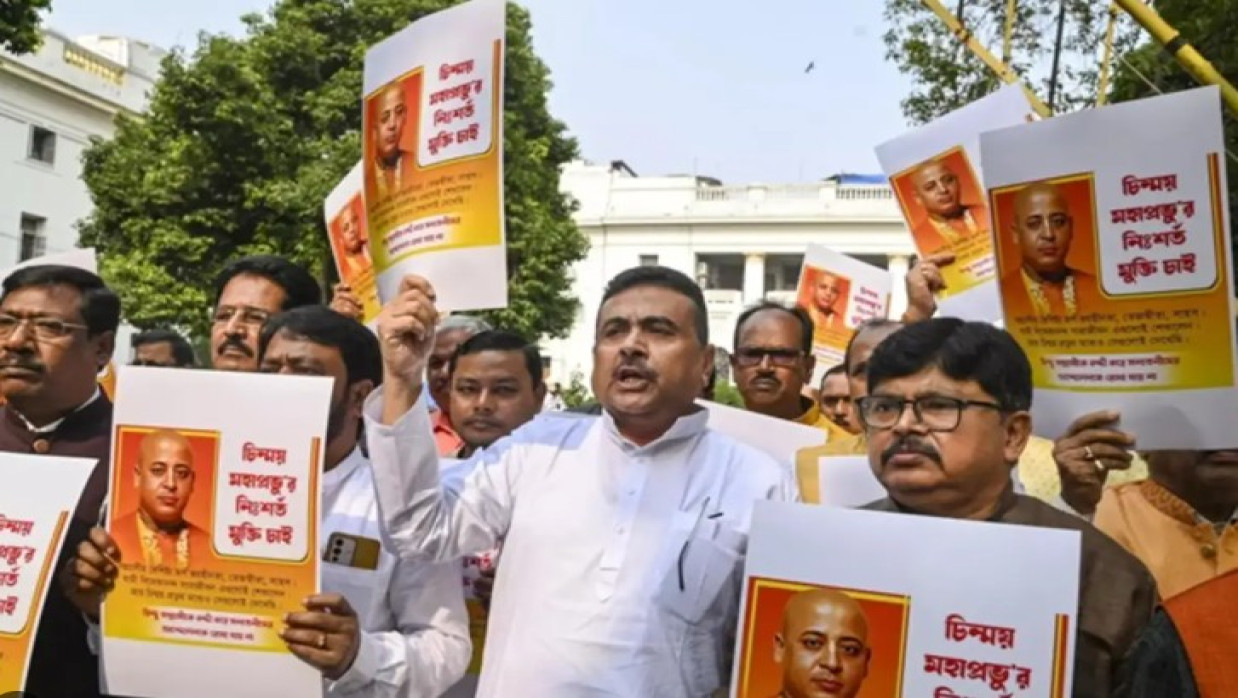
Political signals coming from West Bengal’s new dispensation have already added nuance to the bilateral ties. Bengal BJP President Shuvendu Adhikari has offered his congratulations to Sheikh Hasina, the democratically elected Prime Minister of Bangladesh. However, he conveniently forgot to congratulate previous regimes. Such double standards on political niceties hardly bode well for relations between Dhaka and New Delhi. India and Bangladesh have developed a fair amount of pragmatism in bilateral ties over the past few years. Cooperation continues across trade, security, connectivity, and energy. However, the BJP’s ideological baggage and its extra-parliamentary machismo, often laced with sectarian overtones, do not help bilateral relations either. If statements by BJP leaders hurt Bangladesh’s national sentiments and are construed as New Delhi meddling in Dhaka’s domestic affairs, trust and confidence levels will take a hit. Dhaka will also feel jittery over such remarks. Outstanding bilateral issues such as Teesta River water-sharing, border management, and trade imbalance will also become harder to resolve when domestic electoral politics weigh down India’s decision-making process.
The Question of Voter Representation and Democratic Integrity
Even as voters were dirtying ballots with election violence, another controversy dominated. Millions of voters were alleged to have been purged from, or disenfranchised from voting altogether. These claims particularly applied to Muslim voters, and have been substantiated as well as politically disputed. Either way, entire populations being prevented from voting raises major questions about Indian Democracy. While the splitting of Muslim votes between opposition parties surely played a factor, much of the blame lies in how unified Hindu voters were behind Modi and the BJP. In Bangladesh, as a majority Muslim nation, all of this comes with several extra layers of uncertainty. Regardless of international commentary on the matter, Bangladeshis will form their own opinions about where India is headed politically – and what that means for minorities at home. If voters are being wrongfully excluded from the democratic process, perceived or not, that narrative will become part of the conversation here at home.
Rise of Communal Politics and Security Concerns
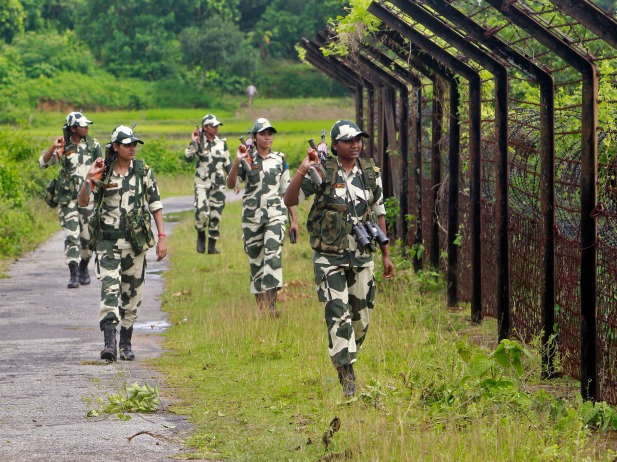
The most serious worry for Bangladesh revolves around the rise of communal forces in West Bengal. “The BJP’s Hindu-first politics and even the anti-Muslim rhetoric peddled by certain fringe groups raise the danger of violence along Bangladesh’s nearly 4,000-kilometer border with India,” one Bangladesh watcher wrote recently. While Bengal has had its share of communal harmony and strife over the decades, the latest tilt could disrupt a longstanding equilibrium. Bangladesh too has witnessed the return of religion-affiliated politics in recent years. Another fear cited by experts as conjectural is that India is moving towards a hyper-securitized border. Increased paramilitary patrols and controls could upend decades of easy cross-border movement and trade.
Migration Pressures and Humanitarian Risks
Second, there could be migration pressures. If the cultural/religious conflict intensifies, there can be small-scale displacement internally within Bangladesh or increased “push back” attempts from the borderlands. Bangladesh is already strained with humanitarian concerns, namely the Rohingya refugee crisis. Internal or cross-border displacement of large numbers of people will be unwelcome in Dhaka. Smaller-scale migration can disrupt life in the borderlands. It can create diplomatic issues between the countries if accusations of illegal infiltration occur, as has been a staple of the BJP’s political rhetoric. Pushback efforts will only increase tension at the border and affect human movement, trade, and legal cultural exchange currently occurring across the open border.
Decline of Traditional Political Forces
There’s something that may matter beyond Bengal. The two national parties on whom the burden of losing Bengal falls — the Left Front and Congress — are both ideologically congenial to Bangladesh’s establishment. They are both, to an extent, secular parties that have promoted good-neighborly relations with Bangladesh. Their loss means one less friendly voice in India’s east, where the BJP currently reigns supreme, backed by money, organization, and the winds of the central government.
Implications for Bangladesh’s Domestic Politics
Events in West Bengal will likely have repercussions in domestic politics in Bangladesh. Bangladesh’s domestic actors may take lessons on what to do and what not to do regarding electoral mobilization from the BJP’s victory. Domestic political actors may become more polarized, galvanizing around narratives if they become further entrenched along identity lines. Additionally, this election brings into focus political cohesion, institutional capacity, and democratic space within Bangladesh itself. Fragmentation in Bangladesh’s domestic political scene will reduce Dhaka’s bandwidth to deal with New Delhi and manage regional crises going forward.
Strategic Diplomacy: The Way Forward
Given these factors, Bangladesh’s policy needs to be pragmatic and hedged. Cooperation with India should continue, especially in trade, connectivity, power projects, and regional stability, which are of common interest to both countries. Diplomatic measures need to be robust when required, without being confrontational. Bangladesh should take the initiative in areas of bilateral cooperation, such as water sharing and border management. It should reach out to other regional players and countries to keep its options open. Domestically, Bangladesh needs to focus on governance that can accommodate all.
Future Outlook: Risks and Opportunities
Will the change of guard in West Bengal affect Bangladesh-India relations in the long term? Much will depend on how campaign politics play out in governance. Should the BJP act responsibly in government by making development, investment, economy, and regionalism its top agenda, fears will largely be unfounded. On the contrary, if communal ideology drives policy decisions, Dhaka might face increased diplomatic hurdles, hyper-sensitive societies, and threats to economic interests. Threats of increased migration and border hostility might also arise.
On the other hand, this situation will allow Bangladesh to re-evaluate and refocus its priorities. Doubling down on democratic values, ensuring a corruption-free regime, and pursuing smart diplomacy can take Bangladesh far.
Conclusion
BJP’s ascendancy to power in Bengal means a new political equation in South Asia. Bangladesh’s interests are at stake beyond the political slugfest for short-term diplomatic maneuvers. Our stakes include security, social harmony, and broader long-term interests. There is nothing negative or positive in one Bengal that does not impact the other Bengal. Nothing happens in either Bengal these days without rippling through the shared waters of history, culture, and economy of our respective societies. Bangladesh needs to step up to it with maturity, unity, and a strategic approach.