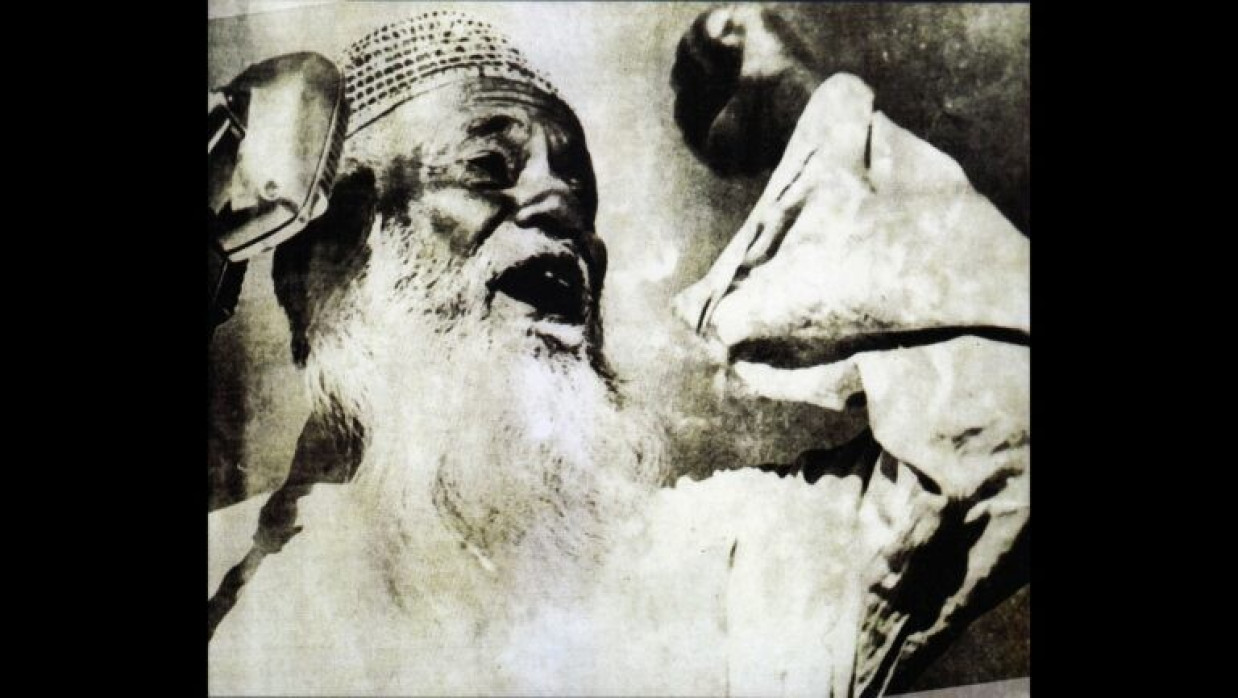
Maulana Abdul Hamid Khan Bhashani (12 December 1880–17 November 1976), better known as Maulana Bhashani, was one of the most loved and respected left-oriented political leaders of the Indian subcontinent and of Bangladesh. During the Pakistan period (1947–1971), Maulana Bhashani’s political trajectory evolved from sustained advocacy for the rights and interests of the poor and marginalised to an increasingly explicit challenge to the political, economic, and administrative structures underpinning West Pakistan’s dominance over East Pakistan. His politics thus progressively linked the pursuit of social justice with demands for greater regional autonomy, reflecting his broader critique of entrenched patterns of economic inequality, political exclusion, and centralised state power.
Following Bangladesh’s independence in December 1971 and until his death in November 1976, Maulana Bhashani continued to campaign for democracy, social justice, and national sovereignty.
Maulana Bhashani’s Anecdotes
An interesting aspect of Maulana’s political expressions was that they reflected his distinctive style and political philosophy, conveying enduring messages through day-to-day chats and interviews that, over time, acquired considerable historical significance.
These off-the-cuff observations of the Maulana, the anecdotes, though expressed decades ago, remain pertinent to contemporary debates about democracy, social justice, political accountability, and national sovereignty. Here are a few.
The ‘prophet of violence’
During the 1969 anti-Ayub movement in the then United Pakistan, Maulana Bhashani played a pivotal role in mobilising the political rank and file in East Pakistan. He encouraged mass resistance through militant forms of direct action, including his calls for ‘jwalao-porao’ (burn and destroy), ‘gherao’ (lay siege to government offices and institutions), etc.
Intrigued by his uncompromising vitriol against the establishment, which the Maulana considered unjust and oppressive, and his violent methods of protest, the weekly TIME’s Dan Coggin, who gave the Maulana the unceremonious title of “Prophet of Violence”, once interviewed the Maulana on his methods and asked: “How come you always ask people to destroy and never offer any constructive advice?”
In reply, the Maulana said: “My only constructive advice to my people is to bring about the destruction of a system that makes the rich richer and the poor poorer, a system that makes the powerful more powerful and the powerless more powerless, a system that has made oppression a norm.”
The remark captured a central feature of Maulana Bhashani’s political outlook: destruction, in his view, was not an end but a means of dismantling an exploitative political and socioeconomic order that structurally perpetuates inequality, injustice, and oppression.
On making Bangladesh an ‘Islamic Republic’
Around 1973, soon after the liberation of Bangladesh, a section of the population began advocating that, because Bangladesh had an overwhelming Muslim-majority population (90%), it should be constituted as an Islamic republic.
On one of those early post-liberation days, at a press conference in Dhaka, a member of the audience appealed to the Maulana, a deeply devout Muslim, to exert pressure on the government to change the country’s constitutional designation from the “People’s Republic of Bangladesh” to the “Islamic Republic of Bangladesh.”
The Maulana responded not with a theological argument, but with a characteristically pointed illustration.
He asked the individual who had raised the issue, “What is your name?” The man replied, “Hujur, my name is Abdur Rahman.” The Maulana responded, in effect, “So I now know that you are a Muslim, and to establish that you are a Muslim, you did not have to identify yourself by saying, ‘My name is Mussalman Abdur Rahman’, did you?” Through this, the point the Maulana sought to make was both simple and profound: Muslim identity should be demonstrated through one’s character, conduct, and moral disposition, not necessarily through nomenclature or formal designation.
In other words, for Bangladesh to be seen as an Islamic state, its Islamic identity should be manifested through the practice of Islam’s fundamental values—which, according to the Maulana, is Insaaf—through justice, compassion, integrity, and social responsibility.
In other words, Maulana’s key argument was that merely changing the country’s name would neither make Bangladesh more Islamic nor ensure genuine Islamic character; focus should be on core values, not nomenclature.
BaKSAL and Maulana’s prognosis of ‘one door’
In early 1975, a few months after Bangabandhu Sheikh Mujibur Rahman, the Father of the Nation, replaced Bangladesh’s parliamentary democracy with a one-party system and established BaKSAL as the country’s sole governing party, several of Maulana Bhashani’s younger political associates gathered at his village home in Santosh, Mymensingh. They sought his views on the country’s dramatic political transformation and the growing centralisation of power. Their concerns reflected widespread apprehension about the erosion of political pluralism, press freedom, and freedom of expression.
One of the young men reportedly lamented: “Hujur, what a terrible transformation—there is no democracy, no freedom of the press, and no freedom of speech.”
Maulana Bhashani did not respond immediately. He remained silent for a moment, apparently absorbed in thought, his gaze fixed on the floor. He then slowly raised his head and, in a sombre voice, replied: “My sons (‘Baba-ra’), I too am deeply concerned about the loss of democracy, freedom of speech, and freedom of the press. But I am even more concerned about Sheikh Mujib. By establishing the one-party BaKSAL system, Mujib has effectively left only one door open through which the government could ultimately be changed.”
The subsequent course of events gave Maulana’s observation a prophetic dimension, a tragic historical resonance: the prophesied “Open One-Door” was accessed on 15 August 1975; a violent military coup led to the tragic assassination of Sheikh Mujibur Rahman and several of his family members, ending the political order that BaKSAL had sought to establish only months earlier.
The tragic episode illustrated a broader and enduring dilemma of authoritarian governance: by narrowing the legitimate avenues through which political authority can be challenged, or transferred, an authoritarian system ensures its own end, at times abrupt, through coercive and/or violent means.
The Farakka March – a different diplomacy
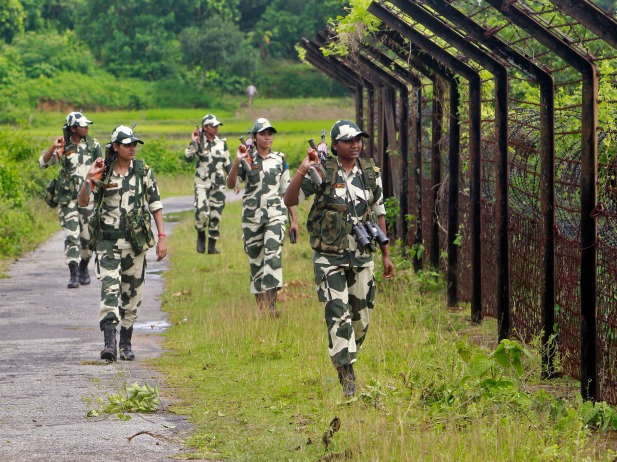
In the early 1970s, the Indian government planned to build the Farakka Barrage across the Ganges in Murshidabad district, West Bengal, to divert Ganges water to flush sediment deposits, keep Kolkata port running, and keep the Hooghly River salinity-free. However, the barrage entailed far-reaching negative consequences for Bangladesh.
As a result, the barrage became a political issue and a matter of profound national concern in Bangladesh.
Despite repeated appeals by the Bangladesh government for an equitable and sustainable arrangement for sharing Ganges waters, successive Indian governments turned a deaf ear.
For Bangladesh, the timing of the construction of the Barrage, the beginning of 1976, could hardly have come at a more challenging time – following a succession of coups and countercoups, Ziaur Rahman had only recently assumed power and was still attempting to consolidate governmental authority.
The Farakka issue, the contentious Ganges water-sharing dispute with India, added another layer of complexity to an already volatile domestic and regional environment.
In these challenging circumstances, Maulana Abdul Hamid Khan Bhashani rose to the occasion. True to his political tradition, he mobilised public opinion around the issue of what he regarded as Bangladesh’s legitimate claim to “water justice.”
To internationalise the issue and to put pressure on India, he announced a “Long March to Farakka,” scheduled for 16 May 1976.
Approximately a week before the proposed march, however, the Maulana declared himself ill and was admitted to Dhaka’s then PG Hospital.
According to accounts from some of his close associates, such hospital stays before major political events were not necessarily unusual. They suggested that the Maulana sometimes used “hospitalisation” as a period of relative seclusion to reflect, consult, and plan his next political move.
However, Maulana’s Farakka March announcement presented Zia with a delicate political dilemma. Having only recently assumed power, Zia was seeking to consolidate his authority and stabilise relations with neighbouring India. He feared that a mass mobilisation at the border might antagonise the Indian government and further complicate an already fragile political and diplomatic situation.
General Zia thus decided to meet the Maulana personally and persuade him to reconsider the proposed march.
Accordingly, Ziaur Rahman went to the PG Hospital and reportedly appealed to the Maulana not to proceed, saying, “Hujur, we are trying to resolve the issue diplomatically, and therefore, a march at this stage may create more problems than it solves.”
The octogenarian Maulana, characteristically unimpressed by such diplomatic caution, is said to have replied with a remark that captured both his irreverence and his confidence in his own political instincts. In response to Zia’s request, Maulana, who treated Zia with great affection, apparently said: “You are an Intermediate-passed General. What do you know of politics? Leave the politics to me; you focus on administration.”
Whether every word of this exchange can be independently verified is less important than what the anecdote conveys about the relationship between the two men.
Zia, the soldier-turned-ruler, approached the Farakka question primarily as a matter of statecraft and diplomacy, whereas Bhashani, the veteran mass politician, approached it as an issue requiring popular mobilisation and political pressure, within and beyond.
Their methods differed, but both were responding to what they regarded as a matter of vital national interest.
True to his word, Bhashani proceeded with the march on 16 May 1976. Joined by thousands of supporters, he led the procession towards the Farakka border, eventually reaching the Kansat area in Rajshahi district. There, with the Maulana at the forefront, the demonstrators, in the presence of a large group of local and foreign journalists, protested India’s unilateral withdrawal of Ganges water and demanded an equitable and just water-sharing arrangement between the two countries.
Indeed, as the Maulana had envisioned, the March proved politically consequential.
By transforming what had largely been a bilateral dispute into a highly visible international issue, Maulana’s mass mobilisation at the Indian border generated considerable public and diplomatic attention and, at the same time, strengthened the Bangladesh government’s hand in taking the matter to the international arena, including the United Nations, resulting in the 1977 Ganges Water Agreement between Bangladesh and India.
The episode therefore illustrates a recurring feature of Bhashani’s political career: his willingness to use mass mobilisation and public pressure where conventional methods appear insufficient.
Maulana’s anecdotes and the thousand messages
There are many such anecdotes of Maulana, simple in expression but profound in the messages they convey.
So, what messages do these above-mentioned anecdotes of Maulana Bhashani convey?
Message 1- Mass agitation and political violence can be justified and could be the means of change if it is mobilised and directed toward a clearly defined and legitimate end.
Message 2 – In statecraft, it is not the religion but the ethical substance of religion that should take precedence over its symbolic or institutional expression.
Message 3 – No matter how noble its intents are, authoritarianism ultimately ends badly.
Message 4 – Effective diplomacy has many facets – some official, some unofficial; some formal, some informal; some discreet, some open and loud.
These enduring messages of the Maulana, embodied in the lessons of his life and political legacy, remain relevant today and offer valuable guidance for Bangladesh to advance as a genuinely democratic, just, and inclusive society.

M. Adil Khan
M. Adil Khan is a professor of Development Practice, at the School of Social Science, University of Queensland, Brisbane, Australia. He is also former Chief of Socio-Economic Governance and Management Branch of the Division of Public Administration and Development Management, United Nations Department of Economic and Social Affairs, UN Secretariat, New York, USA and an Editorial Board Member of the South Asian Journal.
Source: https://southasiajournal.net/post/bangladesh/61710/collected-anecdotes-of-maulana-bhashani-stories-that-convey-a-thousand-messages