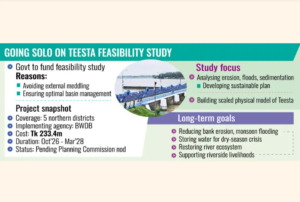
Bangladesh is set to conduct feasibility study on the long-stalled Teesta river-management project on its own to avoid any external meddling and get a better way of managing the cross-border water basin, officials said.
Since the proposed Teesta project is a geopolitically sensitive one, the Bangladesh government wants to conduct the feasibility study with its own funds for finding out viability and justification for the water-management project, they added.
“There some geopolitical issues involved in the Teesta river-management project. This time, the government itself wants to go for the feasibility,” a senior official of the Ministry of Water Resources told The Financial Express.
Bangladesh Water Development Board (BWDB) has recently undertaken a Tk 233.40-million project for feasibility study and sent to the Planning Commission (PC) for approval.
“We have undertaken the feasibility-study project before going to develop the water-management system and river-restoration programme in the Teesta basin,” said a senior BWDB official.
The proposed project for development of the river waters will cover five northern districts–Nilphamari, Lalmonirhat, Rangpur, Kurigram and Gaibandha.
Bangladesh has a stretch of 120-km water flow out of the total 315 kilometres in the Bangladesh-India cross-border Teesta River. The river originated in Sikkim, India.
The project is among the most closely watched infrastructure initiatives in the country, and it has drawn interest from major regional and global powers.
The past interim government last year sent a Preliminary Development Project Proposal (PDPP) to Chinese seeking necessary funds for the 1st phase of the “Teesta River Comprehensive Management and Restoration Project (TRCMRP)”.
The government wanted to start project works in January next and complete the first phase within four years. It ultimately didn’t proceed and the current BNP-led government now prepared the feasibility-study project for a better start-off.
Meanwhile, during Prime Minister Tarique Rahman’s visit to China in June last, the two countries advanced cooperation on the Teesta project, including a new feasibility-study effort.
Besides, nearly a decade ago in September 2016, a memorandum of understanding (MoU) was signed between BWDB and China’s state-owned Power Construction Corporation (Power China). But that project didn’t advance either due to “shifting geopolitical circumstances”.
Water resources ministry officials have said the fresh study would be crucial to taking the plan toward implementation, and that it would determine the precise locations and scope of the proposed works.
They stress that this is not the end of the planning stage. Environmental-impact assessment, final design, government approval, financing and field-level implementation would have to be done after the feasibility study.
According to the feasibility-study project proposal, the BWDB would conduct the study between October 2026 and March 2028.
Under the component-1 of the study project, the Board will analyse river erosion, flood, sedimentation and water-scarcity problem, and will develop “adaptive, integrated and sustainable plan”.
In the componenent-2, the water development board will develop high-quality and scaled physical model representing the Teesta River focusing area under realistic hydrodynamics and sediment-transport condition, and prepare detailed data-sheet to support calibration, validation and performance evaluation of the models.
The Teesta originates in the Himalayas, flows through Sikkim and West Bengal and enters northern Bangladesh before falling into the Jamuna River.
Bangladesh’s section of the river supports irrigation, agriculture, fisheries and the livelihoods of communities in the Rangpur region.
The proposed TRCMRP aims to manage the river as a basin-wide infrastructure and restoration project, with several objectives like reducing riverbank erosion and monsoon flooding, dredging sediment and improving river-channel management, storing and managing water to help address dry-season shortages.
Also, the project aims to reclaim land for agriculture and other economic activities; improve embankments, transport links and river access, restore the river ecosystem, and support communities along its banks.
The Teesta plan comes as the government commits heavily to water infrastructure. It recently approved the first phase of the Padma Barrage project, worth over Tk 330 billion.
Bangladesh and India have negotiated a proposed interim water-sharing agreement for years. A draft was finalised in 2011, but it was not signed. India’s federal and state-level political considerations, including the position of West Bengal, have been major obstacles to reaching agreement.
In their September 2022 joint statement, the two countries reiterated the need to work towards a Teesta water-sharing agreement. India’s official position has also referred to reaching an equitable agreement acceptable to all stakeholders.
The central issue is seasonal water availability. Bangladesh needs sufficient dry-season flow for irrigation and livelihoods, while farmers and water users in India’s West Bengal also depend on the river.
Source: https://thefinancialexpress.com.bd/economy/bangladesh-to-do-feasibility-study-on-its-own