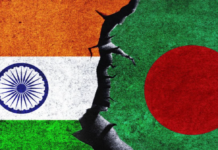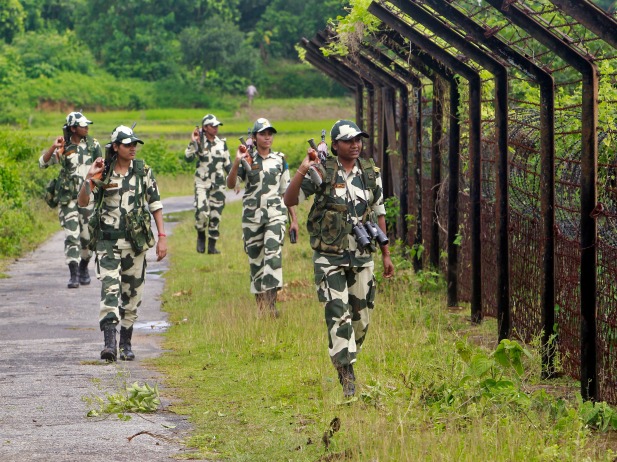

The India–Bangladesh borderlands are not simply spaces of territorial contestation. They are landscapes shaped by shared histories, cultural continuities and deeply intertwined human relationships. These borderlands hold a profound place in Bangladesh’s history. At Baidyanathtala (later renamed Mujibnagar), near the Indian border, the country’s first government took its oath on 17 April 1971. During the Liberation War, millions of Bangladeshis crossed the border into India, fleeing atrocities committed by Pakistani forces. For decades, despite political tensions and an increasingly securitised border, communities on both sides maintained relationships through cross-border marriages, religious practices, trade, shared languages and everyday interactions. The political meaning of these borderlands extends beyond territorial security and migration management, raising a more fundamental question: who has the legitimate right to belong?
Recent developments in India’s northeastern border states point towards an increasingly troubling politics of identity. Demolition drives in Assam’s Dhubri district targeting villages largely inhabited by Bengali-speaking Assamese Muslims, the normalisation of derogatory expressions such as Miya, and controversies surrounding villagers’ encounters with the Indian Border Security Force (BSF) in Tripura have raised questions that extend beyond individual incidents. Who is considered an Indian? Why are certain communities repeatedly required to prove their legitimacy?
These questions reveal a changing relationship between territory, identity and citizenship. For people living along the border, belonging is increasingly negotiated through markers that extend beyond legal documentation: their names, language, attire, religious practices and perceived cultural affiliations. The border, in this sense, is becoming more than a geographical boundary. It is also a political instrument for distinguishing between those who are considered insiders and those who are treated as outsiders.

This is the cartography of othering: the process through which political narratives redraw the social boundaries of belonging, even within internationally recognised national territories.
The problem becomes particularly acute when religious identity is conflated with national allegiance. Bengali-speaking Muslims in West Bengal, Assam and Tripura are frequently situated within political narratives of illegal migration and demographic insecurity. Migration and citizenship are legitimate matters of public policy. States have the authority to regulate their borders and establish legal procedures. But when an entire community is persistently viewed through the lens of suspicion, the distinction between immigration enforcement and identity-based exclusion becomes increasingly difficult to maintain.
The political influence of the Bharatiya Janata Party (BJP) in India’s border states has also contributed to a changing political vocabulary around migration, nationalism and religious identity. Polarising and hateful statements by political leaders, particularly those associated with the political leadership of Assam and West Bengal, have contributed to the normalisation of exclusionary narratives, gradually shifting the boundaries of what is considered acceptable in public discourse.

The territorial imagination underlying some political statements is equally significant. References by Indian politicians to Chittagong, Noakhali and Sylhet as territories that should have belonged to India, or as historical mistakes associated with Partition, are not simply rhetorical provocations. They invoke an unfinished geographical imagination in which historical grievance, religious majoritarianism and territorial nationalism intersect. Such narratives deserve scrutiny not because every political statement signals an immediate territorial ambition, but because they can reshape how neighbouring societies perceive one another.
The consequences of this politics do not stop at the border fence.
For Bangladesh, these developments carry both political and social implications. Social media has become an important arena where statements and incidents from India’s border states are circulated, interpreted and sometimes amplified without sufficient context. Reports of discrimination or violence can generate legitimate concern, but misinformation and emotionally charged responses can also deepen antagonism within Bangladesh. The result is a transnational politics of suspicion in which developments on one side of the border influence perceptions and political narratives on the other.
In this context, Myanmar’s Rohingya crisis offers a crucial warning. The progressive exclusion of the Rohingya from citizenship, their institutionalised marginalisation and eventual mass displacement demonstrate how the gradual denial of belonging can develop into a profound humanitarian catastrophe. Bangladesh continues to bear the consequences nearly a decade after the mass exodus of 2017.

India and Myanmar are fundamentally different political contexts. The comparison, therefore, should not suggest an inevitable repetition of the Rohingya experience. History, however, offers an important lesson: major crises rarely emerge overnight. They can begin with the normalisation of suspicion, the politicisation of identity and the gradual erosion of a community’s social and legal legitimacy. Such crises are often the culmination of processes that unfold over many years, as the Rohingya experience demonstrates.
For Bangladesh, recognising these warning signs is not alarmism. It is a necessary exercise in regional political foresight.
Dhaka’s diplomatic restraint towards New Delhi may reflect a pragmatic recognition of the economic, strategic and security interdependence between the two countries. Trade, connectivity, water sharing and regional stability require sustained engagement. Yet diplomatic restraint should not translate into intellectual or political silence. When narratives of exclusion become normalised, their consequences may eventually extend beyond the immediate communities they target.
Both Bangladesh and India need a forward-looking border policy that recognises borderlands as living socio-cultural spaces rather than exclusively security-sensitive territories. This requires sustained diplomatic engagement on migration, minority rights and border governance, alongside stronger mechanisms for documenting and addressing incidents affecting border communities. It also requires domestic political responsibility: ensuring that developments across the border are not exploited to generate religious polarisation or nationalist hostility within Bangladesh itself.

Ultimately, the question is not whether Bangladesh faces an immediate territorial or demographic threat. It is whether South Asia is entering a political moment in which citizenship, religious identity and national belonging are increasingly determined through majoritarian definitions of who constitutes the legitimate nation.
The people inhabiting the India–Bangladesh borderlands have lived through successive redrawings of geography, political boundaries and national identities. They have adapted to borders imposed by Partition, war and changing state policies. But they should not have to face another, less visible border that separates those whose identities are accepted without question from those who must constantly prove their right to belong. The tragedy of othering is that it does not merely redraw maps; it makes strangers of people in the very places they have always called home.
Dr Anas Ansar is a senior researcher at the Arnold Bergstraesser Institute, University of Freiburg, Germany, and an assistant professor in the Department of Political Science and Sociology at North South University (currently on leave).
Source: https://www.thedailystar.net/slow-reads/geopolitical-insights/news/how-identity-politics-redrawing-the-india-bangladesh-borderlands-4321271