The world’s political map has never been permanent. Borders that appear immutable to one generation can be transformed by war, imperial collapse, nationalism, migration, and the rise of new powers. Europe before the First World War bears little resemblance to Europe today. Empires such as the Ottoman, Austro-Hungarian, and Russian empires have fallen or shrunk. Empires have given rise to many smaller countries that have since gained independence. The USSR fell apart. Yugoslavia was divided, and now we are once again seeing territorial disputes within Europe. Countries such as Bangladesh, which lies in South Asia and Southeast Asia, should take note. But should not fall into nationalistic territorialism.
Some geopolitical theorists search for long cycles in history, arguing that major transformations occur every seventy or eighty years. Such patterns are intriguing, but they should not be mistaken for laws of history. The deeper lesson is simpler: international systems periodically undergo profound disruption when the balance of power changes. The Protestant Reformation, beginning symbolically with Martin Luther’s challenge to Church authority in 1517, contributed to centuries of religious, intellectual and political upheaval in Europe. The Enlightenment, industrialization, nationalism and colonialism subsequently transformed concepts of sovereignty and statehood. By the twentieth century, two world wars had redrawn much of the globe.
The post-1945 international order attempted to establish a fundamentally different principle. Territory was no longer supposed to be acquired simply because a stronger state possessed the military power to seize it. The United Nations Charter prohibited the threat or use of force against the territorial integrity or political independence of states, except under narrowly defined circumstances such as self-defense or Security Council authorization. This principle remains imperfectly enforced, but it is critically important for smaller states such as Bangladesh.
Indeed, Bangladesh has a particular interest in defending itself. If powerful countries can redraw borders based on historical claims, ethnicity, military strength, or strategic convenience, smaller countries become inherently vulnerable. Russia’s annexation of Crimea in 2014 and its subsequent attempt to incorporate additional Ukrainian territories following the 2022 invasion demonstrate that territorial conquest has not disappeared. They also demonstrate, however, the enormous diplomatic, economic and military costs that can follow attempts to alter internationally recognized borders by force.
Bangladesh therefore should view contemporary discussions about changing the map of its own region through the prism of sovereignty rather than expansion.
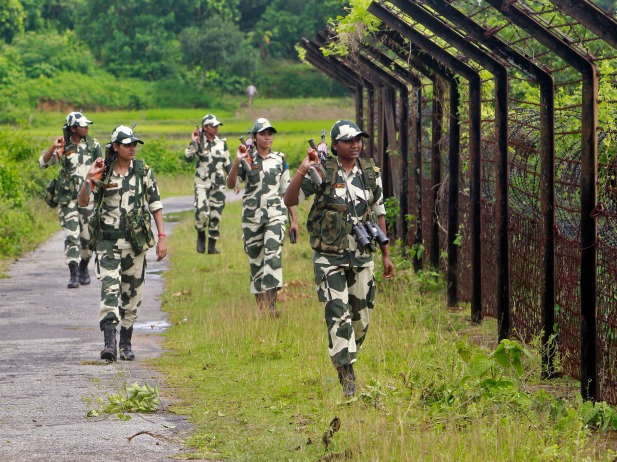
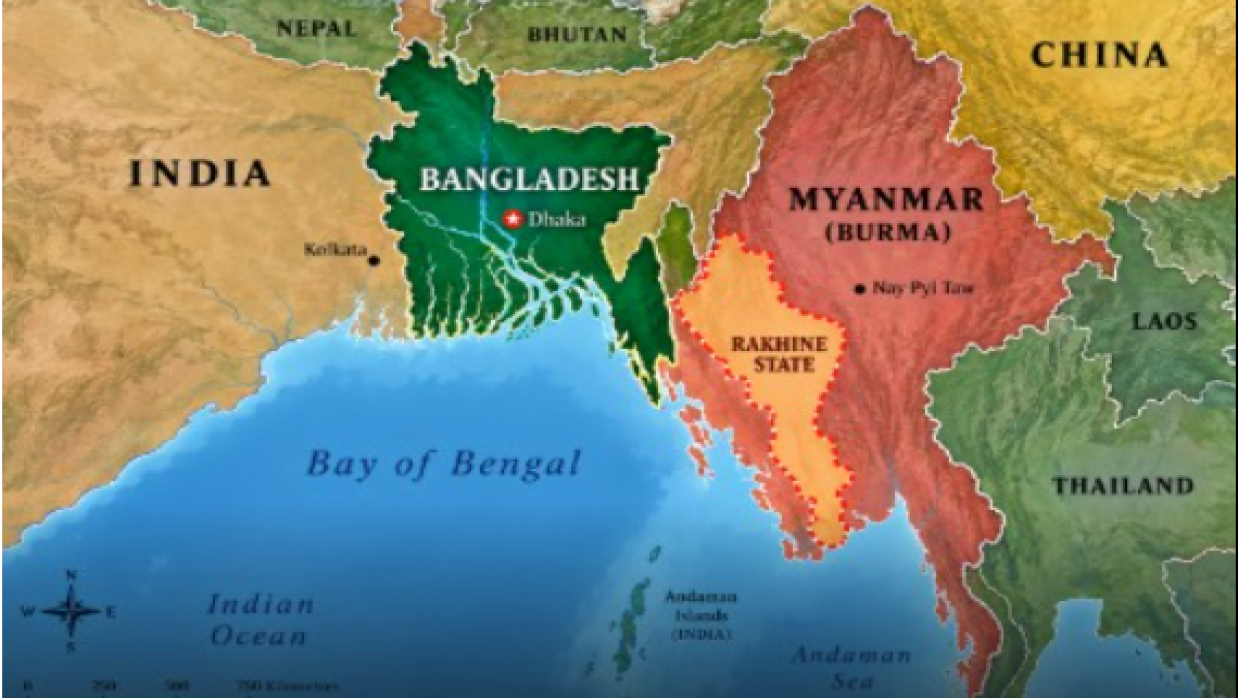
The most immediate uncertainty lies to the southeast. Myanmar’s prolonged internal conflict has dramatically altered conditions along Bangladesh’s frontier. The rise of the Arakan Army and the weakening of Myanmar’s central authority in Rakhine State have created a security environment fundamentally different from the one Bangladesh faced a decade ago. An armed non-state or quasi-state actor controlling territory adjacent to Bangladesh introduces difficult questions involving border security, refugees, narcotics, weapons trafficking, and the future of the Rohingya population.
The Rohingya question makes this frontier particularly combustible. Bangladesh has already carried an extraordinary humanitarian burden by sheltering a huge displaced population from Myanmar. A prolonged political vacuum in Rakhine could further complicate repatriation and create conditions in which criminal networks, militant organizations and regional intelligence services compete for influence.
Yet Bangladesh must distinguish carefully between defending its legitimate security interests and becoming drawn into Myanmar’s territorial disintegration.
The idea occasionally advanced in speculative geopolitical discussions that Bangladesh might someday absorb part of Rakhine State would carry extraordinary dangers. Even if Myanmar fragmented further, territorial acquisition would not automatically become legitimate. Rakhine contains complex ethnic, religious and political constituencies with their own competing visions of sovereignty. Any Bangladeshi attempt to acquire territory through military intervention could transform a border-security problem into a prolonged insurgency while damaging relations with China, India, ASEAN and the wider international community.
No amount of military might can overcome these types of issues. Bangladesh’s military force will outmatch any insurgent group many times over. However, time has shown that a conventional military advantage does not guarantee you can defeat a guerrilla force that knows its home ground better than anyone else. Many countries have experienced this throughout their lifetime after gaining independence from colonial powers. Such as Afghanistan and Vietnam, to name a few.
Bangladesh’s strongest strategic asset may therefore be restraint combined with preparedness.
Geography provides Bangladesh with both advantages and vulnerabilities. Its dense population, enormous river network and difficult terrain would complicate conventional invasion and occupation. At the same time, the country’s economic arteries, ports, energy infrastructure and densely populated cities create vulnerabilities to disruption. Twenty-first-century sovereignty is threatened not merely by tanks crossing borders but through cyberattacks, disinformation, economic coercion, trafficking networks, proxy organizations and domestic political destabilization. This requires Dhaka to think several moves ahead on the geopolitical chessboard.
India remains unavoidable because Bangladesh is surrounded by Indian territory on three sides. China has become increasingly important through trade, infrastructure investment, and defense cooperation. Beijing also possesses substantial influence in Myanmar. The United States remains an important diplomatic, economic, and Indo-Pacific power, while Japan and other Asian states have growing interests in the Bay of Bengal. Bangladesh’s challenge is to engage all these actors without becoming an instrument of any one power’s strategy.
That will require a much more nuanced approach than simply aligning with Washington over Beijing or Delhi over Beijing. Bangladesh must aim for strategic autonomy. It can maintain good ties with India without becoming reliant on India. It can maintain an economic partnership with China without falling under its strategic ambit. It can work with the US without joining any anti-China containment strategy. It can also maintain closer ties with Japan, ASEAN countries, Europe, and the Muslim world.
The Bay of Bengal will become increasingly important in this calculation. Bangladesh’s maritime territory, ports, energy routes and proximity to the Indian Ocean give the country strategic importance far exceeding what its geographical size might suggest. Future competition may therefore concern not simply land borders but access to ports, sea lanes, energy resources, logistics networks, and naval influence.
For Bangladesh, the lesson from five centuries of changing maps should not be that another opportunity for annexation is approaching. It should be that periods of international transition are particularly dangerous for states that fail to understand the strategic environment around them.
Rakhine’s instability must consequently be treated as a national-security priority. Bangladesh requires stronger border surveillance, intelligence capabilities, maritime-domain awareness, counter-narcotics operations, and military readiness. At the same time, Dhaka should maintain communication channels with every relevant actor, including Myanmar’s government, emerging authorities inside Rakhine, China, India, ASEAN, and the United Nations.
One of these is that Bangladesh must not fall into the trap of believing that expanding its landmass will make it more powerful. The opposite can be true. Taking over unfriendly land can cost you troops, create insurgents, and lead to sanctions. Your once friendly neighbors may become your enemy as well.
Bangladesh was itself born from a struggle over political rights, identity, and sovereignty. Its greatest strategic interest is therefore an international system in which sovereignty remains protected, and stronger states cannot casually erase the borders of weaker ones.
The map surrounding Bangladesh may indeed change during the twenty-first century. Myanmar could become more decentralized; Rakhine might acquire greater autonomy; great-power rivalry in the Bay of Bengal will almost certainly intensify. Bangladesh must be prepared for each possibility. But its objective should not be to redraw the map. It should be to ensure that, whatever changes occur around it, Bangladesh remains sovereign, secure, economically strong and sufficiently sophisticated to determine its own destiny.
On the geopolitical chessboard, survival does not always belong to the player making the most aggressive move. Often it belongs to the one who understands the board several moves before everyone else.
Source: https://southasiajournal.net/post/bangladesh/61811/the-geopolitical-chessboard-potential-map-changes-and-sovereignty-challenges-for-bangladesh