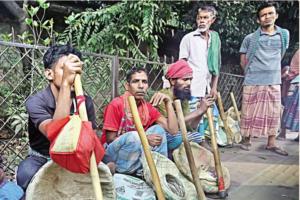
A World Bank (WB) assessment of the proposed Contingent Emergency Response Project in connection with its budget support for Bangladesh finds that 1.4 million more people in the country have slid into poverty in 2025. The outlook for the year 2026 is hardly encouraging. External shock like the Middle East conflict and macroeconomic stress will push an additional 1.2 million people below the poverty line in the fiscal year 2026. The number of vulnerable people estimated at 62 million and living just above the poverty line are ‘at high risk of falling back into destitution due to limited savings and inadequate safety nets’, according to the WB. As many as 0.6 million jobs are projected to be lost during this time. Also the quality of jobs is on the decline.
It is exactly at this point the question arises in whose interest the WB’s budget support has been negotiated. The areas that the $1.5 billion WB budget support are set to cover include 1) institutional governance, 2) financial sector reforms, 3) energy security, 4) food security and vulnerable groups and 5) emergency and crisis response. Well, vulnerable groups have been included in the list of beneficiaries but how much its share will be is a tricky question. The list is long and the amount seems to be too small to address just one of the areas. For example, energy security is an area that defies any temporary solution.
Then the initial rollout of the family card programme covers only 37,500-40,000 families and the first year’s target is to reach out the Tk 2,500 monthly support to 4.1 million. Ultimately, the programme will be geared to cover 40 million families. For the most vulnerable families the Tk2,500 monthly support is likely to prove too little. A family consisting four members will enjoy an allocation of a paltry sum of just Tk625.
In fact, such dole-out programmes fall far short of requirement. Besides leaving a significant portion of the population perpetually dependent on government aid these also ask them indirectly to live a marginal life. The need is to create sustainable jobs for citizens of all segments. A total amount of Tk 123 to Tk145 billion has been earmarked for the family card programme for the benefit of 4.1 million people.
International financial institutes and agencies prefer macroeconomic stability to microeconomic vibrancy or resurgence. The WB’s assistance is expected to follow the same pattern. When energy crisis has hit manufacturing and businesses hard and the economy is on course of a slump, the government has unveiled the 9th National Pay Scale for government officials and employees requiring an additional allocation of Tk1.0558 trillion a year. This extra amount will be spent on 2.4 million civilian and military employees.
While 2.4 million will be entitled to enjoy this increased allocation on top of the Tk1.31 trillion they now draw annually from the exchequer, it is a misplaced priority. The number of family card-holders may rise from the 4.1 million to 40 million over the next four years. If a family has four members, the total number of beneficiaries will stand at a little over160 million. The expenditure on them will be a fraction of the amount to be spent on the civilian and military employees. This shows how the component of discrimination is ingrained in the social and economic structure.
The need was to bridge the gap honouring the spirit of the July uprising that gained its momentum on the participation of working class people, the unemployed and ordinary citizens. Once again their contribution has been ignored and the privileged and educated class has wrested the maximum benefit from the movement. Disillusioned, they now watch helplessly how the leaders, once the comrades in arms, are having the cake and eating it too. The social divide will only widen following the implementation of the national pay scale.
So the rationale behind this extra expenditure on government employees at a time of severe economic crisis is questionable. Implementation of the new national pay scale is likely to trigger further inflation, leaving low-income people and employees in the private sector particularly vulnerable. Socio-economic discrimination will be fuelled further by this record rise in pay structure for the government employees.
When more people are destined to slide into poverty, the situation will worsen because of the money at the disposal of the government employees’ disposal courtesy of at least the double the pay package. When a programme for pulling out the poor and the marginal people from the poverty trap was called for, the investment in the more favoured segment will only widen the economic discrimination and social injustice. If the poor segment of people is left out of development programmes, it is also a national loss the country can ill afford. Like it or not, it will prove self-defeating for a government on the final count. Unless development programmes are inclusive, social friction is bound to be its natural outcome. Once it turns out to be explosive as evidenced by the negative developments during the Sheikh Hasina regime, it can wreak havoc.
Let society come to terms with the principle of socio-economic equanimity. Large investment ought to be made for the welfare of the deprived and neglected segments in society not in the class already privileged. A paradigm shift in the development theory is needed in the context of prevailing conditions of domestic reality.
Source: https://thefinancialexpress.com.bd/columns/stark-poverty-and-misplaced-investment