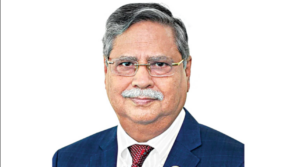
Mohammed Shahabuddin yesterday resigned as Bangladesh’s president, citing ill health, ending days of speculation over his future.
His resignation comes after the BNP top leadership had conveyed a message to Shahabuddin, urging him to resign, according to multiple party sources.
The BNP initiative followed reports that Shahabuddin had spoken by phone with ousted prime minister Sheikh Hasina during his London visit in May.
He submitted his resignation letter to Speaker Hafiz Uddin Ahmad through his representatives at 5:01pm, hours after the Speaker returned to Dhaka from Thailand, where he had been receiving medical treatment.
Shahabuddin confirmed his decision to The Daily Star over the phone.
“I am suffering from various health complications. I have nothing more to add at this moment,” he said at 4:37pm.
His resignation ends the chapter on the last remaining top constitutional office still occupied by a figure appointed during the Awami League government’s tenure before it was ousted on August 5, 2024 in the student-led July uprising.
Under the constitution, Speaker Hafiz immediately assumed the responsibilities of acting president. The Election Commission must now hold a presidential election within 90 days, in which members of parliament will elect the next head of state.
Speaking at a press conference at the Jatiya Sangsad complex around 5:30pm, Hafiz said he had accepted the resignation and directed the parliament secretariat to preserve the records and complete the necessary formalities.
“As a result, I have assumed the responsibility of the president in accordance with article 54 of the constitution,” he said.
He said he had already taken oath as the acting president on the day he was sworn in as the Speaker. Similarly, when the deputy speaker took oath as the deputy speaker, it was mentioned as part of the oath that when the Speaker’s chair falls vacant for any reason, the deputy speaker will perform the duties of the Speaker.
Hafiz said Shahabuddin’s resignation had removed all uncertainty surrounding the issue and wished him a speedy recovery.
“Although he was elected during the tenure of the mafia government, he has always expressed support and respect for the new government currently elected by the votes of the people. I wish him well,” Hafiz said.
THE LETTER
In his resignation letter, Shahabuddin said worsening health had left him physically and mentally incapable of carrying out the responsibilities of the presidency.
He said he was suffering from heart disease, hypertension, diabetes and kidney complications, and had undergone coronary artery bypass surgery. He was also diagnosed with autonomic neuropathy, which occasionally causes him to lose consciousness.
“Due to the progression of these illnesses and the resulting physical and mental incapacity, it is no longer possible for me to perform the responsibilities of the important constitutional office of the president. I require long-term medical treatment,” he wrote.
Shahabuddin said he had tried to discharge his constitutional responsibilities with “honesty, integrity and full allegiance to the constitution” since taking office as Bangladesh’s 22nd president on April 24, 2023.
Referring to the fall of the Awami League government following the uprising, he said the country had faced a governance and constitutional crisis.
To overcome that crisis, acting under the authority of article 106 of the constitution, he sought the opinion of the Appellate Division of the Supreme Court of Bangladesh.
Subsequently, based on the advice of the Appellate Division, he formed the interim government. In consultation with political parties, the interim government arranged the general election.
Based on the election results, the present government was formed and is now administering the country. The ruling party and the opposition are carrying out their responsibilities in parliament through democratic practices, reads the letter.
“Owing to my prudent and historic role, the country did not experience any constitutional vacuum,” Shahabuddin wrote.
TURBULENT TIME
Shahabuddin stepped down with nearly two years remaining in his five-year term after presiding over one of the most turbulent periods in Bangladesh’s recent political history.
During his 39 months at the Bangabhaban, he oversaw two national elections, administered the oath of office to two prime ministers and the chief adviser of the interim government, and witnessed the mass uprising that toppled the Awami League government and forced Hasina into exile.
His future had remained uncertain since the uprising, but speculation intensified in recent days amid media reports that he was preparing to resign.
According to multiple BNP sources, the party asked Shahabuddin to step down after receiving reports that he had spoken by phone with Hasina during his visit to London for medical treatment between May 9 and May 18.
Speaking to The Daily Star on Thursday, Shahabuddin denied that he had talked to Hasina during his London visit.
However, a senior BNP leader said the reported conversation was not the sole reason behind the move, describing the issue as “more complex”.
The leader said the political situation became more sensitive after Hasina recently announced plans to return to Bangladesh in December.
Reuters reported on July 10 that Hasina, who faces a death sentence in Bangladesh and whose party’s activities have been banned, planned to return from exile in India around December and surrender.
The possibility of Shahabuddin’s resignation had surfaced months earlier.
On December 12, 2025, during the tenure of the interim government, he said he intended to step down midway through his term after the February parliamentary election, adding that he had felt humiliated by the interim government led by Muhammad Yunus.
After the BNP-led government assumed office, Shahabuddin again addressed the issue in an interview published on February 24 this year, saying he would remain in office if the new government wanted him to stay but would resign voluntarily if it preferred his departure.
Mohammed Shahabuddin was sworn in as Bangladesh’s 22nd president on April 24, 2023, after being elected unopposed as the Awami League nominee on February 13 that year.
A freedom fighter, he retired as a district and sessions judge in 2006 and later served as a commissioner of the Anti-Corruption Commission from 2011 to 2016.
Before joining the judiciary, Shahabuddin was active in Awami League politics in Pabna.
Born on December 10, 1949, at Jubilee Tank in Pabna town, Shahabuddin was the general secretary of the Pabna Edward College unit of the Chhatra League and president of the Pabna district Chhatra League and Jubo League.
He was the joint secretary of the Bangladesh Krishak Sramik Awami League’s (BaKSAL) district unit and publicity secretary of the Awami League district unit.
Shahabuddin also served on the advisory council of the Awami League, whose activities are now banned.
As an ACC commissioner, Shahabuddin was involved in the Padma Bridge corruption inquiry. He later joined Islami Bank’s board, serving as vice-chairman until his presidential nomination.
Source: https://www.thedailystar.net/news/bangladesh/news/shahabuddin-resigns-citing-health-concerns-4231726