by Ahmad Shihab 13 August 2022
“Truth is stranger than fiction. If you tell the truth, you don’t have to remember anything.” ― Mark Twain
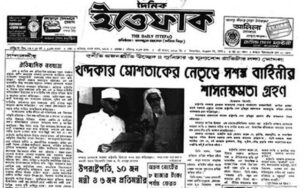
“A Public Relief; A Historic Beginning.”–The Daily Ittefaq
(“জনসাধারনের স্বস্তির নিঃশ্বাস; ঐতিহাসিক নবযাত্রা”–দৈনিক ইত্তেফাক)
That was the front-page news and editorial in the daily Ittefaq on August 16, 1975, after the military coup the previous day. The popular daily was founded by Tofazzal Hossain Manik Mia, a close associate of Sheikh Mujibur Rahman and a supporter of Awami politics. Anwar Hossain Manju, son of Manik Mia and editor of the largest circulated daily in 1975, wrote the editorial welcoming the August 15 military action and the political change.
“The moment the curfew was relaxed at noon time, an unprecedented spectacle descended on the streets of the capital,” said the editorial. “Muslims gathered at the mosques in huge numbers. They embraced each other and exchanged greetings as if it was Eid Happiness.”
The Ittefaq editor said that the people got nothing but “despair and disappointment” and suffered under a “repressive system” during the Mujib rule, which had also sealed all constitutional avenues to bring about a political change. But he added that the course of history could not be blocked by “hunger for power” and credited the patriotic elements of the military that had responded to the call of “the 75 million people to fulfill the historic need of the nation.” Hailing the young officers who “risked their lives” to accomplish the task, he felt that they deserved “greetings of the whole nation.” [1]
Zalim Feraun
In September 1975, then Awami Speaker Abdul Malik Ukil said about Mujib, “The Zalim Feraun has fallen. The country has been freed from a repressive autocrat.”
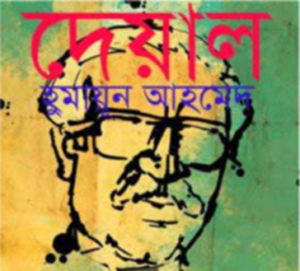
Popular novelist Humayun Ahmed wrote in his book Deyal: “Sheikh Mujibur Rahman was killed. Roads were filled with processions. The reality was that those were the jubilations of the people (শেখ মুজিবুর রহমানকে হত্যা করা হয়েছে, রাস্তায় মিছিল বের হয়েছে। দুর্ভাগ্যজনকহলেও সত্যি, সেই মিছিল আনন্দ-মিছিল।)”
Rashed Khan Menon of the Workers Party said in a statement on August 29, 1975, “For the past three and a half years, the people suffered under the detested and anti-people regime of Sheikh Mujib and prayed every moment for its fall. August 15 had accomplished it.”
Mujib’s Rule
Enayetullah Khan, editor of the prestigious Holiday, summarized Mujib with the following words:
“His strolls around the corridor of power at times drew pity; he frowned at straight talk; he tried to destroy a dissident with his wrath. He loved the nation, yet he betrayed it. He had to pay with his life.”
In an article written for the Weekly Bichitra in October 1975, Khan wrote that Mujib’s politics had dramatic excellence, but they were tainted with his dubious characteristics. His rise was meteoric and his fall was equally sudden and tragic. He was a puppet at the hands of the Indo-Russian expansionists. Like a true stage actor, Mujib followed their script with his skillful oratory and bluffed the people of a rosy future. His masters gave him the “Peacock Throne but no power.”
Raktokorobi
Enayetullah Khan invoked Rabindranath Tagore’s epic “Raktokorobi ” to depict Mujib. Like the heartless, ruthless king in Raktokorobi, Mujib tried to build a self-serving dictatorial fiefdom over the sacrifice of the people in the liberation of Bangladesh (Mujib himself stayed away from the independence war despite repeated requests from his aides). Mujib played God but had no worshiper; nor was he the Lion of Judah. “He could not bear the burden of the crown he wore, and went down under its weight.”
People trusted him to bring freedom, Khan continued, but he betrayed them, because he had to repay the debts to his masters. The repayment included eliminating political opponents, banishing democracy, denying human rights, brutal repression, gagging the media, banning freedom of expression and sending 62,000 patriots to rot in jails. Mujib’s three-year rule broke hearts of thousands of mothers, bled hundreds of patriotic heroes, created new history in smuggling out national resources, destroyed the beauty and culture, and above all, sold out the national sovereignty. And the economy left nothing in the coffer. A tragic story! August 15 saw the accumulated wrath of the people.
(Apart from being a leading journalist, Enayetullah Khan also served as ambassador and minister.) [2]
Zero Popularity
Sharmin Ahmad, in her book Tajuddin Ahmad: Neta O Pita (June 2014) compared the post-August 15 scenario to the victory day celebrations (of December 16, 1971): “In 1975, Mujib uncle’s popularity went down to zero. Dismayed at his leadership, they wanted the end to his dictatorship. The same people who were once ready to sacrifice anything for him, made no protest at his death. They hailed his killing, gave slogans at his downfall (পঁচাত্তরে মুজিব কাকুর জনপ্রিয়তা ছিল শূন্যের কোঠায়। তার নেতৃত্ব সম্পর্কে হতাশাগ্রস্থ জনগণ তার স্বৈরশাসনের অবসান কামনা করেছিল। যারা অতীতে একই নেতার জন্য প্রাণ আহুতি দিতে পর্যন্ত প্রস্তুত ছিল, তারা হত্যাকাণ্ডের প্রদিবাদ করেনি।…মানুষ এই হত্যাকাণ্ডে উল্লাস প্রকাশ করেছে। হত্যাকান্ডকে সমর্থন করে স্লোগান দিয়েছে।”)
In the late 1980s, then Foreign Minister and a latter day Awami Speaker, Humayun Rasheed Choudhury said in Sylhet that Mujib’s sins would not be cleansed even if he was hanged a hundred times.” [3]
Traitor and Collaborator
Zoglul Husain, an activist of Bangladesh’s independence in 1971 and an eminent political analyst and columnist, went deeper in describing Mujib:
“Mujib was a national traitor. The fascist Mujib regime killed 30 thousand patriots, perpetrated indiscriminate killings, torture, tyranny, oppression, repression, reckless plunder, caused an Awami-made famine, in which 1.5 million people perished, and above all, it sold out national interest and surrendered sovereignty to India. Mujib never wanted the independence of Bangladesh. On the night of 25 March 1971, he refused to declare independence, saying that he didn’t want to face the charges of sedition. He arranged with President Yahya Khan, his and his family’s safety, a hefty allowance for his family, and then surrendered. Yahya paid a monthly allowance of 1,500 rupees (about 5 lac Taka now) to the Mujib family for the 9 months of genocide and the freedom war. General Tikka Khan and other Pakistani military officers visited his family from time to time to look after them. Mujib’s mother was brought by helicopter to Dhaka for treatment by the Pakistan army. When Mujib’s daughter Hasina’s son was born in the army hospital, the military celebrated with sweets. Mujib thus collaborated with Yahya on the night of 25 March 1971, and he became the first collaborator and a national traitor since then.”
(Zoglul Husain is a recipient of the Freedom Award for his contribution to the freedom movement in Bangladesh from 1957 to 1971.)
Banglar Mir Jaffor
At a Paltan rally in Dhaka on January 2, 1973, Mujahidul Islam Selim, Vice President of Dhaka University Central Students Union (DUCSU), withdrew the “Bangabandhu” title given to Sheikh Mujibur Rahman and cancelled his life-long membership of the DUCSU, publicly tearing off the page from the register. It was the same student leader who granted him the DUCSU membership a year ago. Selim had further asked all offices to remove the pictures of Mujib. Among other slogans at the rally, “Banglar Mir Jaffor: Sheikh Mujib (Sheikh Mujib, the Traitor of Bangladesh) was the loudest.
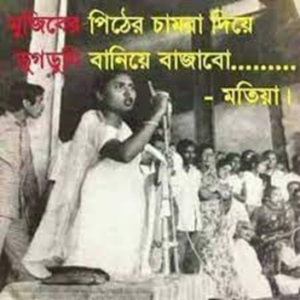
Motia Chowdhury, a fiery leader of the Students Union and later National Awami Party (Muzaffar), desired to make shoes and dug-dugi, hand-held drums, with the back skin of Mujib. “From today,” she declared, “you are no more Bangabandhu. You are Banga Satru.” [4]. So said Shahriar Kabir, today’s Awami intellectual. “Mujib, you are no more Bangabandhu, you are Mujib, the National Betrayer.”
Banga-Shatru?
Well-known Indian journalist and writer Khuswant Singh wrote in the Illustrated Weekly of India about Sheikh Mujib, “In 1970 he (Sheikh Mujibur Rahman) was the most-loved man by his people, and millions of others in India and elsewhere. Within a couple of years, he had lost much of his charisma and lived in a cocoon of self-spun esteem. He came to regard honest critics as traitors and sycophants as loyal friends. It was a classic case of folio de grandeur. He was blissfully unaware that the very people who called him ‘Bangabandhu’ or ‘Bangapita’ to his face were behind his back called him ‘Banga-Shatru.’”
Azizul Karim wrote in the Bangladesh Strategic & Development Forum of June 4, 2005: “The period of AWAMI-BAKSAL rule was full of barbaric atrocities and betrayal of the spirit of the liberation war. By creating Rakkhi Bahini, Lal Bahini, Sheccha Shebok Bahini and other private forces, the regime unleashed an unbearable reign of terror, killing 40,000 nationalists and patriotic people without any trial.”
If No August 15
While detailing the background for the August 15 coup, M M Azizul Haq, in an article in the Daily Inqilab on November 1, 1991, painted a scary picture of Bangladesh had there not been the August Coup. Without going into the details of his horrific tapestry, it may suffice to say that there would have not been a Bangladesh that we had seen since August 15, 1975– sans the Awami periods.
It is regrettable that some innocent lives were lost during the short military action on the day. Narratives differ as to the circumstances of those deaths, each attempting to score its point. However, in a military coup, collateral damage is not unexpected. The public reaction and the media reports of the time suggested the overwhelming acceptance by the whole nation of the event, which was aimed at higher national interests, nay the national survival. The revolutionary action bailed the nation out of an oppressive one-party dictatorship, and it led to multiparty democracy; political openness, press freedom, rule of law and public accountability, among others. Above all, Bangladesh regained its sovereignty hitherto lost to an external hegemon.
Re-visit August, 1975
An event must be judged in the context of the time and situation. To understand why the Bengalis took up arms against the marauding Pakistanis in 1971, one needs to recall the time and know the facts. Similarly, to understand and evaluate August 15, one must place oneself in the period of Mujib rule and visualize the state of the country under an enforced fascism. One doesn’t have to be a rocket scientist, nor would one need a crystal ball to perceive why August 15 had to happen. It was inevitable. It was in response to the national outcry to bail the country out of the dark pit and save the people. If anyone was responsible for the August Coup, it was Mujib himself.
Wasn’t it a harsh pity that in fall Mujib did not get a tear, nor a word of remorse, nor a token challenge, nor a ritualistic Innalillah? His one-time close associates rushed to join the next Awami government under veteran Khandakar Mushtaq Ahmed while his dead body was still bleeding on the steps at 32 Dhanmondi. Sheikh Hasina herself lamented that only a handful of people (10-18) could be gathered for her father’s funeral at their village home. Mujib followers shedding a sea of crocodile tears today, should re-visit Mujib’s rule of 1972-75 and recount the death of thousands and suffering of millions under Mujib. They should also ponder why Mujib’s death attracted wild celebrations at home and abroad.
Apples, that includes the rotten ones, do not fall far from the tree. Sheikh Hasina Wazed, daughter of the fallen dictator, has been running a worse dictatorship than her father’s, with overt and covert help from her all-weather sponsors in New Delhi. And, the vast majority of the country silently remembers the Surja Sontans, divine sons, of the August Revolution. M K Gandhi said: “There have been tyrants and murderers, and for a time, they can seem invincible, but in the end, they always fall.” So shall be in Bangladesh, hopefully.
Truth is Revolutionary
English writer George Orwell said, “In a time of deceit telling the truth is a revolutionary act.” Orwell’s American counterpart, William Faulkner, wrote: “Never be afraid to raise your voice for honesty and truth and compassion against injustice and lying and greed.” Interestingly, if not ironically, even Sheikh Mujib highlighted the “truth” to his faithful caretaker of Pakistani jail (a police officer in the disguise of a prisoner) at parting: “In the long war between falsehood and the truth, falsehood wins the first battle and the truth the last.” Mujib wrote it on a book he presented to his jail-mate, Raja Anar Khan, on January 5, 1972.
It is my humble battle to explore the truth and compassion at a time of deceit, distortion, falsehood and injustice. It is time for the truth to win the war.
May the Almighty help us!
Writer is an activist for democracy, human rights and freedom. A regular in the media on contemporary Bangladesh, he wrote four books of his own and shared with other eminent writers.in the publication of six others.
[1] Facts and Documents: Bongabandhu Killing/ Professor Abu Sayed. Charulipi, July 2010 (Translated from original Bangla)
[2] Facts and Documents: Bangladesh: 1972-75, Ed Muniruddin Ahmed, Novel Publishing
House, Junuary 1989. (Translated from original Bangla published in the Weekly Bichital in October 1975).
[3] The Weekly Sugondha, November 1, 1996.)
[4] The Dainik Songbad January 2 and 3, 1973); The Daily Gonokontho January 2, 1973.