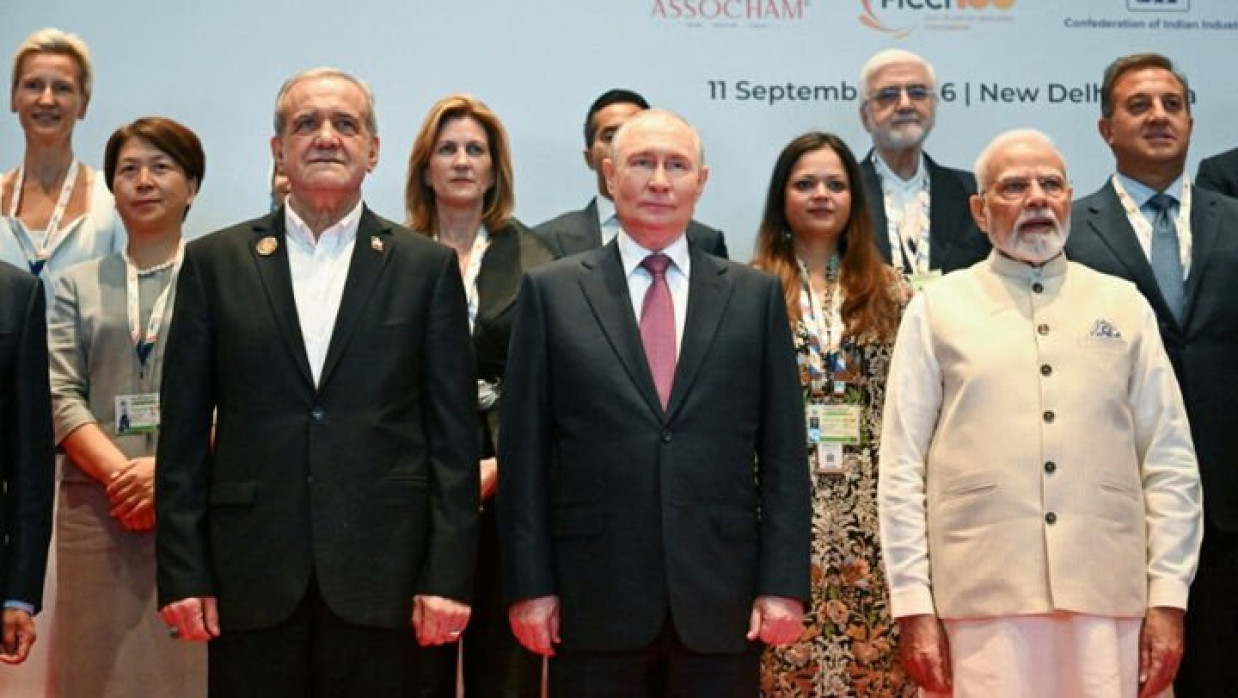
BRICS turned twenty this year, marking the anniversary with its longest communiqué to date. The 18th BRICS Summit, held on 12-13 September at New Delhi under the theme “Building for Resilience, Innovation, Cooperation and Sustainability,” concluded with the unanimous adoption of a 140-point New Delhi Declaration. The document reflects the breadth of issues now covered by the BRICS agenda, ranging from global governance and development to technology, climate change, and international security. However, the length of the declaration alone does not necessarily indicate substantive progress. A more pertinent question is what India’s fourth chairship of the bloc achieved in terms of advancing cooperation, building consensus among its increasingly diverse membership, and translating stated priorities into concrete initiatives.
On primary challenge facing BRICS in contemporary geopolitical environment is to build consensus amongst actors with divergent interests. With its expansion to include Iran, Egypt, Ethiopia, Indonesia, and the UAE, the demographic, economic and geopolitical weight of this bloc has increased. Multiple actors mean divergent interests and policy preferences which makes it difficult to reach consensus on diverse issues especially given active geopolitical conflicts. This is especially notable given the current geopolitical environment, where conflicts such as Russia-Ukraine, Gaza, and the wider Middle East have proven that consensus among member states is often out of reach. One such example is the issue of language over Gaza negotiations where there was disagreement between Iran and United Arab Emirates. Another example was the issue of Russia-Ukraine war where the final declaration stressed the resolution of this conflict through dialogue without attributing responsibility to any single party. Such carefully calibrated language enabled the membership to maintain a common position despite significant differences in their respective approaches to the conflict.
Although building consensus to produce a joint declaration is significant, but preservation of consensus should be differentiated from producing actual policy outcomes. The problem of producing substantive policy outcome has lingered with this bloc for many years and this issue is getting bigger with its expansion. Therefore, it is equally important to analyze whether this diplomatic process of building consensus will be translated into concrete institutional initiatives, policy coordination, or measurable advances in the bloc’s stated objectives.
The declaration adopted in this years’ summit outlined provisions regarding the economic and financial issues which is consistent with BRICS overall agenda of consideration for new economic order against liberal order. Several BRICS members, including Russia, China, and India, have recently found themselves on the receiving end of tariffs making it a shared pressure point that has arguably given the bloc’s trade language added weight this year. The declaration expressed concern over unilateral tariff and non-tariff measures that are inconsistent with World Trade Organization (WTO) rules, as well as unilateral economic and secondary sanctions. It also calls for greater cooperation among members in addressing disruptions to global trade and supply chains. It also called for a reform in WTO to make it more representative and effective multilateral institution equally serving the interests of developing countries. These positions reflect the bloc’s broader interest in increasing the representation of emerging and developing economies within existing global economic institutions.
The question of de-dollarization and alternative economic order was catered very cautiously. Although states within this bloc support bilateral trade done via national currencies but it didn’t endorse a common BRICS currency or explicitly frame these measures as a programme of de-dollarization. Taken together, the economic agenda therefore appears to combine efforts to strengthen the role of BRICS members within existing multilateral institutions with gradual initiatives aimed at increasing their financial and economic autonomy. Beyond trade, the declaration backed India and Brazil for expanded roles at the UN, continuing a now-standard BRICS call for Security Council reform that reflects contemporary geopolitical and economic realities rather than the 1945 settlement. It also flagged the absence of a woman from the UN’s top post and called for greater representation in selecting the next Secretary-General: a modest but notable addition to the bloc’s institutional-reform agenda.
The fairest reading of the 18th Summit is neither the triumphalist one nor the dismissive one. BRICS did not, this year, remake global governance, de-dollarize trade, or resolve the conflicts simmering among its own members. What it did was hold together ten states with real disagreements produced a unanimous, wide-ranging declaration that advances the bloc’s economic agenda in concrete terms while carefully avoiding the fractures that could have split it apart. As one regional analyst put it, members invested in the grouping’s success would be reasonably satisfied with a modest outcome.
For a twenty-year-old coalition built on shared grievance rather than shared doctrine, modest and unified may be the more honest measure of achievement than transformative and divided. The bloc has long manufactured consensus by retreating into vagueness wherever specificity would force a member to pick a side, and this summit did little to break that pattern. The declaration’s language on Ukraine calls for “dialogue” without assigning responsibility, reflecting an agreement to disagree quietly rather than any shared position. The same held for Gaza and the wider Middle East, where India’s efforts to bridge the UAE and Iran produced text broad enough for both to sign but too thin to commit either too much. Expansion has arguably compounded the problem: with Iran, Egypt, Ethiopia, Indonesia, and the UAE now at the table alongside the founding five, BRICS spans a wider range of strategic interests than ever before, and the lowest-common-denominator diplomacy on display looks less like an exception than the bloc’s emerging default.
Source: https://southasiajournal.net/post/india/61759/what-the-18th-brics-summit-actually-achieved