Concerns about Bangladesh’s export competitiveness stoke up as the local-currency taka gets overvalued by nearly 6.5 per cent against its benchmark level in exchange with peer currencies and makes products costlier.
According to latest data, the real effective exchange rate (REER) of the currency rose to 106.29 in September, indicating that the taka was overvalued by nearly 6.5 per cent.
The elevated REER suggests that the local currency has become relatively expensive against the currencies of Bangladesh’s major trading partners, potentially making Bangladeshi goods less competitive on the international market.
The increase has largely been driven by persistently higher inflation in Bangladesh than in its trading-partner economies which has pushed up the relative price of locally produced goods.
The September reading indicates that the local currency would need to depreciate to restore external competitiveness, economists and central bank officials have said.
However, instead of allowing the currency to weaken in line with the REER movement, Bangladesh Bank has maintained an exchange rate that has kept the taka relatively strong against the US dollar.
The dollar-taka exchange rate stood at Tk 121.87 in September, while the indicative bilateral rate consistent with the REER benchmark was Tk 123.03, suggesting a gap between the prevailing and indicative exchange rates.
REER measures a currency’s value against a weighted basket of currencies of major trading partners, adjusted for differences in inflation.
It is widely used by central banks to assess a country’s external price competitiveness.
An index value of 100 represents the benchmark level. A reading above this mark generally indicates that a currency is relatively overvalued, while a reading below 100 suggests undervaluation.
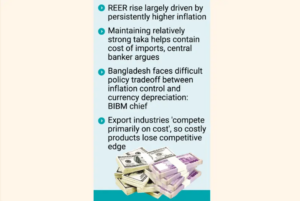
The central bank officials argued that maintaining a relatively strong taka helps contain the domestic cost of imports.
Since import payments are settled in foreign currencies, a depreciation of the taka would require importers to spend more local currency to purchase the same amount of dollars, increasing the cost of imported goods.
“If we depreciate the taka in line with the REER, we will have to pay more in local currency for imported goods,” a Bangladesh Bank official told the FE, requesting anonymity, about the virtues of managed exchange rate.
But economists warn that keeping the currency relatively strong for an extended period could undermine export competitiveness and affect foreign-exchange earnings as well as the remittance inflows.
“In my view, higher inflation is the principal reason behind the increase in the REER,” said Dr Md. Ezazul Islam, director-general of the Bangladesh Institute of Bank Management (BIBM).
He said a persistently high REER would adversely affect exports by making Bangladeshi products relatively more expensive in overseas markets.
The longer-term implications could also extend to remittance inflows if an overvalued taka reduces the incentives for expatriate Bangladeshis to send money through formal banking channels, he added.
Bangladesh faces a difficult policy tradeoff between bringing inflation under control and allowing further depreciation of the taka to restore external competitiveness, Dr Islam said about the quandary.
A persistently elevated REER can erode the price advantage of domestic producers in international markets, particularly in export-oriented industries that compete primarily on cost.
The central bank calculates the REER using a basket of 17 currencies, with fiscal year 2023-24 serving as the base year, when the index was assigned a value of 100.
The calculation incorporates Bangladesh’s trade and remittance relationships with its major trading partners, adjusting the nominal exchange rate for relative inflation movements.
Source: https://thefinancialexpress.com.bd/economy/concern-about-bangladesh-losing-export-competitiveness