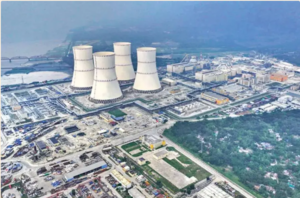
Bangladesh has cleared a major hurdle in commissioning its first nuclear power plant, with the country’s nuclear regulator granting approval for the ‘first criticality’ process for Unit 1 of the 2,400 MW Rooppur Nuclear Power Plant (RNPP).
“We have issued the approval named – B2 – for Unit-1 to move forward in the second stage of rigorous scrutiny before initiation of its commercial operation,” BAERA Chairman Mahmudul Hasan told The Financial Express on Thursday.
The Unit-1 will have to attain two more certifications, namely C and D, before initiating commercial operation, said the BAERA chief without elaborating.
The B2 certification marks a significant step toward bringing the country’s maiden nuclear power facility into operation.
First criticality is the stage at which a reactor achieves a self-sustaining nuclear chain reaction for the first time, a prerequisite for commercial power generation.
Project officials said the approval had been delayed due to technical complications involving the reactor’s pilot-operated relief and safety valves, a critical component of the plant’s safety systems.
Russian experts were brought in to resolve the issue, and the system subsequently passed a series of tests, clearing the way for regulatory authorisation.
With the latest approval in place, officials expect the reactor to begin supplying electricity to the national grid on a trial basis by the end of December.
According to project sources, first criticality has long been regarded as one of the most challenging milestones for the Rooppur project. During this phase, the reactor will transition from a static installation into an operational nuclear facility through the initiation of a stable and self-sustaining nuclear chain reaction.
As part of the physical start-up process, the reactor will initially be operated at less than one percent of its designed thermal capacity. Engineers and regulators will closely monitor and verify key reactor parameters, safety systems, control equipment and operational performance during the first criticality stage.
The entire physical start-up process, including initial criticality, is expected to take between 30 and 40 days. If test results prove satisfactory, reactor power will be gradually increased in successive stages.
Following completion of the physical start-up phase, the project will enter the power start-up stage, during which reactor output will be increased progressively, turbine synchronisation will be carried out, and the generator will ultimately be connected to the national grid.
Before entering this stage, the operating organisation must obtain a trial operational licence from BAERA.
Officials noted that the power start-up phase involves significant technical and organisational challenges, requiring seamless coordination among the reactor, turbine and safety systems, as well as strict regulatory oversight and cooperation with external agencies.
Electricity generation would initially begin at around three percent capacity before being gradually raised to between 20 and 30 percent, at which point power can be supplied to the national grid.
Trial generation is expected to continue for seven to eight months after the reactor begins producing electricity.
Once Rooppur starts supplying power to the grid, Bangladesh will become the world’s 33rd nuclear power-producing nation, opening a new chapter in the country’s energy security and technological advancement.
The long-awaited achievement is also expected to strengthen Bangladesh’s efforts to diversify its energy mix and ensure a more stable long-term electricity supply.
Source: https://thefinancialexpress.com.bd/trade/baera-clears-first-criticality-for-rooppur-unit-1