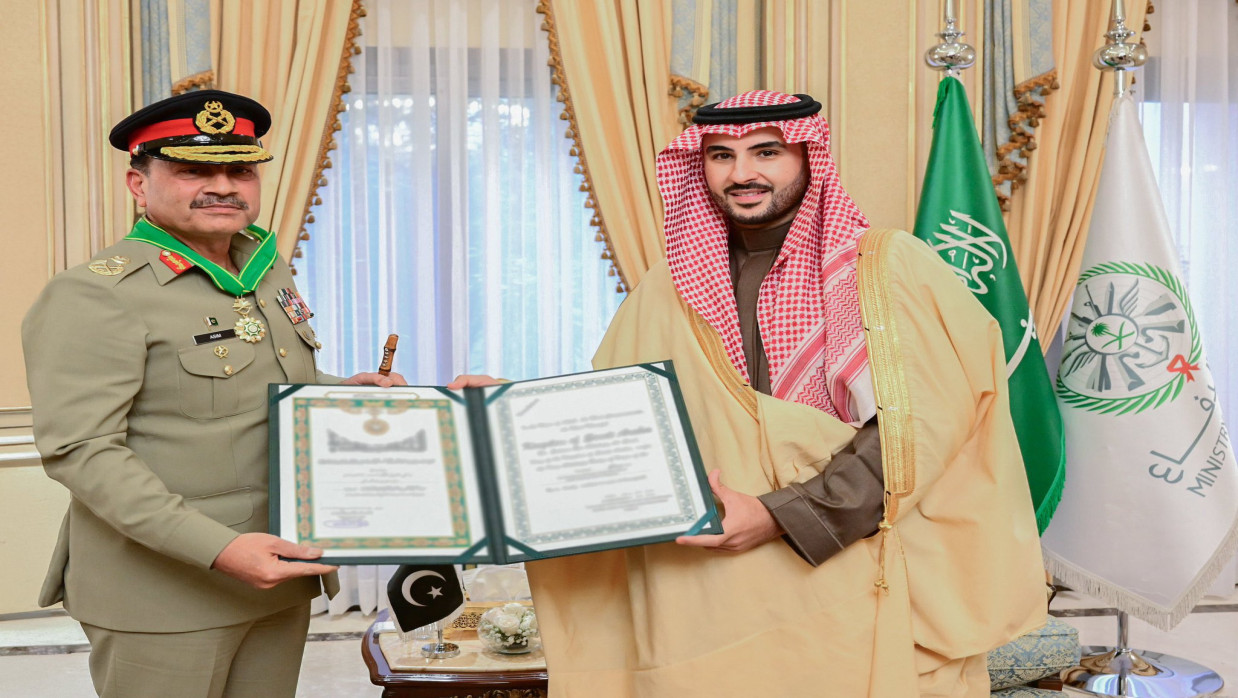
History remembers generals for the wars they fought. It occasionally remembers those who understood war well enough to help stop one. For Pakistan’s Field Marshal Asim Munir, however, the diplomatic test has become considerably harder in just the past week. On August 6, Iranian Foreign Minister Abbas Araqchi spoke with Munir as Tehran pressed regional governments to persuade U.S. President Donald Trump to step back from renewed military strikes. On August 7, Pakistan joined Saudi Arabia and Türkiye in the Makkah Joint Defence Agreement, under which an armed attack on one is to be treated as an attack on all three. Then, on August 10, Iran publicly said it saw no reason to believe the new pact was directed against Tehran.
That three-day sequence captures the paradox now at the heart of Pakistan’s role. Islamabad is trying to remain a bridge between Washington and Tehran while simultaneously becoming part of a more explicit regional security architecture. Munir sits at the center of both tracks. His value is no longer measured simply by who takes his call. It will be measured by whether Pakistan can turn overlapping—and sometimes contradictory—relationships into a process that lowers the risk of another escalation.
A mediator that is not neutral
Pakistan’s usefulness has never come from textbook neutrality. It has close security ties with Saudi Arabia, a recovering strategic relationship with the United States, an all-weather partnership with China, and a long border and working relationship with Iran. The advantage is not distance from the parties; it is access to them.
There is historical precedent for this kind of diplomacy. In the early 1970s, President General Yahya Khan quietly transmitted messages between Washington and Beijing, helping create the channel that led to Henry Kissinger’s secret trip to China and eventually Richard Nixon’s 1972 visit. Elsewhere, military figures have played important roles in peace processes when security guarantees, armed actors and implementation mattered as much as political language—from General Lazarus Sumbeiywo in Sudan to General John de Chastelain in Northern Ireland.
The lesson is not that generals are better diplomats. It is that a senior military figure can sometimes communicate with security establishments in a register civilian diplomacy struggles to reach. But that advantage works only when the uniform is embedded in a wider diplomatic structure. Personal access can open a door; institutions have to keep it open.
Pakistan and Qatar demonstrated that access in June when they helped broker the Islamabad Memorandum of Understanding between the United States and Iran. The agreement created a framework for a cessation of hostilities and a negotiating window. It did not become a durable settlement. The arrangement later frayed amid allegations of violations, sanctions disputes, the blockade of Iranian ports and renewed confrontation in and around the Strait of Hormuz.
The latest developments make the limitation even clearer. On August 9, Araqchi said Iran and the United States were not in formal talks and that Tehran would not begin them while Washington, in Iran’s view, continued to breach the interim agreement. He did, however, confirm that messages were still being exchanged through intermediaries. At the same time, Iran and Oman were nearing an arrangement on new shipping lanes through the Strait of Hormuz, although Tehran said that maritime agreement alone would not reopen the strait.
This is important for Pakistan because it changes what successful mediation should look like. Islamabad does not need to control every file. Pakistan’s Foreign Office has now said openly that different countries may take the lead on different issues: Oman on the Hormuz standoff, Pakistan and Qatar on the longer political process, and other regional states on specific security concerns. That is not evidence that Pakistan has been sidelined. It is what a workable mediation architecture looks like when the crisis is too complex for any single capital to manage.
Why Munir still matters
Munir’s strongest asset remains operational access at moments of maximum pressure. During an earlier push to stop renewed fighting, he was in direct contact with Trump shortly before a breakthrough was announced. This month, Araqchi again used the channel to the Pakistani army chief while Iran was warning regional states of the consequences of fresh U.S. attacks and simultaneously urging them to steer Washington back toward diplomacy.
That two-way access matters because the conflict is no longer only a diplomatic dispute about sanctions and nuclear limits. It is a security contest involving missiles, maritime coercion, U.S. deployments, Gulf infrastructure, Iranian partners and armed groups across the region. The people who can spoil an agreement are often the same people who must enforce one.
Iran’s decision on August 10 to appoint former Revolutionary Guards commander Mohsen Rezaei as secretary of the Supreme National Security Council reinforces that reality. It is too early to say whether the personnel change signals a shift in policy. But the council coordinates Iran’s security and foreign policy, and Rezaei’s background underlines how central the security establishment will remain to any eventual settlement. This is where Munir’s military credentials may be genuinely useful: not as a substitute for diplomacy, but in translating ideas such as deterrence, verification, command responsibility and de-confliction into terms security institutions take seriously.
The danger is personalization. If the process becomes identified with one field marshal, one prime minister or one foreign minister, it becomes vulnerable to domestic politics, institutional rivalry and leadership change. Pakistan’s own Foreign Office has wisely described the peace effort as coordinated teamwork. The fourth Pakistan–U.S. Counterterrorism Dialogue in Washington on August 5 also showed that the bilateral relationship has institutional channels beyond leader-to-leader chemistry. A peace process built on a phone book is fragile; one built on institutions can survive a bad week.
The Makkah contradiction
The Makkah Joint Defence Agreement is the development that most changes the original question about Munir’s peacemaking role. Pakistan, Saudi Arabia and Türkiye have now committed that an armed attack on one will be treated as an attack on all. Pakistan says the pact is defensive, is not directed against any country and is intended to strengthen collective deterrence. The Foreign Office has also credited Prime Minister Shehbaz Sharif, Munir and Pakistan’s diplomatic machinery with playing pivotal roles in bringing the agreement together.
For mediation, that creates both leverage and risk. The leverage is that Pakistan can now speak to Saudi Arabia and Türkiye not merely as a friendly outsider but as a security partner with shared stakes in preventing attacks and keeping escalation under control. A credible defence guarantee could, in theory, reduce incentives for unilateral retaliation by reassuring partners that they are not alone.
The risk is more obvious. If Iran or an Iran-aligned actor launches an attack that Riyadh or Ankara treats as triggering the pact, Pakistan could face pressure to act militarily against a state it is simultaneously trying to bring back to negotiations. Conversely, if Islamabad appears unwilling to honor the security commitment for fear of losing access to Tehran, the pact itself will lose credibility.
Iran’s response on August 10 gives Pakistan diplomatic room. Tehran said it saw no reason to fear the pact and framed greater regional self-reliance in security as potentially positive, provided arrangements are inclusive and reflect regional realities. That should not be read as a permanent blank cheque. It is better understood as an opening Pakistan must protect.
The principle Pakistan now has to demonstrate is simple: a mediator does not have to be neutral, but it has to be predictable. Tehran must believe that Pakistan’s defence commitments will not become a platform for offensive action against Iran. Riyadh and Ankara must believe that Pakistan’s relationship with Tehran will not dilute its obligations to them. Washington must believe Islamabad can transmit messages without becoming an advocate for Iranian maximalism. That is a much harder balancing act than merely hosting talks.
From access to architecture
Pakistan should therefore resist chasing one grand bargain covering the nuclear issue, sanctions, Hormuz, regional armed groups, Gulf security and every unresolved grievance at once. The June experience showed how quickly an ambitious framework can buckle when there is insufficient trust and weak enforcement.
A more durable approach would be staged. First, freeze the immediate escalation: no new strikes on national infrastructure, no attacks on commercial shipping, and no use of neighboring territory to widen the war. Second, lock in a practical maritime arrangement for Hormuz, with clear rules for transit and an incident-management mechanism. Third, return the parties to the Islamabad MoU framework for technical talks, with written procedures for handling alleged violations rather than allowing every incident to collapse the entire process. Only after those foundations hold should negotiations move to the hardest questions of sanctions relief, nuclear limits and long-term regional security guarantees.
This is also where Pakistan should welcome, rather than compete with, Oman and Qatar. Oman has geographic and diplomatic advantages on Hormuz. Qatar has its own channels in Washington and across the region. Saudi Arabia and Türkiye now have direct security stakes through the Makkah pact. China has encouraged renewed diplomacy and has strong interests in regional energy stability. A division of labour gives any agreement more anchors and makes it harder for one bilateral rupture to destroy the whole process.
Pakistan should also be careful not to monetize the mediation too visibly. Islamabad has legitimate economic interests in regional peace: energy prices, remittances, trade routes and currency stability all suffer when the Gulf is at war. But if diplomatic access appears to be converted into financial concessions, the country’s credibility can quickly erode. A mediator can have interests; it cannot afford to look as though peace itself is a transaction.
Can Munir become a peacemaker?
The answer is more conditional now than it was a week ago. Munir cannot be called a historic peacemaker because he has access, receives praise or helps produce another communiqué. That label would have to be earned by outcomes that survive the next missile strike, the next maritime incident and the next political reversal in Washington or Tehran.
If Pakistan helps restore a sustained ceasefire, protects commercial shipping, supports credible monitoring, keeps Gulf states out of a wider war and creates a negotiating mechanism that survives violations, Munir will deserve a place in the story. But the credit would necessarily be shared with Shehbaz Sharif, Pakistan’s diplomats, Oman, Qatar, Saudi Arabia, Türkiye, China—and above all with American and Iranian leaders willing to accept and enforce compromise.
The more interesting question is no longer whether a general can make peace. It is whether Pakistan can make its contradictions useful rather than combustible. It now sits inside a mutual-defence pact with two major regional powers while still receiving calls from Tehran and maintaining access in Washington. Iran’s public acceptance of the Makkah pact, for now, suggests that bridge has not collapsed.
Keeping it standing will be the real test. History is not generous with the title of peacemaker. It does not award it to the person with the best access or the strongest public relations. It awards it to those who build a channel strong enough to survive the moment when every side has a reason to walk away.
Mansoor Qaisar is a communications specialist and freelance writer based in Islamabad, writing on foreign policy, public policy and social issues shaping Pakistan and the wider region. He can be reached at mansoor.qaisar@gmail.com

Mansoor Qaisar
Mansoor Qaisar, Pakistan-based writer and media professional
Source: https://southasiajournal.net/post/pakistan/61593/when-diplomacy-wears-a-uniform-asim-munirs-harder-test-after-the-makkah-defence-pact