The Daily Star
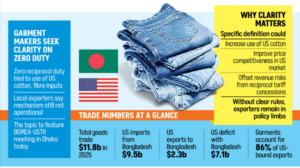
Bangladeshi garment exporters will today ask visiting US trade officials in Dhaka to clarify how a promised zero reciprocal tariff will apply to apparel made with American cotton and other US textile inputs.
The provision is included in the US-Bangladesh Agreement on Reciprocal Trade signed in February this year, but exporters say they have yet to benefit from it.
“We will raise this issue with the USTR high-ups in the meeting tomorrow [Tuesday],” said Mahmud Hasan Khan, president of the Bangladesh Garment Manufacturers and Exporters Association (BGMEA).
A delegation from the Office of the United States Trade Representative (USTR), led by Assistant US Trade Representative for South and Central Asia Brendan Lynch, will visit Dhaka from May 5 to May 7.
In a statement issued ahead of the visit, the US Embassy in Dhaka said the United States looks forward to partnering on the implementation of the reciprocal trade agreement. The delegation is expected to discuss ways to strengthen trade and investment ties.
Under Article 5.3 of the reciprocal trade agreement, the United States commits to establishing a mechanism allowing certain textile and apparel goods from Bangladesh to enter the American market at a zero reciprocal tariff rate.
The deal says that a to be specified volume of apparel and textile imports from Bangladesh may qualify for the reduced rate. That volume will be determined in relation to the quantity of US-produced cotton and man-made fibre textile inputs exported to Bangladesh.
However, BGMEA President Khan said Bangladesh is not currently enjoying the benefits in the US market.
He said the zero-duty facility would be the main agenda at the scheduled meeting between the visiting officials and BGMEA leaders in Dhaka.
A senior commerce ministry official said the USTR delegation will also meet Commerce Minister Khandakar Abdul Muktadir at the secretariat today. Discussions are expected to cover the reciprocal trade deal, broader bilateral trade matters, labour rights and intellectual property.
The USTR is currently conducting two investigations covering 60 countries, including Bangladesh. One is about forced labour in industrial units, while the other relates to industrial overcapacity that could hurt the US manufacturers.
In a position paper submitted to the commerce ministry recently, BGMEA said the Bangladesh garment industry does not have overproduction capacity that could harm the American manufacturing sector and is free from forced labour, as exporters comply with internationally recognised labour laws.
The association said that in a market-driven economy, production levels constantly adjust to shifts in demand, input costs and supply chain conditions. Determining “excess capacity” without clear parameters or methodology is a major challenge.
According to USTR data, US goods trade with Bangladesh totalled an estimated $11.8 billion in 2025. US imports from Bangladesh stood at $9.5 billion, up 13.3 percent from 2024, while US exports to Bangladesh were $2.3 billion, up 1.4 percent.
The US goods trade deficit with Bangladesh was $7.1 billion in 2025, a 17.9 percent increase from the previous year.
Garments account for 86 percent of Bangladesh’s exports to the United States.
In its position paper, BGMEA said the Bangladesh apparel sector has not expanded suddenly or in a way that would indicate structural excess capacity. The industry growth should be viewed over the long term.
Over the past decade, the sector has followed a steady growth path, it said, driven by global demand and shifting sourcing strategies rather than policy-induced expansion.
After more than four decades of development, Bangladesh exported garment products worth $39.3 billion in fiscal year 2024-25, accounting for nearly 7 percent of the global apparel market. It is now the world’s second-largest garment exporter after China.
In 2025, Bangladesh accounted for 10.73 percent of US apparel imports by volume and 10.53 percent by value, according to the American Apparel and Footwear Association (AAFA).
This week, a separate USTR report said Bangladesh has stayed off the latest US intellectual property rights watch lists. However, Washington urged Dhaka to strengthen enforcement to prevent unfair trade practices.
In its annual Special 301 Report, the USTR identified 26 trading partners with concerns over intellectual property protection and enforcement.
Source: https://www.thedailystar.net/business/economy/news/apparel-makers-seek-clarity-us-cotton-tariff-deal-4167686