
The Jamaat-e-Islami-led 11-Party Alliance will jointly pursue a dual strategy — acting as an opposition in parliament and in street protests — while seeking legal redress over alleged irregularities in the 13th parliamentary election, the coalition said yesterday.
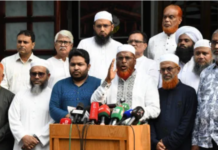
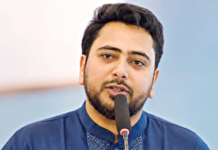
Jamaat Assistant Secretary General Hamidur Rahman Azad announced the decisions at a briefing at the party’s central office in Moghbazar, Dhaka, following a meeting of the alliance’s liaison committee.
The alliance would act as a constructive opposition in parliament, but if lawful avenues are blocked, the option of taking to the streets would remain open, he said.
“It was decided that our electoral alliance will act jointly both inside and outside parliament. Since we contested the election together, we will also perform our parliamentary role jointly,” he said, adding that the alliance would take unified decisions in line with the country’s political context and act in the interest of the nation and the public.
Alleging “election engineering” and result manipulation, Azad said several seats were lost by narrow margins or recorded questionable victory gaps. Although applications seeking recounts were filed in those constituencies, many candidates could not complete the process as the gazette was published late at night on Friday, he claimed.
According to him, assistant returning officers advised candidates to approach the Election Commission, but when they did so, their applications were rejected on the grounds that the gazette had already been published, effectively depriving them of their rights.
With the gazette now in place, Azad said the only remaining option was to seek remedy through election tribunals, and if necessary, to file writ petitions with the High Court.
He also said that as the “Yes” vote prevailed in the July charter referendum, the provision for nominating 100 upper house members based on proportional votes is now in effect. According to him, the people have rejected the scope for a “note of dissent”, making proportional representation by popular vote mandatory in forming the upper house. During the July charter reform discussions, the BNP had argued that the upper house should be formed based on the proportion of seats won, not total votes.
Addressing the BNP, which secured a parliamentary majority, Azad said the party now bears greater responsibility and should act accordingly.
Referring to post-election violence, he warned that the alliance would be compelled to announce political programmes if such incidents continue. A draft of possible programmes has already been prepared and will be finalised after consultations at the highest level.
Azad also claimed that in some constituencies the number of “No” votes in the referendum was unusually high. He added that detailed allegations of irregularities, including claims of manipulation in 30 seats, would be placed before the Election Commission at a meeting today.
At a press conference earlier in the day, the Jamaat demanded recounts in the 30 constituencies, alleging “fraud”.
The constituencies are Dhaka-7, 8, 10, 13 and 17; Panchagarh-1; Thakurgaon-2; Dinajpur-3 and 5; Lalmonirhat-1 and 2; Gaibandha-4; Bogura-3; Sirajganj-1; Jashore-1; Khulna-3 and 5; Barguna-1 and 2; Jhalakathi-1; Pirojpur-2; Mymensingh-1, 4 and 10; Kishoreganj-3; Gopalganj-2; Brahmanbaria-5; Chandpur-4; Chattogram-14; and Cox’s Bazar-4.
A recount, the party claimed, would change the results in many of these seats.
JAMAAT ACCEPTS OUTCOME
Earlier in the day, Jamaat Ameer Shafiqur Rahman said his party recognises the overall outcome of the election and will serve as a “vigilant, principled, and peaceful opposition” in parliament.
In a post on his verified Facebook page, Shafiqur said Jamaat remained committed to a stable and functioning democratic order and would respect the rule of law.
“In any genuine democratic journey, the true test of leadership is not only how we campaign, but how we respond to the verdict of the people,” he wrote. “We recognise the overall outcome, and we respect the rule of law.”
Highlighting the party’s performance, he said Jamaat secured 77 seats, nearly quadrupling its parliamentary presence and emerging as one of the strongest opposition blocs in contemporary Bangladeshi politics.
“That is not a setback. That is a foundation,” he said, describing the result as a base for future political growth.
He thanked party activists and volunteers who, he said, worked tirelessly during the campaign, noting that some faced intimidation and harassment for exercising their democratic rights. Their “courage”, he added, “has strengthened our democracy”.
In a separate post, Shafiqur condemned incidents of violence allegedly targeting Jamaat supporters and other political activists after the polls, warning the incoming government that the people’s mandate is “not a licence” but a conditional trust.
“The core conditions of that trust are maintaining law and order, ensuring equal protection for all, and guaranteeing the safety of every citizen regardless of political identity.”
At the briefing in the afternoon, Jamaat Assistant Secretary General and head of its central publicity department Ahsanul Mahboob Zubair demanded that oath-taking of the declared winners in those constituencies be suspended until the recounts are completed.
According to Zubair, the results were “deliberately altered to defeat the candidates of Jamaat and the 11-party alliance”. He further alleged that a section of officials from the administration and the Election Commission were involved in the “fraud”, adding that Jamaat is taking legal steps over the issue.
After the briefing, in a post published at 6:24pm on Jamaat’s official Facebook page, Shafiqur wrote, “The BNP alliance has secured a majority of seats. We recognise this result and respect the constitutional process. However, the national vote outcome also reflects a deeper and more complex reality.”
The post was taken down within seven minutes, but by then had already been shared more than a hundred times and drawn over a hundred comments.