Dr. Zahid Sultan and Anusreeta Dutta
There is a peculiar amnesia that settles over a state when it forgets the terms of its own founding. For India, freedom was not given; it was argued, marched, fasted, and suffered into being. The vocabulary of that founding- satyagraha, ahimsa, the conviction that unearned suffering could itself be a form of political speech is not a decoration on our constitutional preamble. It is the preamble’s grammar. Which is what makes the scenes from Jantar Mantar this July so difficult to file away as routine law-and-order management, and so necessary to examine as something closer to a civilisational relapse.
The Proximate Cause
It is worth being precise about what actually happened, because precision is the first casualty of both government denial and protest romanticism.
In May 2026, the National Testing Agency was forced to cancel the results of the NEET-UG examination – the gateway test that roughly two million aspiring doctors sit every year, after credible allegations surfaced of a leaked question paper and a circulating “guess paper” that reportedly matched the actual questions. This was not the first such episode. NEET has been dogged by leak allegations in successive cycles, and the education ministry’s own language over those years traces an arc from denial to concession: no corruption, no proof of leak; then an “isolated” incident in a couple of centres; then, finally, in 2026, Education Minister Dharmendra Pradhan’s admission that the agency had suffered an outright “institutional failure.” The exam was ordered re-conducted. Local reporting linked the resulting stress and uncertainty to a number of student suicides. For a cohort that had already been re-tested once in recent years over grace-mark irregularities, this was not an abstract grievance about testing methodology. It was, for many families, a second bereavement layered on top of a first.
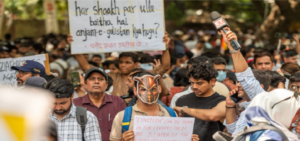
Out of this grievance grew a protest movement with an unlikely name: the Cockroach Janta Party, founded in May 2026 by digital strategist Abhijeet Dipke as a satirical jab, an allusion to a remark by the Chief Justice of India comparing unemployed, socially-mediated youth to cockroaches. What began as internet mockery hardened, over the following weeks, into a genuine sit-in at Jantar Mantar, the designated protest ground a few hundred metres from Parliament. On 28 June, the Ladakhi education reformer Sonam Wangchuk, a man with no history of insurrectionary politics, known chiefly for pedagogical innovation, joined the site and began an indefinite hunger strike. He was shortly joined by doctoral students from the All India Students Association. The demands were specific and modest by the standards of Indian protest politics: Pradhan’s resignation, structural reform of the examination system, and roughly one crore rupees in compensation for the families of NEET aspirants who had died by suicide.
The State’s Answer
The state’s response unfolded in two registers, and the gap between them is itself instructive.
The first register was procedural. Delhi’s New Delhi district has stood under a standing prohibitory order , Section 163 of the Bharatiya Nagarik Suraksha Sanhita, the successor to the old Section 144 of the Criminal Procedure Code , restricting any assembly of five or more people outside the designated Jantar Mantar site without prior permission. With the Monsoon Session of Parliament opening on 20 July, the police cited the compounded burden of protectee security and public order to justify barricading, an internet shutdown, and the suspension of metro services in the area. This is not, on its face, an unreasonable regulatory posture for any capital city hosting its legislature. Democracies routinely draw lines around the time, place, and manner of assembly, and no serious civil-libertarian argument holds that a government must simply absorb an unpermitted march on its Parliament as a matter of course.
The second register was physical, and it is here that the procedural justification comes under real strain. On 18 July, citing a Delhi High Court order and medical advice, authorities removed the visibly frail Wangchuk from the protest site and admitted him to Safdarjung Hospital , an act Dipke described, in language whose hyperbole should not obscure the underlying grievance, as a kidnapping. Wangchuk himself, in a handwritten note issued from his hospital bed, said he would continue his fast until protest leaders were permitted to meet parliamentarians, either at Parliament House or at his bedside. Two days later, on 20 July, more than ten thousand protesters attempted to march toward Parliament after a delegation had met the Union Health Minister to present their demands. They were dispersed with tear gas and what multiple accounts described as a baton charge , the Wire’s reporting spoke of thousands injured, some seriously; other outlets put confirmed injuries above a hundred. Delhi Police, for its part, issued a same-day statement on social media insisting that no such violence or mass detention had occurred, and that the protest was being “handled professionally” – an insistence that sat uneasily beside the video footage already circulating of young protesters being struck and of others pleading with officers not to hit them.
Amnesty International’s subsequent statement did not indulge in polemic; it asked the narrower and more damning legal question is whether the policing met the standard of legality, necessity, and proportionality that both international human-rights law and the Indian Constitution require of any restriction on peaceful assembly. That is exactly the right question, and it is one the procedural justification, however defensible in the abstract, cannot answer once the facts of the hospitalisation and the baton charge are placed beside it.
What Gandhi Actually Argued
It has become fashionable to invoke Gandhi as a kind of national mascot, a face on the currency rather than a mind with an argument. But the argument matters here, and it is more precise than the folk memory of “nonviolent protest” usually allows.
Gandhi’s case for satyagraha was never that suffering is noble in itself, still less that fasting is a form of moral blackmail, as his critics sometimes alleged even in his lifetime. His case was structural: a state’s willingness to visit disproportionate coercion upon those who have deliberately renounced violence is itself a form of confession, legible to the whole watching public, that the state cannot answer the argument being made against it and so must instead answer the body making it. This is why Gandhi insisted on the distinction between satyagraha and mere duragraha, stubborn agitation dressed up as principle and why he was so exacting about discipline within his own movements at Champaran, Bardoli, and on the Salt March to Dandi: the moral force of nonviolent resistance depends entirely on the credibility of its restraint. A hunger strike is not a threat. It is a wager that the state’s cruelty, once made visible, will cost the state more than the protester’s suffering costs the protester. Whatever one thinks of the wisdom of that wager, it is categorically different from the instrument used to answer it. The lathi and the fast are not morally symmetrical. One is a weapon; the other is testimony.
This is where the comparison to the colonial state, however tempting, deserves to be made with some intellectual honesty rather than as easy rhetoric. It would be dishonest and beneath the seriousness this moment demands , to claim that the Raj was some model of restraint. It was not. Jallianwala Bagh was a mass murder dressed as crowd control. The lathi charges that met the Dandi marchers, the mass internments of the Quit India years, the routine humiliation of political prisoners , none of this can be waved away in the service of a tidy comparison, and anyone who tells you the empire was gentler than the republic is not being serious.
What can honestly be said is narrower, and I think more damaging: a colonial administration whose legitimacy rested on naked coercion at least had the excuse of never having claimed Gandhian legitimacy in the first place. It could be violent without being hypocritical. A postcolonial republic that teaches satyagraha in its civics textbooks, that names its metro stations and airports after the men who practiced it, that marks the Dandi March as a national holiday of the spirit, has no such alibi. It cannot claim to be governing badly out of ignorance of what nonviolent resistance means or what an appropriate response to it looks like. It wrote the theory. Removing a hunger-striking reformer to a hospital under court order might be medically defensible; describing the crackdown that followed two days later as “professional handling,” in the face of video evidence and international monitors, is not merely a public-relations failure. It is a category error about what the state itself was founded to be.
The Political Economy of a Crackdown
None of this should tip into romanticising the protest as pure innocence, or pretending that a ten-thousand-strong unpermitted march toward the seat of the legislature, during a live parliamentary session with protectees to secure, raises no legitimate security question. That question is real, and a government that simply waved the march through without any preparation would be failing a different duty. The state’s argument- public order, protectee security, an existing and lawfully promulgated prohibitory order is not frivolous on its face.
But the argument does not survive contact with proportionality, which is the actual legal and moral test, not mere prior authorisation. A protest camp that had stood peacefully at its designated site for the better part of a month is not, by its mere continuation, an emergency requiring hospital removal under police escort. A delegation that has just met a Union Minister to present its demands is not a mob that has forfeited the right to walk toward Parliament without being gassed. Ten thousand people carrying grievances about examination fraud and compensation for suicide victims are not, whatever the standing prohibitory order says, best managed by disabling the metro and the mobile internet of India’s capital. Proportionality asks not whether force was available to the state, but whether the scale of force matched the scale of the threat; on that test, an internet shutdown and a baton charge against students whose stated demand was an audit of an exam paper is not proportionate. It is what a state does when it has concluded that the exhaustion of protesters is cheaper than the accommodation of their argument.
The Cost of Getting This Wrong
What is being tested at Jantar Mantar is not really examination policy, although examination policy – the NTA’s repeated failures, the ministry’s slow arc from denial to admission, the still-unresolved question of who profits from an “education mafia” the minister himself has named, deserves its own reckoning and its own accountability, quite apart from how the protest against it was policed. What is being tested is whether the Indian state still believes that legitimacy is something one earns by persuading citizens, or whether it has quietly concluded that legitimacy is simply what remains once dissent has been made sufficiently exhausting to sustain.
Every baton charge against students who came to fast, not to fight, teaches a generation a lesson no civics textbook intended: that the founding grammar was a story told to children, not a commitment binding on the adults who now hold power. A republic can survive disagreement about examinations, about compensation figures, about whether a minister should resign over an agency’s institutional failure. It cannot indefinitely survive teaching its most idealistic young citizens that the only political vocabulary the state actually respects is the one its own textbooks claim, falsely it now appears, to have already overcome.
Author:
Dr. Zahid Sultan and Anusreeta Dutta
Dr. Zahid Sultan is an independent researcher with a PhD in political science. Anusreeta Dutta is a columnist and political ecology researcher with prior experience as an ESG analyst.