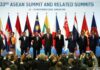
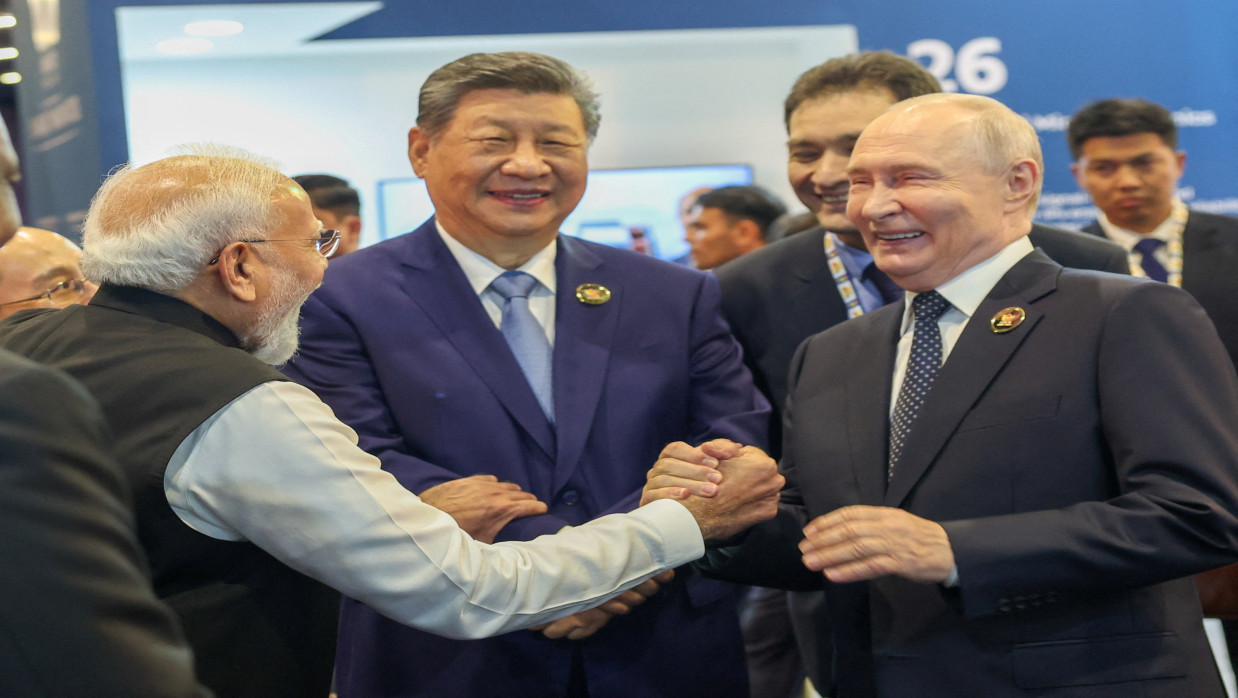
India wants to be a great power. It has over a billion citizens, nuclear weapons, a space program, a blue-water navy, an army of software engineers, diplomats stationed all over the world, and one of the largest economies on Earth. India rhetorically pledges to reemerge as Vishwaguru (teacher of the world), steward of the Global South, or both. At the September 20, 2026 BRICS Summit in New Delhi, which Chinese President Xi attended after almost seven years away from Indian diaspora audiences, India looked very ascendant and on display as a diplomatic epicenter.
But great-power status is not determined by summit photo-ops, GDP rankings, or clever civilizational hashtags. True international greatness is judged by a state’s ability to convert economic riches into military might and technological superiority at home and abroad, social vitality and cohesion, diplomatic influence, and soft power. By these harder measures, India is an important emerging power but not yet a superpower. India remains a-have overtaken its power.
India’s challenge is not that it lacks the prerequisites for great-power status. On paper at least, it has nearly all of them: geography, demography, entrepreneurial talent, a vast home market, scientific minds, democratic credentials, and control over the Indian Ocean’s central corridors. India’s problem is that it has been unable to convert these factors into widespread national power. Poverty, inequality, communal division, poor public services, unstable neighborhoods, and gaps between leaders’ words and institutions’ performance have held India back.
The Trouble with “Large”
India’s economy is approaching the world’s largest in aggregate terms. That is no trivial feat. Economic reforms, the rise of the service economy, infrastructure investment, digitization, generic medicines, space technology, and India’s numerous entrepreneurs have changed the country for the better. India’s economic growth has often outpaced its competitors, and global companies now view India as a key node in supply chains previously too reliant on China.
However, GDP only tells part of the story. It measures the total output of nearly 1.46 billion people. As an average, it tells us little about living standards, distribution, education, health care, sanitation, housing availability, clean water access, or poverty alleviation. GDP per capita adjusts for population, but even that doesn’t capture state capacity. A country can be large and have a big economy and still be poor.
The World Bank placed India’s 2025 GDP at approximately $3.96 trillion, but GDP per capita was only about $2,703. The International Monetary Fund estimated that the figure would remain around $2,810 in 2026. These numbers place India far below the living standards of developed powers and even below several smaller Asian economies. India’s economy is immense because India itself is immense. Economic mass should not be confused with economic maturity.
Poverty has fallen sharply. Let’s applaud that fact. Define poverty as the bare minimum income needed to survive, and millions of Indians have risen above that line. But define poverty as what should exist in a country that aspires to be upper-middle income, and hundreds of millions are barely able to afford so little that if they fall sick, or their crops fail, or they lose their jobs, or their child needs urgent care, they slip back into poverty. Escaping the official definition of extreme poverty is not escaping vulnerability, fragility, indignity, or a moderately decent life.
You can see this gap between India’s growing economy and India’s anxious households across the country’s major cities. Elite airports and gleaming high-rises. Fast highways and free wifi. Facial recognition payment platforms and tech campuses. Meanwhile, millions of Indians live in slums. They drink contaminated water. They breathe dangerously polluted air. They lack basic sewage facilities. They are stuck in hours-long traffic jams. They work in the informal economy without any safety net. India has built islands of world-class greatness, but inequality surrounds it.
That is not the social foundation of a superpower. A country cannot sustainably project strength abroad when a substantial share of its citizens lacks dependable public services at home.
Growth Without Sufficient Transformation
India’s growth story has been remarkable but hasn’t created enough stable, productive jobs. According to the International Labor Organization, informal jobs still account for an estimated 87 percent of total employment in India. Informal employment is associated with inconsistent wages, few legal rights, low workplace protection, and little to no social security. As such, India’s official unemployment rates only tell us part of the story. Someone may be considered employed while scraping by on intermittent, low-wage, or unproductive work. Youth unemployment can be particularly harmful. India likes to boast about its large population of young people representing a “demographic dividend.” Young people are an asset to a country only when they have access to quality education, relevant skills, healthcare, and productive work. If not, demography can become a source of anger and social unrest.
India also did not manage to develop labor-intensive manufacturing on a Chinese scale. China started by becoming the world’s factory. It used export-led manufacturing to employ tens of millions of workers, build roads and cities, gain technology, and amass capital. China then leveraged this into advanced sectors like electric vehicles, batteries, solar panels, telecoms, robotics, high-speed rail, and artificial intelligence.
India churned out world-class services and some of the finest scientists, engineers, doctors, and executives. What it did not build was a similarly robust manufacturing base. India’s top private companies and most successful citizens are indeed national assets. But top-tier excellence cannot make up for sub-par elementary education, public healthcare, city infrastructure, farm yields, and wage employment for all.
Aggregate GDP numbers aren’t therefore wrong; they’re just incomplete. GDP itself does not capture dignity, or security, or equality, or quality of governance, or national cohesion. Whatever satisfaction BJP may take in hitting the $5 trillion target will seem hollow if the everyday Indian citizen doesn’t feel it in their child’s school, their government hospital, their office, their community.
Shared Leadership
A regional power with real substance allows others to view cooperation with it as a rewarding, reliable and reasonably risk-free proposition. India has frequently failed to offer that assurance to its neighbors. Not all of New Delhi’s neighborhood is hostile; claiming that all bilateral ties are at rock bottom would be an exaggeration. Delhi shares robust ties with Bhutan, growing economic connections with Sri Lanka, profound historical ties with Bangladesh, and deep security and economic interests with Nepal and the Maldives. India has provided development finance, disaster relief, energy connectivity, and security cooperation to several countries in South Asia
But suspicion of Indian motives has been periodically woven into the domestic politics of several of New Delhi’s neighbors. Given its size, some neighborly anxiety towards India is understandable; but Indian policies have often validated those fears of Indian domination. Political movements in Nepal, Bangladesh, Maldives, and Sri Lanka have at times gained traction by stoking anti-Indian sentiments of bias, interference, or intimidation. While some of these accusations are legitimate, others are magnified, and their continued recurrence indicates a failure of India’s regional diplomacy.
Relations between India and Pakistan have long been locked in hostility and flirted with overt conflict. The dangerous nuclear dimensions of the 2025 India-Pakistan crisis showed how terrorist strikes, cross-border skirmishes, drones, missiles, and nuclear coercion from both sides can trigger an escalatory spiral that eventually gets out of both sides’ hands. Even if India has the conventional advantage, perpetual conflict with another nuclear adversary squanders goodwill and military resources and leaves trade and connectivity in South Asia stagnated.
India’s relationship with China is far more consequential. The Modi-Xi handshake at the 2026 BRICS Summit was celebrated by both governments, showing that neither side wants a long-term crisis. Dialogue, border stabilization, restarting commercial activities, and re-instituting high-level visits are all welcome steps. However, healthy communication will not change the fact that there is a disputed border, hundreds of thousands of military troops along the Himalayas, China continues to build ties with Pakistan, or that trade and the economic relationship are seriously skewed against India.
China’s GDP remains many times that of India, its manufacturing base far deeper, and its military-industrial and technological base far larger. India imports hundreds of billions of dollars worth of machinery, electronic parts, pharmaceutical supplies, solar panels, and other industrial goods from China. If India wishes to push back strategically against China, New Delhi finds its ability to act constrained by its reliance on Chinese imports.
India’s strongest geopolitical asset remains geography. Blessed to be located between Africa, the Middle East and Southeast Asia along critical sea lanes, India has an enormous geographic advantage. India’s participation in QUAD (U.S., Japan, Australia) aims to enhance maritime domain awareness, interoperability of defense forces and platforms, co-development of cutting-edge technology, and promote freedom of navigation in the Indo-Pacific region. Geography, though, isn’t destiny in geopolitics. That geography must be supported by naval strength, industrial might, reliable allies, and diplomatic credibility with countries on its shores.
South Asia itself remains one of the least economically integrated regions in the world. SAARC has been virtually immobilized by India-Pakistan hostility. Trade barriers, poor connectivity, visa restrictions, political suspicion, and bilateral disputes prevent the region from realizing its economic potential. A country aspiring to global leadership should first demonstrate that it can make its immediate neighborhood more connected, stable, and prosperous.
Majoritarianism Weakens National Power
India’s treatment of its minorities is not merely a domestic moral issue. It directly affects national cohesion and international credibility.
India’s greatest historical claim to global respect has been its attempt to maintain democracy and pluralism across an extraordinarily diverse population. Its Constitution promised equal citizenship regardless of religion, caste, language, or ethnicity. That promise distinguished India from states built around a single religious identity. It gave New Delhi diplomatic authority when speaking about decolonization, racial equality, democratic government, and peaceful coexistence.
Indian Muslims have also been targets of political scapegoating, hate speech, “lash-out” campaigns, cow-related violence, forced demolition of homes, citizenship concerns, and being characterized as a community that is culturally suspect or unfaithful enough. Many Christians have alleged mob violence and harassment under state laws against conversion. These charges have been made by Sikhs, Dalits, India’s tribal peoples, journalists, activists, and civil society groups. The US Commission on International Religious Freedom and Human Rights Watch have issued significant reports documenting deteriorating conditions for minorities, critics of government, and civil society.
India’s government has quickly condemned many of these critiques as unfair or as meddling in India’s internal affairs. Outside organizations can get things wrong, hold double standards, or willfully misunderstand context. However, brushing aside all external criticism becomes indefensible when faced with the growing pile of alleged incidents, official inflammatory rhetoric, ongoing detention of activists, crackdowns on organizations, and failure to consistently enforce laws against hate speech.
Nor will India build a great power by making 200 million Muslims feel like they have to prove themselves as citizens every single day. India also will not build national cohesion by tying citizenship status to religious majority politics. Mobilizing a religious or ethnic majority against their minority neighbors might help politicians win votes, but it does not make for stronger democratic institutions or a healthier society.
Prejudice also hurts India’s international standing. India has deep interests in building relationships with Muslim-majority countries in the Gulf, Central Asia, Africa and Southeast Asia. Indian businesses need stable access to energy, markets and investment. India’s economy benefits from over 8 million Indian workers abroad, many in Muslim-majority countries. Domestic anti-Muslim rhetoric only undermines those relationships and gives actual adversaries fodder to challenge India’s democratic pretensions.
China has built power through authoritarian nationalism, but India cannot outcompete China by abandoning the principle that made India different. Its strategic advantage should be a successful, pluralistic democracy, not an imitation of centralized majoritarian rule.
BRICS and the Limits of Symbolic Diplomacy
India flexed its muscles at the New Delhi BRICS Summit but also saw its limitations as a global power. Xi Jinping and Vladimir Putin joined other Global South leaders in New Delhi. BRICS allows New Delhi to demand reform of the international financial architecture, trade with other developing economies, pursue technological collaboration, and resist great-power pressure.
However, BRICS is ultimately a group of countries with very different interests. India and China are rivals. Beijing wants to become the dominant state in the region, if not a first-tier power globally. It envisions an international order with fewer constraints on its behavior. Russia’s economy relies more on China each year, but Moscow also wants to stay close to India. Iran and the United Arab Emirates have their own disagreements. Additional members have made BRICS more representative but also less manageable.
India should avoid assuming that because it sits at so many tables it has proportional influence at each of them. India’s memberships in BRICS, the Quad, the Shanghai Cooperation Organization, and the G20 show that Indian diplomacy can multitask, but prestige ultimately means delivering results. Can India formulate and export peace? Can it provide development capital? Engineer cutting-edge technology? Supply goods without bottlenecks? Keep sea lanes open? Provide humanitarian relief? Lead by example? Are Indian institutions strong enough for other countries to trust them with power?
Good to know that Modi-Xi summits produced results. Talk is better than war, and signaling can prevent war. But photo ops won’t settle the border dispute, decrease India’s economic dependence, or create a stable regional balance. Handshakes can only help reset negative perceptions. They can’t rebuild confidence on their own.
Walking Before Running
India would do well not to give up on its aspiration to stand alongside the United States and China as a leading power in the world. But it might reconsider what it takes to get there. Superpower standing cannot be decreed with slogans or declarations or diplomatic pageantry. It has to be earned through hard work on the fundamentals: decades of sustained domestic development, technological prowess, institutional capacity, social resilience, and broadly distributed prosperity.
Domestic development includes widespread high-quality education. It also includes robust public health infrastructure. It means access to clean water, breathable air, less crime, faster courts, a job for everyone who wants one, competitive industries, higher investment in R&D, and effective city governments. Superpower India must have a state that does what it says it will do. Equally importantly, New Delhi must have the courage to continue protecting constitutional equality, independent institutions, press freedoms, and religious diversity from violent nationalists within its own borders.
India must also work harder to become the leader its neighbors want rather than expect them to lead. Bhutan, Bangladesh, the Maldives, Nepal, and Sri Lanka will follow New Delhi’s lead more willingly when it consults with them, gives them economic benefits, and respects their sovereignty. India should revive connectivity projects, increase bilateral trade, allow legitimate people to travel across borders, and insulate itself from erratic leadership in its neighborhood by building ties with foreign ministries and industry groups instead of relying primarily on high-profile leadership summits.
India is already a great power. Its population, economy, military, and diplomacy can affect events globally. However, being greater than most countries is not enough to be the greatest. Superpowers exude something more. They exude capability. They exude confidence. They have soft power to back up their hard power. They have world-class technology industries. They have stable political systems and leaders other countries want to follow without being told to.
India’s biggest challenge, as such, is not Chinese competition, Pakistani disruptions, Western hostility, or an unjust international order. India’s biggest challenge is the gap between how Indian politicians describe India and what the average Indian experiences every day. Until that gap shrinks, until rising incomes raise standards of living, until India’s democracy sincerely protects every ethnic and religious minority, and until Indian leadership is confident but humble, New Delhi’s claims to superpower status will ring hollow.

Ghulam M. Suhrawardi
Ghulam M. Suhrawardi is the Publisher of South Asia Journal.
Source: https://southasiajournal.net/post/india/61733/the-mirage-of-a-superpower-why-indias-global-ambitions-outrun-its-national-reality