by Abdullah Mohammad Ferdaus Khan, CEng, CMarEng, FIMarEST
The transport sector in Bangladesh has become a central pillar of political commitments. Various political parties have pledged to expand infrastructure, modernize public transport, implement intelligent traffic systems, build metro rail networks, construct expressways, and reduce intercity travel time. These ambitions reflect the nation’s aspiration for modernization and economic growth.
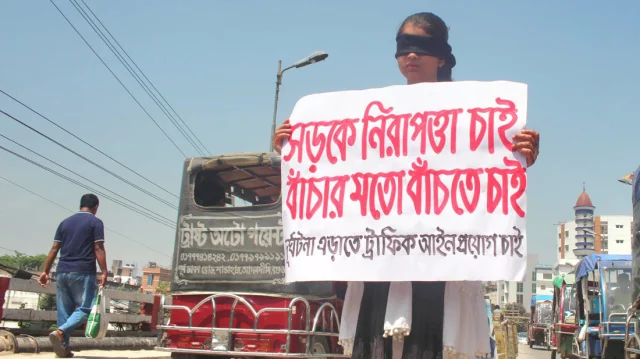
However, a critical question remains: Do these commitments prioritize the protection of human life equally? Development measured solely by speed and infrastructure expansion risks overlooking the most fundamental responsibility of governance — safeguarding citizens’ lives.
Political Commitments and Road Safety Position
Bangladesh Nationalist Party (BNP) has emphasized urban transport development, satellite towns, metro and monorail systems, and strengthening traffic management through Intelligent Transport Systems (ITS) and CCTV. While these initiatives may indirectly support safer traffic management, there is no explicit commitment to reducing road crashes or fatalities.
Bangladesh Jamaat-e-Islami (BJI) has proposed modernization of the transport system to reduce travel time between Dhaka and divisional cities to 2–3 hours, along with improvements in regional connectivity and urban transport. However, there is no direct reference to reducing road accidents or enhancing road safety.
The National Citizen Party (NCP) has pledged to establish integrated public transport under a single authority in Dhaka and Chattogram and to expand freight train services to reduce truck pressure on highways. Yet, there are no direct commitments to nationwide crash reduction.
Gono Odhikar Parishad has explicitly committed to enacting and implementing a separate Road Safety Act to reduce accidents and fatalities, providing a clearer acknowledgment of the crisis.
Although transport development is widely prioritized, reducing road fatalities has not yet become a clearly articulated, measurable political commitment across the board.
The Reality of Road Crashes in Bangladesh
Reference: Road Safety Foundation (Bangladesh), Annual Road Crash Monitoring Reports 2024–2025.
Bangladesh continues to face a severe road safety crisis. In 2024, 6,927 road crashes resulted in 7,294 deaths and 12,019 injuries. In 2025, 7,584 crashes caused 7,359 deaths and 16,476 injuries. Approximately 36% of deaths were motorcycle-related, and pedestrians remain highly vulnerable.
In Dhaka alone in 2025, 409 crashes led to 219 deaths and 511 injuries. Women and children are disproportionately affected. In 2024, 893 women and 1,152 children lost their lives in road crashes.
The economic loss exceeds 21,000 crore BDT annually — more than 1.5% of national GDP — including healthcare costs, productivity losses, and social disruption.
Systemic Causes of Road Crashes
Road crashes stem from unsafe acts, unsafe behaviours, and unsafe conditions. Key driver-related factors include overspeeding, reckless overtaking, fatigue, mobile phone use, substance abuse, inadequate training, and irregular licensing.
Infrastructure-related causes include faulty road design, lack of safety audits, dangerous intersections, inadequate signage, poor lighting, absence of pedestrian facilities, and unplanned speed breakers.
Vehicle-related factors include unfit vehicles, mechanical defects, overloading, and unauthorized modifications.
Institutional weaknesses — including inconsistent law enforcement, fragmented governance, and absence of an integrated crash database — demonstrate that most crashes are systemic failures rather than isolated human errors.
Modern Transport: Not Time, But Life
A modern transport system cannot be defined solely by speed. Highways and expressways may reduce travel time, but if fatalities increase, the system fails its core purpose. True development allows citizens to travel fast and return home safely.
Success must be measured not in minutes saved, but in lives protected.
Policy Recommendations for a Safer Bangladesh
- Mandatory Road Safety Audits for all major transport projects.
- Evidence-based speed limits with automated enforcement.
- Protection for vulnerable road users through sidewalks, crossings, and cycle lanes.
- Professional driver training, fatigue management, and regulated working hours.
- Safe intersection redesign, median barriers, and roundabouts.
- Highway trauma care and rapid emergency response systems.
- Centralized national crash database for data-driven policy.
- Implementation of Road Traffic Safety Management Systems (RTSMS).
- Establishment of a National Road Safety Authority with measurable fatality reduction targets.
From Safety-I to Safety-II
Traditional Safety-I focuses on preventing failure. Safety-II emphasizes understanding why systems succeed and building resilience. Bangladesh must adopt this modern safety mindset to move beyond reactive enforcement toward proactive prevention.
Conclusion
Transport development is essential for national progress, and political parties deserve recognition for prioritizing infrastructure. However, development must not come at the cost of human life.
If road safety becomes an explicit, measurable manifesto commitment, Bangladesh can achieve a transport system that is fast, modern, and, above all, safe. “Safety First” is not merely a slogan — it must be embedded in policy, governance, and action.
The author is a Marine Engineer, Chartered Engineer, Chief Engineer & Technical Consultant, Neu Seeschiffahrt GmbH, Germany, Vice Chairman, IMarEST Bangladesh, Vice Chairman, Road Safety Foundation