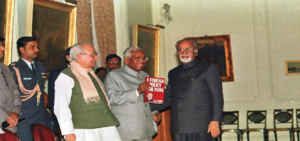
Prime Minister I. K. Gujral presenting a book to President K. R. Narayanan
Astate’s cohesion is undermined once its citizens begin to fear each other. India’s case involves more than a disputed shrine or a provocative speech. This becomes an issue when congregations fear disturbances, families live in fear of losing their homes, or citizens feel obliged to hide an obvious manifestation of their faith. What is the fate of a republic when membership within it comes to depend on resemblance to the majority?
Former Indian Prime Minister I.K. Gujral recognized that India’s unity rested on the state’s ability to accommodate diversity. Delivering his speech to the Lok Sabha on September 1, 1997, which is quoted by ThePrint, he argued against “the mould of uniformity” for the nation. In essence, it means that diversity of religions, languages, cultures, and history of the country made the nationhood possible only if these differences were taken into account. Today, when there is proof of minority insecurity, it is evident that the warning was not exaggerated. India undermines the basis of its own unity with every instance of cultural uniformity.
“Hate Speech and Religious Hatred in India” by Human Rights Watch, “India Hate Lab”, “Report of India Hate Lab” by the Association for Protection of Civil Rights, “A Survey on Hate Crimes Against Christians” by the United Christian Forum, and “Religious Liberty Report 2011” by Religious Liberty Commission of the Evangelical Fellowship of India all report hate speech, acts of violence, disruption of worship services, social ostracism, and discriminatory acts of the state.
It is not just about the mistreatment of one particular community. Can India uphold its constitutional identity while rendering minority identities harder to articulate? Gujral’s warning provides the criterion for assessing the answer: citizens need to be able to be different and yet remain equal members of the community.
From Babri Masjid to renewed disputes over worship
Babri Masjid’s destruction on December 6, 1992, remains an important warning. The Ram Janmabhoomi movement, in connection with the BJP, the RSS and the Vishwa Hindu Parishad, made religion into a tool for mass politics. In its Ayodhya judgment on November 9, 2019, the Supreme Court referred to the demolition of the mosque as an “egregious violation of the rule of law.” The Supreme Court granted the land for temple construction but also ordered five additional acres for constructing a mosque; such an outcome doesn’t make the demolition legal.
This is the significance of the issues at Gyanvapi in Varanasi, Shahi Eidgah in Mathura, and Shahi Jama Masjid in Sambhal. According to a Supreme Court Observer, claims that temples existed at the sites of mosques have led to lawsuits and requests for surveys. Historical and archaeological claims need to be backed by evidence and due process; historical grievance cannot justify destruction by the mob, political organizations, or the government.
Political influence is evident in the Places of Worship Act, which BJP activist Subramanian Swamy and lawyer-politician Ashwini Kumar Upadhyay challenged in the Supreme Court. Nevertheless, it cannot be said that all mosque cases involve an order from the BJP or RSS, since RSS chief Mohan Bhagwat, in December 2024, rejected the perpetual resurrection of the temple-mosque controversy. Here, the question is whether there is any indication of such restraint within the organization and in protecting the endangered community.
In general, the Places of Worship Act of 1991 preserves the religion of the place as it stood on August 15, 1947, except for statutory exceptions, and the Ayodhya case was kept outside its scope. According to Supreme Court Observer, the Supreme Court had decided to restrain proceedings and orders regarding this matter, surveying being included, on December 12, 2024.
Gujral’s remark provides a wider view of this question. Individuals may be burdened with a complex legacy, but they will have to co-exist in the future. If each generation is compelled to make amends to its neighbors for the sins of their ancestors, individuals become trapped in an insoluble dispute.
When worship becomes a place of insecurity
It is manifested in specific instances. For instance, Sub Inspector Manoj Kumar Tomar of the Delhi Police was recorded beating Muslim men offering Friday prayers in the middle of a road in the Inderlok area of north Delhi on March 8, 2024. The Indian Express states that Tomar has been immediately suspended for this act. While authorities can monitor the activities happening on public roads, it does not give them the right to humiliate and beat worshippers.
On January 30, 2024, the Delhi Development Authority bulldozed down the Akhoondji mosque and madrasa in the Mehrauli area of Delhi. As per The Indian Express, the mosque has been listed in the Archaeological Survey of India journal since 1922. The DDA says they were illegal structures, but the Delhi High Court wants an explanation for the demolition and notice before such action is taken.
The Christian community has also been subjected to severe destruction. As per the Human Rights Watch report on May 30, 2023, citing Christians Goodwill Council in Churachandpur, more than 200 churches were set on fire or destroyed between May 3 and May 15, 2023, in Manipur. There were also allegations of police bias, refuted by the police. This is just historical information beyond the immediate period of the 2024-2025 statistical table. Manipur has complicated ethnic, territorial, and political concerns, but this should not detract from the obligation to protect the congregation and conduct an unbiased inquiry into the destruction.
Religious acts and processions can also be used for intimidation. This is evident in the Statesman on March 28, 2024, which reported disputes in Chengicherla, Medipally, Telangana, over the playing of provocative songs before the mosque during Holi. The police have arrested people on both sides. Playing songs by a DJ and conducting cultural programs are not religious misconduct.
Here, different governments and actors come into play. They do not point out any definite reason for persecution of all minorities. They do show an obligatory task: public authorities should treat citizens equally, and religious activities should not be an excuse for intimidation.
The pattern behind the incidents
The wider monitoring history shows why such cases cannot be labeled as temporary controversies. As per the data by India Hate Lab, there were 1,165 hate-speech events taking place face-to-face in 2024, and this rose to 1,318 in 2025, a 13.1 percent increase. Of the hate speeches identified in its 2025 report, 308 were found to urge violence while 120 urged economic or social boycotts. These are monitoring findings, not judicial pronouncements.
However, Christian surveillance reports show another aspect altogether. According to the Religious Liberty Commission of the Evangelical Fellowship of India, there have been 747 such occurrences of violence against Christians during 2025 as opposed to 640 in 2024; an increase of 16.7%. Their classification of violence includes elements like intimidation, disruption of worship, discrimination and violence and not just physical attacks. However, another report from the Association for Protection of Civil Rights between June 7, 2024 and June 7, 2025 reported 173 physical violence cases that included 25 deaths; all Muslims.
Source: https://southasiajournal.net/post/india/61824/i-k-gujrals-warning-when-india-demands-uniformity-it-risks-its-unity