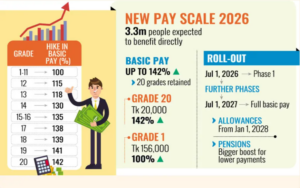
Basic salaries of government service-holders rise by up to 142 per cent as the government Thursday approved the National Pay Scale 2026, retaining the existing 20-grade pay structure.
The new pay scale takes retrospective effect from July 1, 2026, but the revised basic salaries will be implemented in three phases through July 1, 2027, with priority given to employees in grades 10 to 20.
Various allowances under the new structure will take effect from January 1, 2028.
Economist Dr M Masrur Reaz, however, urges the government to adopt a more cautious implementation schedule, warning that a rapid pay hike could fuel inflation, strain government’s finances and increase borrowing.
The cabinet approved the National Pay Scale in its meeting Monday, with Prime Minister Tarique Rahman in the chair.
Cabinet Secretary Nasimul Gani disclosed the details at a press briefing after the meeting.
“The pay scale was approved by the cabinet today (Monday). Various parts of it will be clarified through several SROs,” he told journalists.
He said a new pay structure for government officials and employees was being introduced after nearly 12 years.
The new structure was finalised after reviewing the recommendations of a secretaries’ committee formed on the basis of reports from the National Pay Commission 2025 and the Armed Forces Pay Committee 2025.
Meanwhile, the Cabinet Secretary said no decision had yet been taken on the pay-scale issue concerning non-MPO teachers.
The government said the new structure took into account its fiscal capacity, the overall economic situation, inflation and the rising cost of living.
Under the new scale, the starting basic salary for employees in the lowest, 20th grade, has been set at Tk 20,000, up 142 per cent from the existing level.
The fixed salary for first-grade employees will rise to Tk 156,000 in a 100-percent increase.
Basic salaries for grades 1 to 11 will increase cent percent (100 per cent) while employees in grades 12 to 20 will receive increases ranging from 115 to 142 per cent.
Employees are not receiving the full increases immediately. The government will implement the revised basic salaries in three phases between July 1, 2026 and July 1, 2027.
The phased approach is intended to ease the pressure of a large one-time increase in government expenditure and contain possible inflationary pressures.
Talking with The Financial Express, Dr Masrur Reaz said the public-sector pay increase was justified as there was little disagreement over the need to raise salaries that had fallen below levels warranted by the current cost of living.
“The question is not whether, but when and how,” he says about the modus operandi.
Although inflation has declined over the past two months, it remains high, he notes, warning that a sharp income boost for a large segment of the workforce could reverse the recent progress and make inflation management more difficult.
“Three phases have reportedly been proposed. I would recommend keeping the first phase modest and pushing the bigger increases out over the next two to three years, timed to when inflation eases closer to 7 per cent.”
Dr Reaz also warns that government’s weak fiscal position warranted caution.
“Government revenue, already weak, has deteriorated further amid a slowing economy. Funding all three phases within a short span would strain an already-fragile fiscal position and likely force greater reliance on bank borrowing – a poor outcome for fiscal discipline,” he observes.
The private sector would also feel the impact, he says, as higher inflation would raise business costs, while increased government borrowing could squeeze private businesses through tighter credit conditions.
At the same time, wage expectations among private-sector employees are likely to rise, increasing pressure on employers already facing high costs, weak demand and an energy crisis.
“Public-sector pay should go up – that much is settled. But the pace and timing of the increase deserve far more careful thought than the current three-phase plan suggests,” says Dr Reaz.
The government has also decided to introduce “One Rank, One Pension” (OROP), an election pledge, by 2030.
Given its substantial financial implications and the lack of data on civilian employees who retired before 2019, the system will be introduced gradually.
As an interim measure, pensions of existing pensioners will be increased according to slabs, with larger increases going to those receiving lower pensions.
Pensioners receiving a net monthly pension of up to Tk 9,000 will get a 100-percent increase. Those receiving Tk 9,001 to Tk 20,000 will get a 75-percent increase, while those receiving Tk 20,001 to Tk 30,000 will get a 65-percent increase.
The increase will be 60 per cent for pensions of Tk 30,001 to Tk 40,000 and 55 per cent for those receiving Tk 40,001 or more.
The government says the arrangement would particularly benefit long-retired pensioners receiving comparatively low pensions.
“Before that, a new formula for increasing pensions has been approved as an interim arrangement. Under the formula, those receiving lower pensions will receive benefits at comparatively higher rates,” the Cabinet Secretary said.
For the first time, government employees with children with special needs will receive a monthly allowance of Tk 3,000.
The new pay structure will also extend mobile allowances to all government employees from grades 1 to 20.
At present, the allowance is available only to employees at certain higher levels, up to the fifth grade.
Nasimul Gani said the expansion reflected the growing importance and cost of digital communications in government offices.
Employees across grades increasingly use personal mobile phones and internet connections for official communications, emails, online meetings, digital file management and app-based government services.
The new pay scale will benefit around 2.4 million military and civilian employees, along with more than 900,000 retired employees and other eligible beneficiaries.
In total, around 3.3 million people are expected to benefit directly from the new system of state pay and perks.
The government will incur an estimated additional annual expenditure of Tk 1.0558 trillion to implement the pay scale, according to the Cabinet Secretary.
The additional expenditure will be incorporated into the budgets of the respective fiscal years under the Medium-Term Budget Framework.
The government expects the new pay structure “to strengthen the financial security and morale of public employees and contribute to a more efficient, dynamic and people-oriented administration”.
The Finance Division will issue the necessary gazettes and directives detailing salary fixation, allowances, pensions and post-retirement benefits.
The pay scale for the Bangladesh Judicial Service will be approved separately based on the report of a committee formed for the purpose. It will also be effective simultaneously from July 1, 2026 and implemented in phases.
Source: