The government has devised an ambitious five-year strategic plan to help revive Bangladesh’s ailing jute sector after export earnings from jute and jute goods fell by nearly 29 per cent over the past five years despite rising domestic production.
The plan seeks to double the export earnings by 2031 through greater value addition, improved productivity, enhanced competitiveness and diversification of export markets, said a senior official at the Ministry of Textile and Jute.
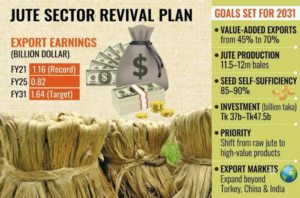
The “Bangladesh Jute Sector Development Strategy and Action Plan (2026-2031)”, prepared by the Department of Jute (DoJ), sets a target of raising annual export earnings from jute and jute products to US$1.64 billion by 2031 from the current level of about $820 million.
The action plan also aims to increase raw jute production to 11.5-12.0 million bales, achieve 85-90 per cent self-sufficiency in jute seed production, and raise the share of value-added products in total exports from the current 45 per cent to 70 percent, said the official.
The initiative comes at a time when global demand for the sustainable and environmentally friendly products are expanding rapidly as countries increasingly replace single-use plastics with natural fibres.
Despite being the world’s second-largest producer of raw jute, Bangladesh has so far failed to fully capitalise on its growing market.
According to the strategy paper, export earnings from jute and jute products reached a record $1.16 billion in FY2020-21, but the amount continued to decline for four years to $820 million in FY25, representing a fall of nearly 29 percent.
The document says the decline was not caused by lower production. Instead, it attributes the weak export performance to inadequate value addition, limited market access, lack of product diversification and declining international competitiveness.
To reverse the downward trend, the government has planned to shift the industry’s focus from exporting raw jute to the production and export of higher-value finished products.
The strategy paper has recommended expanding the production of geotextiles, biodegradable packaging materials, home furnishing products, composite materials, technical textiles, fashion items and automotive components made from jute.
Officials at DoJ said the strategic plan has also proposed establishing three to four internationally accredited testing laboratories to reduce exporters’ dependence on overseas certification facilities.
At present, Bangladeshi exporters have to send samples abroad because the country lacks internationally recognised testing centres, it was leant.
As a result, testing a single product costs between $500 and $2,000 and takes 10 to 21 days, while similar testing in India costs only $60 to $150 and is completed within three to seven days.
China offers similar cost and time advantages.
According to the document, the higher testing costs significantly undermine the competitiveness of Bangladeshi exporters, particularly small and medium-sized enterprises.
The strategy paper further recommends preparing the industry to comply with the European Union’s new environmental regulations, including the Digital Product Passport, strengthening collaboration between research institutions and manufacturers, and expanding the use of digital technologies throughout the jute value chain.
Syed Md Nurul Basir, Director General of DoJ, said implementation of the five-year programme is expected to require Tk 37 billion to Tk 47.5 billion worth of investment.
The government has planned to mobilise funds through public financing, private investment, development partners and public-private partnerships, the officials said.
Eight strategic pillars — increasing farm productivity, ensuring the supply of quality seeds, modernising jute mills, promoting research and innovation, developing internationally accredited testing facilities, diversifying export markets, establishing digital information systems and undertaking policy reforms — have identified for transforming the sector, he said.
The Ministry of Textiles and Jute will lead its implementation, while the Department of Jute will coordinate activities involving the Bangladesh Jute Research Institute, Bangladesh Agricultural Development Corporation, Export Promotion Bureau, Bangladesh Investment Development Authority and other public and private organizations, according to the strategy paper.
The plan also includes a regular monitoring and evaluation mechanism, it was leant.
The strategy paper identifies several structural challenges that have weakened the sector over the years.
They include India’s anti-dumping duties on Bangladeshi jute products imposed since 2017, smuggling of raw jute across the border, rising production costs, weak links between research and industry, limited product diversification and inadequate quality assurance infrastructure.
It also said some 73 of the country’s 266 jute mills are currently closed, affecting production capacity and skilled employment.
At the same time, the Department of Jute is operating with an extreme manpower shortage.
The strategy paper also calls for improving the domestic seed supply as Bangladesh currently imports a significant portion of its jute seed requirements.
Through expanded research, certified seed production and farmer support programmes, the government aims to meet 85-90 per cent of country’s seeds demand from domestic production by 2031.
Bangladesh currently exports jute and jute products to 152 countries, but the strategy paper said about 63 per cent of total exports are concentrated in just three markets namely Turkey, China and India.
To reduce the dependence, it proposes expanding exports to Africa, Southeast Asia, the Middle East, Europe and North America through stronger trade promotion, participation in international fairs, buyer-seller matchmaking and partnerships with global brands.
Source: https://thefinancialexpress.com.bd/bangladesh/govt-devises-five-year-strategic-plan-to-help-revive-ailing-jute-sector