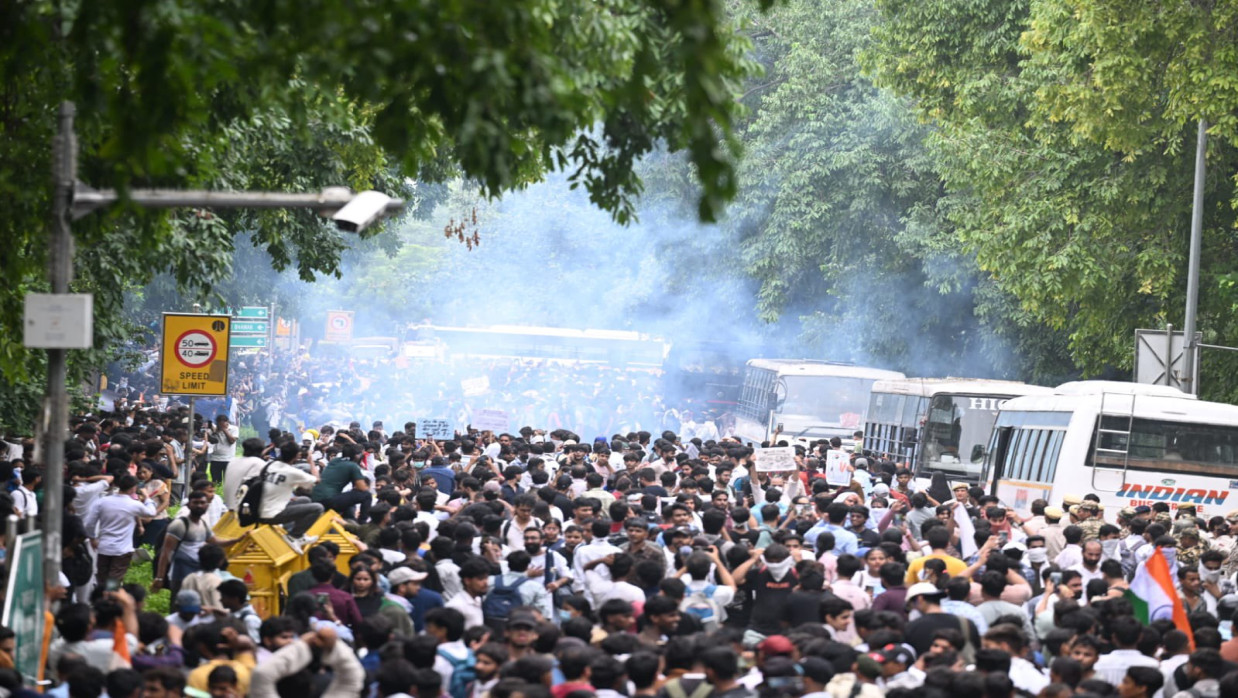
Success of Cockroach Janata Party (CJP), within a few months of its foundation, in securing resignation of Education Minister Dharmendra Pradhan may be viewed as just of the many strong messages signaled during the course of hectic political activity witnessed at Jantar Mantar in New Delhi. What cannot be missed is the coming together of thousands of young people from various parts of the country. The intensive as well as extensive campaign indulged in by CJP members and its supporters did not remain confined to limited circles. As the protest took place at Jantar Mantar, what stood out was the zeal displayed by the participant while shouting slogans, singing songs, displaying banners and even resisting police-attacks. This also added a strong touch of unity among participants, with apparently common identity, trying to surge forward on the national stage with a strong message for the country as a whole. Interestingly, a number of these protestors also had support of their parents with them, some also choosing to accompany the young ones. This was not the case of protestors defying their parents to gather at Jantar Mantar but of being strongly supported by them.
Socially, this protest signals the coming out of a significant percentage of middle-class sections against the government. It is the Indian middle class which is credited as being responsible for the electoral support gained by Bharatiya Janata Party (BJP). If educated sections of this class have chosen to speak out so vehemently against Prime Minister Narendra Modi (BJP), clearly the message extends beyond this. Perhaps, it needs to be understood, people’s grievances cannot be answered by using religious, right-winged and/or communal rhetoric. Population of educated sections is certainly showing an increase. But jobs for them are hardly on the rise.
Those who gathered at Jantar Mantar seemed to be primarily dependent on services for employment, whether government or non-government. A significant number also belonged to unemployed section. The participation of illiterate from poorer sections cannot also be ignored. The same can be said about invisible supporters who displayed their participation by sending food-items, napkins, water, tea, etc. The gathering at Jantar Mantar was nucleus of a protest, the support for which was visible in many parts of the country in various forms and through means of communication.
On one hand, presence of educated sections, faced with unemployment-problems, stands out. Economic problems confronting illiterate, poorer sections cannot also be ignored. The same can be said about presence of both sections at Jantar Mantar. It was perhaps a means of these surging out to voice their economic problems and that they could identify themselves with those present there. Please note, economic problems confronting various sections of Indian society, from upper middle to lower classes, appears to have shaken them with practically the same vehemence adding a common zeal in their not just raising their voice but also asserting the same strongly.
Severe unemployment crisis is faced by educated Indian youth, including college graduates. The number of white-collar unemployed only appears to be increasing. Graduation is no longer considered sufficient for employment. Nearly 70% of unemployed youth are college graduates. Weight of economic problems confronting Indians from these sections, justified the protest at Jantar Mantar, from their own angle. They thus surged forward strongly to make their presence felt. The protest was called off only after the resignation of Education Minister.
The protest movement is going to be remembered and be talked about for a long time. Democratically, CJP has succeeded in asserting its stand and compelling the government to yield to its demand for Education Minister’s resignation. Opposition leaders, particularly Rahul Gandhi (Congress Party) and others haven’t failed to assert their stand against the government.
Against the tendency of BJP leaders to exploit religious and/or right-winged communal cards to win votes, it seems the protest movement has delivered a very strong message. Religious and/or communal cards were not engaged in. Rather, what was visible, was people of diverse religious backgrounds (Hindus, Muslims, Christians, Sikhs and others) choosing to participate together and as one team. Several protestors also commented during the course of the movement that they were pleasantly stunned by coming together of Hindus and Muslims without any communalism. They apparently weren’t prepared for this. Less than 15% of the country’s population are Muslims, which also means that there prevail chances of a significant percentage of Hindus having limited and/or no interaction with them.
Definitely, the movement has only begun with a few key steps taken by it. The nature of protest at Jantar Mantar and Education Minister’s resignation may be viewed as signs of initial success achieved by it. Equally significant is that participants themselves did not allow their protest to be marked by any social communalism. This was possible primarily because the participants asserted themselves without using communal cards. They could identify themselves with protest economically in the name of Indian democracy as well as secularism. Significant sections of Indian middle classes have certainly protested without any communal moves. Undeniably, leaders of protest movement should be credited for ensuring that secularism of participants was not overshadowed by any communal patterns!

Nilofar Suhrawardy
Nilofar Suhrawardy is a Senior Journalist. She has come out with four books: Modi’s Victory, A Lesson for the Congress (2019), Arab Spring, Not Just a Mirage (2019), Image and Substance: Modi’s First Year in Office (2015) and Ayodhya Without Communal Stamp: In the Name of Indian Secularism (2006).