Climate change is often discussed as a distant environmental problem, a matter of temperatures, carbon targets, and scientific projections. For countries such as the Maldives, Bangladesh and Nepal, however, it is no longer an abstract debate. It is about territory, food, water, livelihoods and, ultimately, national survival.
Former Maldivian President Mohamed Nasheed recently put the argument in unusually clear terms: climate-vulnerable countries are not asking for charity. They are asking for what is rightfully theirs.
That distinction matters.
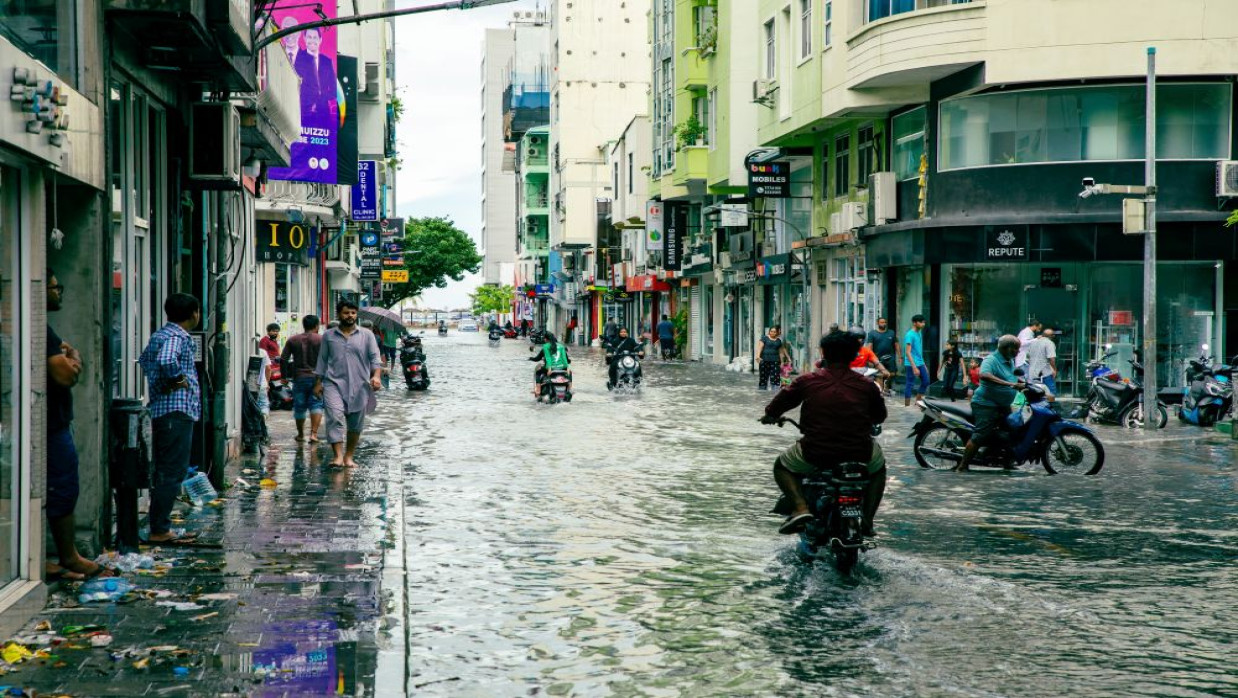
The Maldives did not become prosperous by burning coal for two centuries or creating the industrial emissions now accumulating in the atmosphere. Yet it faces perhaps the most dramatic consequences. Around 80 percent of its islands are less than one meter above sea level. The World Bank projects sea-level rise of roughly 0.5 to 0.9 meters by 2100 and estimates the country may need $2–4 billion to adapt to rising seas and associated flooding.
For a small nation, these figures are staggering.
Climate change also threatens the coral reefs that provide natural coastal protection while sustaining tourism and fisheries, the foundations of the Maldivian economy. The World Bank warns that nearly all shallow coral cover could disappear if global temperatures rise beyond 2°C.
Nasheed therefore raises a profound question that extends beyond environmental policy into international law. What happens when rising seas alter a country’s coastline? Maritime boundaries, territorial seas and exclusive economic zones are measured from geographical baselines. If an island becomes uninhabitable or eventually disappears beneath the ocean, should its people also lose rights over the surrounding sea and its resources?
Surely the international community cannot reasonably say: first you lost your homes because of emissions overwhelmingly generated elsewhere, and now you must lose your maritime inheritance as well.
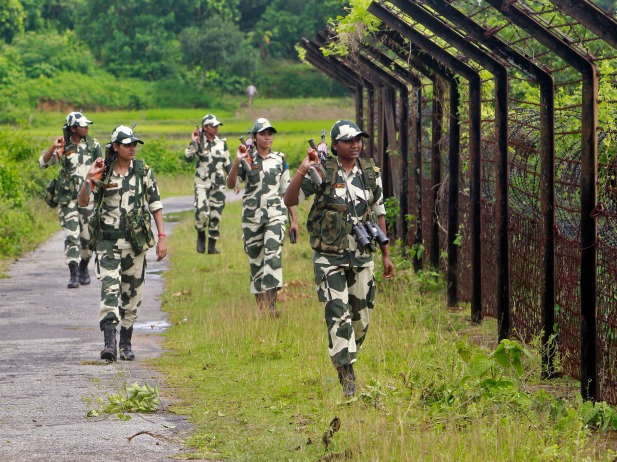
Bangladesh faces a different but equally dangerous geography. It sits at the enormous delta formed by the Ganges, Brahmaputra and Meghna river systems. Its coastal communities confront cyclones, storm surges, flooding, erosion and increasing salinity. The World Bank notes that Bangladesh remains among the countries most at risk from climate change and that rising water and soil salinity are already affecting millions of lives.
Bangladesh has become remarkably capable at cyclone preparedness, shelters, early warnings and disaster response. Yet adaptation has limits. A country cannot endlessly build higher embankments while the ocean rises, rivers become more unpredictable, and agricultural land becomes saline. The burden increasingly falls upon ordinary families who contributed almost nothing to creating the atmospheric problem they are being asked to survive.
Nepal demonstrates another dimension of the same injustice.
It has no coastline. Instead, its vulnerability begins high in the Himalayas. Rising temperatures accelerate glacier loss while changing rainfall patterns increase the dangers of floods, landslides, drought, and glacial-lake outburst floods. The World Bank describes Nepal as facing increasing threats from floods, droughts, landslides, and glacier melt, with severe human and economic consequences.
Thus, from the Himalayan glaciers through the great river systems of Bangladesh to the coral islands of the Maldives, South Asia is witnessing different manifestations of the same planetary disturbance.
And yet the international political response remains woefully inadequate.
Particularly troubling is the direction the current American administration has taken. The United States formally ceased being a party to the Paris Agreement on January 27, 2026. The administration also revoked the U.S. International Climate Finance Plan and ordered the cessation or revocation of financial commitments made under the UN climate framework.
At home, we have also retreated. The EPA eliminated its 2009 determination of endangerment for greenhouse gases, along with federal vehicle greenhouse gas regulations. This occurred in February of 2026. In September, they also decided to eliminate the requirement for power plants to limit their greenhouse gas emissions.
The administration argues that these policies protect American consumers, economic growth, energy security, and national sovereignty. Those arguments deserve acknowledgment. Every government has obligations to protect its citizens from high costs and poorly designed regulation.
But climate change does not recognize sovereignty at the water’s edge.
Carbon emitted in Texas, China, Europe, or India does not remain there. The atmospheric consequences eventually reach a farmer in coastal Bangladesh, a Himalayan village in Nepal and a family living barely above sea level in the Maldives.
That is why Nasheed’s distinction between charity and obligation matters.
Climate finance should not be portrayed as simple generosity from rich nations to poor ones. Industrialized economies accumulated enormous wealth during an era when the environmental cost of fossil-fuel consumption was effectively transferred to the global commons. Climate-vulnerable countries are now absorbing part of that unpaid bill.
Of course they should, but developing nations also need to act. Bangladesh needs to save its rivers and marshes. Nepal needs to stop harmful development projects. The Maldives need to be mindful when allowing development on their reefs and shorelines. Even countries like India and China are big contributors to global warming now.
Poor countries should not be condemned to permanent poverty in the name of environmental protection. Nasheed is right on this point, too. A Bangladeshi, Nepali or Maldivian child has as much right to electricity, transportation, housing and economic opportunity as an American or European child.
The challenge is therefore not to stop development but to finance a cleaner and more resilient form of development.
The world needs a climate compact grounded less in charity and more in justice: predictable adaptation financing, protection of the maritime rights of threatened island states, investment in resilient infrastructure, technology transfer and serious implementation of mechanisms addressing climate-related loss and damage.
The Maldives may be the world’s early-warning system, but it will not be the last victim. Bangladesh and Nepal are already experiencing their own versions of the crisis.
Nasheed’s warning should therefore be taken literally. The question is no longer whether climate change will arrive. It has arrived.
The only remaining question is who will pay for the damage and whether those who contributed most to creating the problem are prepared to accept their share of responsibility.
Source: https://southasiajournal.net/post/south-asia/61812/climate-injustice-when-the-maldives-bangladesh-and-nepal-pay-for-the-prosperity-of-others