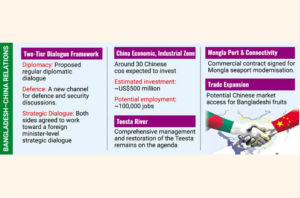
Bangladesh and China prepare to launch a new two-tier diplomacy and defence dialogue that signals a further deepening of ties between Dhaka and Beijing following Prime Minister Tarique Rahman’s recent visit.
The proposed model of dialogue was discussed Sunday during a meeting between Bangladesh state minister for foreign affairs Humaiun Kabir and Chinese ambassador in Bangladesh Yao Wen at the foreign ministry in Dhaka.
The two sides also agreed to work towards launching a foreign minister-level strategic dialogue, as Bangladesh seeks to give greater institutional depth to its relationship with its largest trading partner and a major development and infrastructure partner.
Kabir described China as a “trusted friend and valued strategic partner” and reaffirmed Bangladesh’s commitment to the one-China principle. He said Dhaka was pleased with the renewed momentum in bilateral relations and the elevation of ties to what the two governments describe as a “China-Bangladesh Community with a Shared Future”.
The developments follow Rahman’s recent visit to China, during which the two countries advanced cooperation on infrastructure, trade and investment.
Yao briefed Kabir on the outcomes of the prime minister’s China visit, including the groundbreaking of the China Economic and Industrial Zone (CEIZ), the signing of a commercial contract for the modernisation of Mongla seaport and possible Chinese cooperation in establishing a Mongla export-processing zone.
According to the Chinese side, the CEIZ is expected to attract about 30 Chinese companies and investment of roughly $500m, with the potential to create an estimated 100,000 jobs for Bangladeshis.
The proposed diplomacy and defence dialogue could add a new dimension to a relationship that has traditionally been driven by trade, infrastructure and development cooperation. Bangladesh has increasingly sought to diversify its economic and strategic partnerships while maintaining its longstanding diplomatic principle of balancing relations among major powers.
The two sides also discussed the long-running issue of the Teesta river, with cooperation on the comprehensive management and restoration of the river again featuring in their talks.
For Dhaka, the Teesta remains one of the most politically sensitive issues in its relationship with India. Bangladesh has for years sought a comprehensive agreement on the sharing and management of the river, while China has previously offered to participate in a major water-management project in the Teesta basin.
The meeting also covered the possible export of Bangladeshi jackfruit and guava to the Chinese market, the proposed China-Bangladesh-Myanmar economic corridor and cooperation over the Rohingya crisis.
The Rohingya issue remains a major concern for Bangladesh, which hosts more than a million refugees who fled violence and persecution in Myanmar. Dhaka has repeatedly sought greater international pressure on Myanmar to create conditions for a safe, voluntary and sustainable repatriation of the refugees.
China has played a significant diplomatic role in efforts to facilitate Rohingya repatriation, although repeated attempts to begin large-scale returns have so far failed.
The meeting comes as Bangladesh and China prepare for a series of high-level exchanges.
Yao has said senior Chinese officials are expected to visit Bangladesh, including the vice-president of China International Development Cooperation Agency, the minister of the International Department of the Central Committee of the Communist Party of China and the executive vice-governor of Yunnan province.
The Chinese ambassador also invited Kabir to visit China in October.
The flurry of planned exchanges suggests that Rahman’s China visit could mark the beginning of a more structured phase in Bangladesh-China relations, extending cooperation beyond major infrastructure projects into diplomacy, defence, investment and regional connectivity.
For Beijing, Bangladesh occupies an important position in its broader economic and strategic engagement with South Asia and the Bay of Bengal. For Dhaka, closer engagement with China offers access to investment, infrastructure financing and a vast export market at a time when Bangladesh is seeking new sources of trade and economic growth.
The proposed strategic and defence dialogues will, therefore, be closely watched in the region, particularly as Bangladesh seeks to deepen relations with China while navigating its longstanding ties with India and growing engagement with other major powers.
Source: https://thefinancialexpress.com.bd/economy/bd-china-set-to-launch-new-strategic-diplomacy