A National Trauma That Remains Unresolved
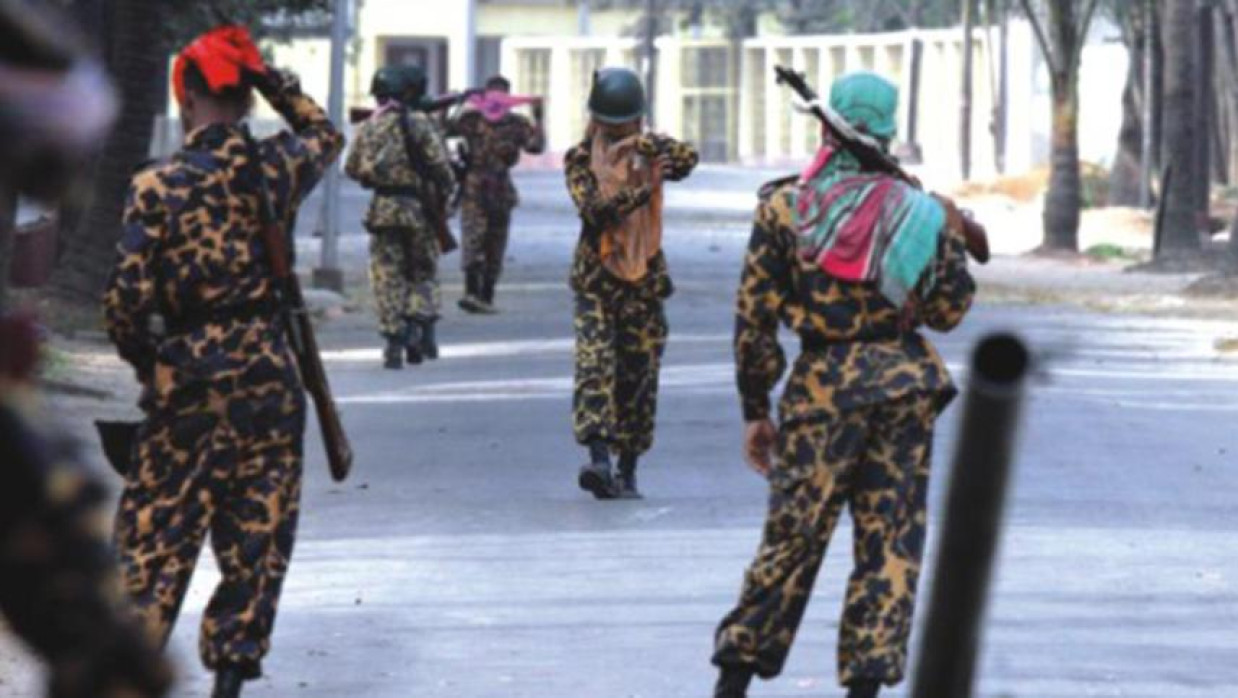
On February 25–26, 2009, a rebellion erupted at the Bangladesh Rifles headquarters in Pilkhana, Dhaka. By the time the compound was brought under government control, 74 people were dead, including 57 army officers serving on deputation with the BDR. The victims included the force’s director general, Major General Shakil Ahmed, and members of several officers’ families. Bodies were concealed in mass graves and drains, while some victims reportedly suffered torture and mutilation.
The scale, concentration and brutality of the killings immediately raised a question that has never been satisfactorily answered: was Pilkhana an unexpectedly violent mutiny caused by accumulated grievances, or were those grievances exploited to carry out a pre-planned operation against the Bangladesh Army?
These allegations have been substantiated by accounts given by survivors, including officers, former military officials and intelligence officials. Notably, the National Independent Inquiry Commission set up in December 2024 released a report in November 2025 which found that the massacre was premeditated and was not simply the result of a spontaneous mob killing. The commission held top-level officials of Sheikh Hasina’s regime responsible and accused them of having an Indian link. Such serious allegations demand verification through a criminal investigation and a fair trial.
Genuine Grievances but an Extraordinary Operation
Issues around pay and allowances, promotion, army officers commanding BDR battalions, participation in UN missions, and purported anomalies in the force’s “Operation Dal-Bhat” meals program had been longstanding sources of resentment among BDR members. The Bangladesh Army’s initial investigation noted that the grievances had existed prior to BDR Week and were used to incite members of the rank and file.
Grievances can explain discontent and perhaps even rebellion. They do not, by themselves, explain the systematic elimination of so many senior officers gathered in one place. The attack began during the annual Darbar at Pilkhana, when a large portion of the BDR’s army leadership was assembled and particularly vulnerable. The killing of officers, attacks on their families, concealment of bodies, disruption of communications and apparent facilitation of some perpetrators’ escape suggest a level of preparation exceeding an ordinary workplace revolt.
That’s an important difference. Some portion of the BDR may have mutinied because they were angry about their working conditions. Another portion apparently saw the chaos as an opportunity to exact some planned killings. Both can be true. From what we read about the evidence collected, it looks like legitimate grievances created a powder keg situation. However, there was probably a core group that organized some of the killings to target particular individuals.
The Failure to Intervene
Perhaps one of the most significant issues surrounding the mutiny is the government’s decision not to allow an immediate military crackdown on the rebels. Army and RAB units were deployed around the location of Pilkhana, but the country’s leaders opted for talks and declared an amnesty for the mutineers who gave up arms.
Supporters of the decision maintain that had there been an assault in the middle of crowded Dhaka, hundreds if not thousands could have died. The rebels had significant weaponry and ammunition at their disposal, hostages included officers and families, and the government had limited trustworthy knowledge of what was occurring within the compound. A sloppy assault could have increased the violence.
The other side of the story is that killings had already started and forces placed nearby were not allowed to move in. 2025 commission found that the top brass had repeatedly asked for permission to move into Pilkhana but were held back. It further stated that there was no specific operational order given and troops were recalled from positions near the headquarters, giving assassins more time to murder hostages, hide dead bodies and flee the spot.
In a video statement released in Sept. 2024, retired army chief General Moeen U Ahmed said he first ordered the army’s 46th Independent Infantry Brigade to make preparations to launch “Operation Restore Order” without waiting for orders from anyone. Prime Minister Sheikh Hasina later gave the Brigade permission to move towards Pilkhana, he claimed. But the government then chose a political solution: the Armed Forces Division told him that mutineers were demanding the army leave before talks began, and the soldiers were ordered out of sight. Political leaders were sent to negotiate with the rebels instead, he said. Moeen’s version of events provides important first-hand testimony. However, it should be corroborated by after-action military reports, radio logs, and interviews with other key decision-makers. Determining command responsibility is not about whose signature is on an order that was ultimately issued. Investigators need to determine what, if any, information reached or failed to reach the prime minister, army chief, intelligence agencies, and unit commanders at each decision-point; why they did not at least attempt to rescue those trapped via a targeted operation; and why every avenue of escape was not blocked at Pilkhana.
The question is not whether we should have undertaken a reckless attack. Did the government and military leaders leave any stone unturned to save the lives of officers who were in imminent danger?
What the New Commission Alleges
After overthrowing Sheikh Hasina’s government on 5 August 2024, the interim government formed a seven-member commission to reinvestigate the massacre. The Daily Star reports that the commission interviewed 247 witnesses and reviewed over 50 past investigations.
Commission chairman Major General (retired) A.L.M. Fazlur Rahman named Hasina, former lawmaker Sheikh Fazle Noor Taposh and several other Awami League figures among those considered responsible. The commission described Taposh as an important coordinator and cited testimony alleging contacts between political figures and disaffected BDR personnel before the massacre.
The report also alleged that a parallel chain of command operated during the crisis and that political officials prevented both the army and the RAB from intervening. A subsequent account of the commission’s evidence reported claims that some politicians entered and left Pilkhana apparently to liaise between the rebels and the government hire-ups. At the same time, security forces remained outside, and officers who attempted rescue operations or gathered sensitive evidence were later persecuted. These claims are detailed in The Daily Star’s review of the commission’s findings.
These findings materially strengthen the case for investigating political complicity. However, a commission report is not the equivalent of a criminal conviction. Some allegations reportedly depend on testimony by prisoners, indirect accounts or a single witness. Each assertion must be corroborated through telephone records, contemporaneous intelligence reports, movement logs, weapons evidence, financial transactions and testimony given under legally protected conditions.
Does the Evidence Implicate Sheikh Hasina and the Awami League?
The evidence points to serious questions that Hasina and members of her government must answer. The failure to authorize intervention, the unusual access reportedly enjoyed by certain political figures, alleged pre-mutiny contacts with BDR personnel, interference with investigations and the subsequent persecution of officers collectively make a finding of simple incompetence increasingly difficult to accept without further examination.
Nevertheless, three levels of responsibility must be distinguished.
First is political and command responsibility: whether Hasina’s government failed to protect the officers or made catastrophically unsound decisions. Second is responsibility for obstruction: whether officials concealed evidence, manipulated investigations or protected suspects after the massacre. Third and most serious is direct criminal complicity: whether political leaders helped plan, authorize or facilitate the killings.
Published evidence gives reason to believe we should look into the first two scenarios and render the third theory plausible. However, it cannot be said as an objective matter of judicial fact that Hasina gave the order to slaughter until… That determination can only be made with evidence admissible in court and sufficient corroboration after a fair trial in which the accused can defend themselves against the charges.
The Question of India
The commission also reported indications of Indian involvement. It cited intelligence material, the presence of Indian nationals in Bangladesh at the time and General Moeen’s reported claim that Indian intervention was feared if the army acted. The commission chairman cited General Moeen U Ahmed’s testimony as stating that, had the army intervened at Pilkhana, India might have entered Bangladesh and “would not have left as they did in 1971.” Commission officials characterized India as a major beneficiary of an operation that weakened Bangladesh’s military establishment. Bdnews24.com and other Bangladeshi outlets reported these allegations.
Of course, motive, opportunity, and political gain do not necessarily imply operational complicity either. The commission’s supposed conclusion that 921 Indians crossed into Bangladesh during the pertinent time period and 67 could not be accounted for does not in itself demonstrate culpability in the killings either. To do that, investigators would first have to identify the attackers, how they came to Bangladesh, if any had contact with Pilkhana, and what immigration, travel, communications, financial, or forensic records might connect them to the attackers. Serious allegations such as the involvement of Indian intelligence agencies merit the most stringent and independently corroborated evidence, considering the extreme hostility they can generate and the potential for jeopardizing Bangladesh–India relations. In the absence of making such evidence public and open to review, Indian complicity should be treated as a finding of the commission rather than a fact.
So we shouldn’t dismiss the Indian connection outright, but we shouldn’t claim it as fact. Research into this would have to include immigration records, border patrol paperwork, intelligence archives, cell phone metadata, embassy documents, and everything else that can be researched, including contacting Indian officials themselves.
A Justice Process Compromised by Abuse
The original trials led to thousands of convictions. Hundreds were sentenced to death. Tens of thousands were sentenced to life in prison. Torture was reported. People died in custody. Confessions were coerced. Defendants were denied access to counsel.
Human Rights Watch said over 6,000 members of BDR had been detained and had evidence of their systematic abuse. At least 47 suspects have died while in custody. Amnesty International had also expressed concern that torture and mass trials endangered the rights of defendants as well as finding the true culprits.
This isn’t a footnote. Torture = false confessions, contamination of the evidentiary trail, and enables the real guys who did it to pin it on hundreds of fall guys. Let’s not dishonor these dead officers by treating these suspects unfairly.
What the Massacre Points Toward
Everything points to the killings at Pilkhana having been planned by an inner ring of organizers. The timing of the attack, focus on army officers, the coordination of armed attackers, hiding of bodies and getaway of killers do not suggest a completely spontaneous reaction. To that limited extent, the killings were like an execution which took place with or during a larger mutiny.
Unclear is whether the entire plan of the conspiracy has been proven: who originated it, what U.S. political/military leaders knew of it, if foreigners were involved at all, and how high up the chain of command it went.
Bangladesh needs a witness-protection program, forensic retesting of the evidence that still exists, the release of intelligence documents, and trials that meet international standards of fairness. Convictions should not be reached in order to whitewash one politically convenient story with another. Guilt should be decided by corroborated evidence.
Pilkhana was more than a massacre of officers. It was a slaughter of public confidence in the state. Seventeen years later, neither patriotic bombast nor partisan finger-pointing can replace evidence. Only an independent, open and legally defensible accounting can reveal whether the tragedy was allowed to happen by incompetence, political conspiracy, foreign meddling or all of the above.

Ghulam M. Suhrawardi
Ghulam M. Suhrawardi is the Publisher of South Asia Journal.