
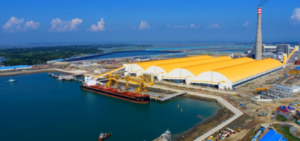
Japan’s proposed regional trade corridor raises a fundamental question: what will Bangladesh receive in return for opening its infrastructure to India’s northeastern states?
An offshore deep-sea port can pave the way for a country’s prosperity. However, the utility of such an asset depends on who controls it, its costs, and where the benefits flow. In Bangladesh’s case, the proposed plan to link the northeastern states of India to maritime trade through Matarbari requires clarification and concrete commitment, not just political excitement Recent reporting on October 18, citing The Hindu, mentions Japan’s interest in establishing an industrial value chain connecting Bangladesh’s Matarbari Deep Sea Port with northeastern India and Southeast Asia. The proposal is being talked about before the visit of the country’s Prime Minister, Tarique Rahman, to Japan. Nevertheless, the reporting doesn’t clarify the venture’s commercial terms, how costs will be shared, or what advantages Bangladesh stands to gain.
Omissions are important. Geography is a precious natural resource for Bangladesh. Bangladesh needs to negotiate access in the same spirit as others negotiate energy, technology, and markets. The message to the government is clear: any deal that makes Bangladesh take the burden while India gains a strategic advantage is bound to spark widespread public anger.
When Connectivity Can Become an Instrument of Hegemony
The connection of neighboring economies does not, in and of itself, imply domination. Bangladesh might profit greatly from a well-built port used by its exporters and its neighbors. More cargo could enable shipping activities, logistics, and investment. The problem is posed by cooperation based on unequal power dynamics. Matarbari might become a tool for Indian hegemony in case Bangladesh takes the majority of financial and environmental responsibility, while India gets cheap and reliable access to the port without giving anything back. This is something to consider, not take as the already known outcome of the yet-undisclosed deal. It does not necessarily mean territorial ownership – it can emerge in a system where the interests of the larger neighbor dictate the infrastructure and spending policies of the smaller one. The port might remain under Bangladeshi jurisdiction and control, but others will increasingly determine its economic development. For these reasons, all practical questions need to be answered. Who decides on access policies? Who controls the prices? Who invests in additional capacity? Can Bangladesh implement its customs and security regulations? Is there an ability to change commercially unfeasible
Who Will Bear the Cost?
“Japanese-financed” needs to be defined. When a loan is used as finance, it creates a repayment liability; this does not mean Japan bears the cost.
JICA’s official press release states that in March 2023, JICA and the Government of Bangladesh agreed to a loan of up to ¥105.362 billion for the Matarbari Port Development Project (II). The loan includes a 30-year repayment period, a 10-year grace period, an annual project interest rate of 1.20 percent, and an additional rate for consulting services. This is just one loan, not the project’s total cost. JICA. Bangladesh bears the repayment obligation for that sovereign borrowing. Port earnings can help meet the burden, but inadequate earnings would leave the public sector exposed.
The proposed regional arrangement must therefore distinguish between three things: infrastructure Bangladesh needs for its own development, additional infrastructure required to serve foreign transit, and the operating costs generated by that transit.
India should not have to pay for the full construction of a Bangladeshi port just because some Indian companies will use it. Similarly, Bangladesh does not need to build more roads, maintenance structures, customs buildings, or other facilities needed solely for India’s trade.
These costs must be paid through agreed-upon payment systems or any other method.
The government must disclose the full financing plan, including domestic investments, loans, operating costs, and realistic income projections. Specific numbers for the port, the power plants, the roads, and future industrialization are important and cannot be lumped into one grand figure.
What Does Bangladesh Gain from India?
The report leaves the central question unanswered: what, precisely, will India provide in exchange for using Bangladesh as a route to the Seven Sisters?
Potential gains are substantial, but potential is not payment.
Port fees, transport money, storage fees, and logistics service earnings would have been realized by Bangladesh. Bangladeshi exporters stand to gain from increased shipping linkages and industrial investment. These gains depend on cargo volumes, pricing, participation, and market access.
A commercially sound agreement should address the following:
| Bangladesh’s interest | What negotiations should secure |
| Financial sustainability | Charges that cover attributable costs and provide a reasonable return |
| Protection against underused capacity | Credible cargo commitments or suitable risk-sharing arrangements |
| Domestic employment | Competitive opportunities for Bangladeshi transporters, logistics firms, and workers |
| Export growth | Practical, enforceable improvements in access for Bangladeshi goods |
| Regional access | Negotiated transit opportunities through India to Nepal and Bhutan |
| Infrastructure maintenance | Fair contributions toward wear, congestion, and additional facilities |
| National authority | Bangladeshi control over customs, inspection, security, and access conditions |
These are negotiating objectives, not benefits already secured.
Nor should transit charges be selected merely to produce an attractive political headline. Excessively high charges could discourage cargo; excessively low charges could transfer the economic value of Bangladesh’s geography to foreign users. Independent analysis should establish what the market can sustain and what Bangladesh needs to recover.
The key criterion is net national benefit after operational costs, interest on debt, maintenance costs, environmental considerations, and foregone opportunities for public funds elsewhere.
A Corridor Is Not Necessarily an Industrialized Economy
The notion of the “industrial value chain” requires careful consideration.
Products transiting via Bangladesh do not necessarily mean industry will develop in Bangladesh. A product container can transit through a port and along roads, then exit the country with little value generated along the way. For Matarbari to become a means of industrialization, Bangladesh will need investment in industry, supply chains, training, technology transfer, and entrepreneurship. The government will have to ask which country will build its factories, employ its skilled labor, and capture the high-value end of production. If manufacturing continues to develop on the other side of the border, with Bangladesh acting as the transit route, benefit-sharing will remain imbalanced. This means Japan’s involvement should be gauged by the investments it makes in Bangladesh’s productive capacity.
Sovereignty Must Be Written into the Agreement
Bangladesh must retain control over commercial movement. Any agreement must clearly define the types of goods, inspection process, liability, insurance, environmental issues, and dispute resolution. Commercial transit must not secretly turn into a source of security benefits or access.
Bangladesh should also retain clearly defined rights to respond to emergencies, enforce its laws, and review tariffs at agreed intervals. These protections do not have to make trade unreliable. Predictable rules can strengthen commerce while preserving sovereignty. Vulnerability comes from ambiguity, especially when one party has much greater economic and diplomatic influence.
Matarbari should also remain open to commercially viable business from multiple partners. Dependence on a single country’s cargo could weaken Bangladesh’s bargaining position and expose projected revenues to political disruption.
The Government Must Earn Public Trust
No responsible writer can assume that he speaks for all Bangladeshis without any proof. Yet, the government will make a grave error if it ignores the possibility of popular resentment at an uneven deal. Citizens have the right to know why the government should raise loans for foreigners’ business interests and why it should guarantee them. Citizens should also be informed about the jobs and money to be gained. Before committing to any project, the government should inform the public of its terms, conduct a proper study, and allow discussion in parliament. The public statement should include details such as the amount of revenue, debts, cost shares, and the effects if the cargo is not delivered as expected.
Also, the people whose land will be expropriated, who must build something, and who will suffer environmental change must be consulted and treated properly. The country’s development cannot be assessed by cargo alone.
Bangladesh Must Negotiate as a Principal
It’s easy to see why India wants better access. It’s also easy to see why Japan wants industrial networks in the region. Bangladesh needs to be equally clear about its goals. The government must promote cooperation that supports national economic development and re-examine any proposal that is not mutually beneficial. Good diplomatic relations with India do not necessarily mean giving without receiving. Matarbari’s success for Bangladesh comes through exports, sustained income, efficient investment, job creation, and economic independence.
The warning to the government is simple: citizens could become profoundly unhappy if Bangladesh inherits the liabilities while others secure the advantages. Before opening the route, show the country the bargain. Bangladesh’s geography belongs to its people, and its value must be reflected in their future.
Dr. Serajul I. Bhuiyan
Dr. Serajul I. Bhuiyan is Professor and Former Chair, Department of Journalism and Mass Communications, Savannah State University, USA.
Source: https://southasiajournal.net/post/bangladesh/61855/matarbari-for-whom-bangladesh-must-not-pay-for-indias-strategic-advantage