
A downturn in the funneling of inflation-fueling high-powered money into the market reverses significantly and stokes fear of spikes in the inflationary pressure on living and economy.
Money-market experts have pinpointed several factors, including the central bank’s growing quasi-fiscal activities and the regulator’s liquidity support to the struggling banks, largely contributing to the recent leaps in reserve-money growth.
Under a tight monetary-policy regime pursued by the central bank until July last to tame obdurate inflation, the inflow of the reserve money dropped to a negative growth of 0.12 per cent in June 2025. In a rebound since, it has risen significantly in recent months.
Apart from the regular liquidity-feeding instruments of the Bangladesh Bank (BB), they said, the flow of subsidised credits or money injection through irregular arrangements keeps rising on the money market, which is contradictory to the spirit of contractionary monetary-policy stance.
As a matter of fact, the BB-claimed tight monetary policy is not transmitting into the money market properly and not being able to contain the inflationary pressure at the expected level.
This shortcoming in regulating money supply as per policy is ultimately hurting common people through eroding their purchasing power.
According to latest BB data, the growth in the reserve money was recorded 0.12-percent negative in June last year. Afterwards it started leaping to 2.52 per cent, 3.47 per cent, 9.23 per cent, 13.35 per cent and 14.39 per cent, 15.25 per cent and 17.86 per cent in July, September, December of 2025, February, April, June and August this year respectively.
Reserve money is the total amount of currency in circulation plus commercial banks’ deposits held at the central bank, acting as the foundation for the entire monetary system.
It is also called “high-powered money” because it forms the foundation for the expansion of bank deposits through the money-creation process.
Seeking anonymity, a BB official said the central bank, in fact, did nothing to control the higher inflation apart from continuing a higher policy rate of 10 per cent since October in 2024.
“The volume of quasi-fiscal activities by the BB through which commercial banks avail credits from the regulator at subsidised rates, ranging from 0.5 per cent to 5.0 per cent, is still quite large,” he told The Financial Express
On the other hand, the central banker added, regular government borrowing from the central bank through using ways and means, amounting to maximum Tk 120 billion, and overdraft worth maximum Tk 120 billion, goes on to operate some 119 accounts at 8.0 per cent and 9.0 per cent respectively.
“Certainly, it (reserve money growth) is a concern for all of us because it fuels inflation to some extent,” he said.
Considering possible spikes in inflation following latest upward revision of fuel prices and reserve-money growth, the central banker said, the banking regulator decided not to cut the policy rate (now it is 9.50 per cent) until December next.
Overall inflation in Bangladesh eased slightly to 8.26 per cent in August 2026, down from 8.32 per cent in July, according to data from the Bangladesh Bureau of Statistics (BBS).
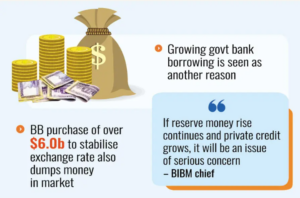
Apart from growing government bank borrowing and quasi-fiscal activities, Director-General of Bangladesh Institute of Bank Management (BIBM) Dr Md. Ezazul Islam points out that the regulator has purchased more than US$6.0 billion since July 13 last year to stabilise the exchange rate and injected huge volumes of money into the market. These all factors contributed to the rising growth of reserve money.
But the money-multiplier effect was not too high because of lower credit demand by the private sector. The credit appetite of the entrepreneurs is expected to increase in the coming days.
“If the uptrend in reserve money continues and private-sector-credit growth gets enhanced, it will be an issue of serious concern in the context of a tight monetary stance,” the monetary economist added.
Source: https://thefinancialexpress.com.bd/economy/injection-of-high-powered-money-up-amid-rising-inflationary-pressure