
SYED FATTAHUL ALIM
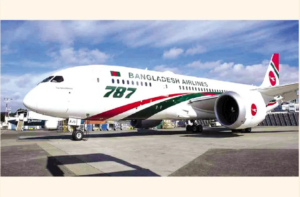
Foreign airlines reportedly control 77 per cent of Bangladesh’s commercial aviation market, while Bangladeshi carriers together account for only around 22 per cent. For a country that has had its own flag carrier for more than half a century, this is not a very flattering picture. Biman Bangladesh Airlines, in short, Biman, began its journey in 1972 and is now 54 years old. During this long period, it has acquired modern aircraft, opened and closed routes, changed managements and in 2007 even turned itself into a public limited company. But has it really grown into a modern commercial airline? The market share tells a different story. Meanwhile, newer private local airlines have been expanding their fleets and international presence, proving that age or national-flag status alone cannot provide any commercial advantage.
True, Biman has lately been making profits. In FY2024-25, it reported a record net profit of Tk785.21 crore and had been posting profits during some fiscal years before. That is welcome news. But one good run cannot erase its old image as a perennial loss-making state entity, especially when its history is littered with allegations of corruption, irregular aircraft leasing, questionable procurement, ticket manipulation, poor ground service and inefficient management. Investigations by the Anti-Corruption Commission and official audits over the years have repeatedly brought these issues to public attention. Small wonder that foreign carriers continue to command the market despite Biman’s national flag status.
The problem, therefore, is not just aircraft. Biman today has comparatively modern Boeing jets. Nor is it simply about opening more destinations. An airline survives on punctuality, customer confidence, route planning, efficient ticketing, quick baggage delivery, cabin service, maintenance, marketing and, above all, professional management. These are areas where an organization operated in the style of a government department cannot compete with renowned airlines like Emirates, Qatar Airways, Singapore Airlines or even increasingly aggressive private Bangladeshi carriers. Biman has to cease behaving like a protected government department and learn to survive as a service-oriented commercial airline in an open aviation market.
That would require a fundamental change in the way its people are appointed, promoted and retained. Service continuation of Biman employees and officials should be subject to measurable performance criteria. So should promotions, bonuses and other entitlements. Its managing director, directors, senior managers and, gradually, other categories of employees should be appointed on fixed-term contracts renewable on the basis of performance.
The aviation market itself should also be opened further to competition. Protection cannot make an inefficient airline efficient. Competition can. The decision to introduce another ground handler alongside Biman at the third terminal of Hazrat Shahjalal International Airport is, in that sense, a move in the right direction. If Biman loses business because another operator provides better service, the answer should be to improve Biman, not close the market to its competitor.
But Biman’s weakness is only one part of the aviation problem. Bangladesh cannot become a regional aviation hub with an airline alone. Hazrat Shahjalal International Airport still depends on a single runway that handles roughly 20 to 22 flights an hour. Less than 5 per cent of Dhaka’s traffic is transit traffic. A modern third terminal will certainly increase passenger and cargo capacity, but a gleaming terminal building by itself does not make an aviation hub. Airside and landside facilities, air traffic management, immigration, customs, baggage systems, maintenance facilities, ground handling, road connectivity and other support services have to be brought to world-class standards.
Bangladesh sits geographically between South and Southeast Asia and close to the huge aviation markets of the Middle East and East Asia. That advantage has so far been exploited more by foreign airlines than by Bangladesh itself. After 54 years, the question is no longer whether Biman can survive with government support. It is whether it can compete without hiding behind that support. If Biman is to carry the national flag with commercial credibility, it must first become an airline that passengers would choose willingly, not one they use for lack of a better option.
Source: https://thefinancialexpress.com.bd/opinions/why-biman-failed-to-take-off