Global ratings agency Moody’s has revised Bangladesh economic outlook to stable from negative following the easing of political and external pressures, stronger foreign-exchange reserves and record remittance inflows.
The ratings agency has, however, kept the long-term rating at B2 that balances long-term growth potential, supported by favourable demographics, a diversified economy and a competitive readymade garment (RMG) sector, against weaknesses in other sectors.
“The change in outlook to stable from negative reflects our assessment that the acute political and external pressures that drove the negative outlook have eased, leaving risks more balanced at the B2 rating level, even as material structural vulnerabilities persist,” says Moody’s in its latest assessment revealed Tuesday.
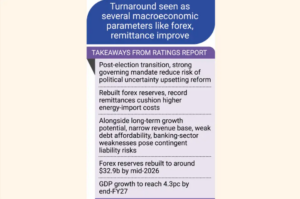
The ratings agency has also said the post-election transition and strong governing mandate have reduced the risk that political uncertainty would derail reform, while Bangladesh’s external position has improved on rebuilt foreign-exchange reserves, a more flexible exchange-rate regime, and record remittances, which have cushioned higher energy-import costs.
 Continued engagement with the International Monetary Fund (IMF) and other international financial institutions (IFIs) remains an important anchor for external financing and reform, despite friction over the pace of reforms and ongoing discussions over the terms of a successor IMF programme, it explains.
Regarding B2 rating, the agency has said the affirmation of Bangladesh’s B2 rating balances its long-term growth potential, supported by favourable demographics, a diversified economy and a competitive readymade garment (RMG) sector, against a narrow revenue base, weak debt affordability and significant banking-sector weaknesses that pose contingent liability risks.
“While the RMG sector remains competitive and will continue to anchor resilient exports, ongoing energy-supply constraints and graduation from least-developed-country (LDC) status in the coming years present challenges,” the agency notes.
Regarding the country’s foreign-exchange reserves, it has said foreign- exchange reserves rebuilt to around US$32.9 billion by mid-2026 — over four months of import cover — from about $21.4 billion at end-2024, supported by record remittances increasingly captured through formal banking channels, a more flexible exchange-rate regime, and the removal of earlier market distortions.
The central bank has shifted from selling reserves to defend the currency to net foreign-exchange purchases, it adds.
Despite risks from higher energy prices, weaker remittances and gas-supply disruptions, stronger reserves and inflows leave Bangladesh better placed to absorb external shocks than during the 2022-24 crisis, according to Moody’s ratings.
The agency has projected that Bangladesh’s gross domestic product (GDP) growth would reach 4.3 per cent by the end of the current fiscal year (FY), 2026-27, as improving confidence and investment are partly offset by the ongoing energy shock, elevated inflation, and domestic supply disruptions, before recovering to around 4.9 per cent from FY2028 as investment and industrial activity normalise.
The agency expects near-term growth to recover only gradually before a firmer pickup from FY2028 onwards.
Bangladesh’s economic growth rose to 4.1 per cent in FY2026 from 3.5 per cent a year before, as the February 2026 election reduced political uncertainty and supported a rebound in activity, according to Moody’s findings.
The New York-based global ratings agency also projects inflationary pressure on Bangladesh’s economy to stay around 9.0 per cent before easing slowly.
“Despite higher import costs, gas-supply volatility, and challenges to the RMG sector, the economy has shown underlying resilience,” the agency says, adding that record remittances underpin relatively firm private consumption and the RMG sector continues to anchor exports despite higher costs.
Moody’s estimates recapitalisation needs at around 10 per cent of GDP to restore banks to the required regulatory capital-adequacy levels.
The process will have to be phased over several years, posing a significant burden amid Bangladesh’s very limited fiscal space and growing reliance on domestic bank financing, which risks crowding out private-sector credits.
It notes that to address longstanding weaknesses in the banking system, the authorities have advanced elements of a reform agenda, including asset-quality reviews, deposit-protection legislation, a medium-term resolution strategy developed with the IMF, and the repeal in September 2026 of a provision that “would have allowed former owners of failed banks to reacquire ownership”.
At the same time, liquidity has remained stable, with system-wide deposits growing around 12 per cent year on year to March 2026 indicating that banking-sector weaknesses are primarily a solvency rather than liquidity challenge.
The ratings agency has also said fiscal strength remains constrained by one of the narrowest government revenue bases among rated sovereigns, limiting fiscal flexibility and leaving interest payments absorbing close to 30 per cent of government revenue despite a still-moderate debt burden of around 40 per cent of GDP.
“We expect debt to rise gradually over the medium term, reflecting persistent primary deficits and prospective banking-sector support costs, although continued access to concessional financing from multilateral and bilateral creditors helps contain borrowing costs and mitigates refinancing risks,” Moody’s ratings says.
Earlier in July this year, S&P Global revised its long-term outlook on Bangladesh to negative from stable one amid persistent weakness in the banking sector, with additional risks stemming from volatile global energy markets and trade conditions.
In May 2026, another global ratings agency, Fitch Ratings, revised its outlook on Bangladesh’s long-term rating to negative from stable, citing macroeconomic vulnerabilities arising from the country’s significant exposure to the conflict in the Middle East.
Source: https://thefinancialexpress.com.bd/economy/economic-outlook-upgrades-to-stable-from-negative