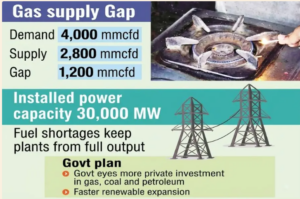
The government is seeking greater private-sector investment in the energy sector to meet rising demand and address persistent fuel and gas shortages, Power, Energy and Mineral Resources Minister Iqbal Hasan Mahmood said on Tuesday.
He said the government was preparing policies to expand private participation in fuel imports and sales while encouraging investment in gas, coal, petroleum and renewable energy.
“Private investment is very much needed, especially in the energy sector,” he said while speaking as the chief guest at a seminar titled “Energy Crisis: Prospects and Ways Forward” at Dhaka Club in the city.
State Minister for the Ministry of Power, Energy and Mineral Resources (MPEMR) Anindya Islam Amit was the special guest at the seminar organised by the Forum for Energy Reporters Bangladesh (FERB).
The MPEMR minister also said the government was preparing a policy to allow qualified private companies to import and sell fuel oil alongside state-owned distributors.
“We are not doing this to give benefits to a particular company. Rather, we are making a general policy so that everyone can do business,” he said.
Under the proposed policy, eligible private companies would be able to import and sell fuel alongside state-owned distributors such as Padma Oil, Jamuna Oil and Meghna Petroleum.
If there is a private company’s filling station alongside a Padma, Meghna or Jamuna station, consumers can buy fuel according to their choice, Mr Mahmood said.
He further said consumers could continue buying from state-owned companies if they offered lower prices, while those willing to pay more could purchase fuel from private operators.
The minister said the government’s plan was partly prompted by the experience of the recent Middle East conflict, when fears of fuel shortages led to long queues at filling stations despite the country having sufficient stocks.
According to the minister, motorists and motorcyclists rushed to refuel amid fears of shortages, while some areas experienced temporary supply disruptions, alleged hoarding and black-market sales.
The experience prompted discussions with Prime Minister Tarique Rahman on how greater private-sector participation could strengthen the country’s fuel supply chain.
The government believes competition will improve supply chains and prevent black-market activity. The minister rejected claims that the policy favoured specific businesses.
“This is a misinterpretation. We are not doing this to benefit one company. We are creating a policy so that everyone can do business,” he said.
The policy might be modelled on India, where both public and private firms — including ONGC and Reliance — operate in the fuel market, the minister said.
On renewable energy, Mr Mahmood said the government was “very aggressive” in promoting solar power and planned to promote rooftop solar under an OPEX model, beginning in Dhaka and gradually expanding across the country, with private investors making the required investments.
He said areas under Dhaka’s two city corporations would be divided among investors through a transparent process, allowing private companies to install rooftop solar systems and recover their investment through electricity billing arrangements.
The minister also said the government was considering making land available for large solar projects through an equity-based arrangement, under which the value of government-provided land could be treated as equity in the project.
Speaking on the occasion, MPEMR State Minister Anindya Islam Amit said the government planned to generate around 10,000MW of electricity from renewable sources within the next four and a half years.
The target is part of the government’s plan to generate 20 per cent of the country’s total electricity from renewable sources, he said.
“After the mass uprising, the government has to be ambitious to fulfil the aspirations of the people,” Mr Amit said.
The government was also working to remove bureaucratic obstacles to rooftop solar installations, he said.
Pointing to the existing crisis, he said Bangladesh had around 30,000MW of installed power generation capacity, but fuel shortages were preventing many plants from operating at full capacity.
The country currently faces a gas supply deficit of around 1,200 million cubic feet per day (mmcfd), he said, adding that domestic gas production was declining by around 150mmcfd annually.
“Even if you have the money, you cannot increase liquefied natural gas (LNG) imports overnight because you do not have the infrastructure,” he said.
Bangladesh currently relies on two floating storage and regasification units (FSRUs).
The government, however, aims to make a new FSRU operational in less than two years and is also considering a third and fourth FSRU, he said.
The government is also moving ahead with plans to establish a land-based LNG terminal at Matarbari to expand LNG import capacity.
He said the tender for appointing a transaction adviser closed on Tuesday and land for the proposed terminal had already been identified.
The government is also hopeful that the ongoing offshore oil and gas bidding round will be successful, while preparations for an onshore bidding round are under way, he said.
The government plans to strengthen Bapex by improving its equipment and workforce, he added.
Bapex officials will be sent abroad for six-month to two-year certificate courses to develop specialised skills.
The MPEMR state minister said the government wanted to increase its presence in the LPG market to help stabilise prices.
Although the Bangladesh Energy Regulatory Commission (BERC) fixes LPG prices, consumers do not always receive the product at the regulated price, he said.
Only five or six private operators currently import LPG despite the presence of many operators in the market, he added.
The government plans to import LPG in bulk and use existing private-sector infrastructure to distribute it and help stabilise the market, he said.
The damaged Excelerate Energy-operated FSRU at Maheshkhali remains a major challenge for the government, he said.
Partial operations have been restored with the help of local and foreign experts, with one boiler operational while the other remains out of service, he said.
Restoring the second boiler will require temporarily shutting down the first, meaning the government is trying to identify a period when the impact on consumers would be lowest.
“We are discussing with them what time we can choose when the suffering of the people will be less for at least 72 hours,” he said.
The government is also working to restore the FSRU to full capacity, he added.
Presenting the keynote paper, Dr Ijaz Hossain warned that the dollar crisis was compounding the energy crisis, urging stronger domestic gas production and expansion of solar power.
Prof M Tamim advised maximising coal-based plants, boosting solar capacity by 2,000-3,000MW and reconsidering over-reliance on the state-run Bangladesh Petroleum Exploration and Production Company Ltd (BAPEX) for gas exploration.
East Coast Group Chairman Azam J. Chowdhury and Bangladesh Independent Power Producers Association (BIPPA) President David Hasnat also spoke on the occasion.
FERB Chairman M Azizur Rahman chaired the event, while FERB Executive Director Serajul Islam Siraj delivered the welcome speech.
Source: https://thefinancialexpress.com.bd/trade/govt-seeks-pvt-investment-to-ease-energy-crisis