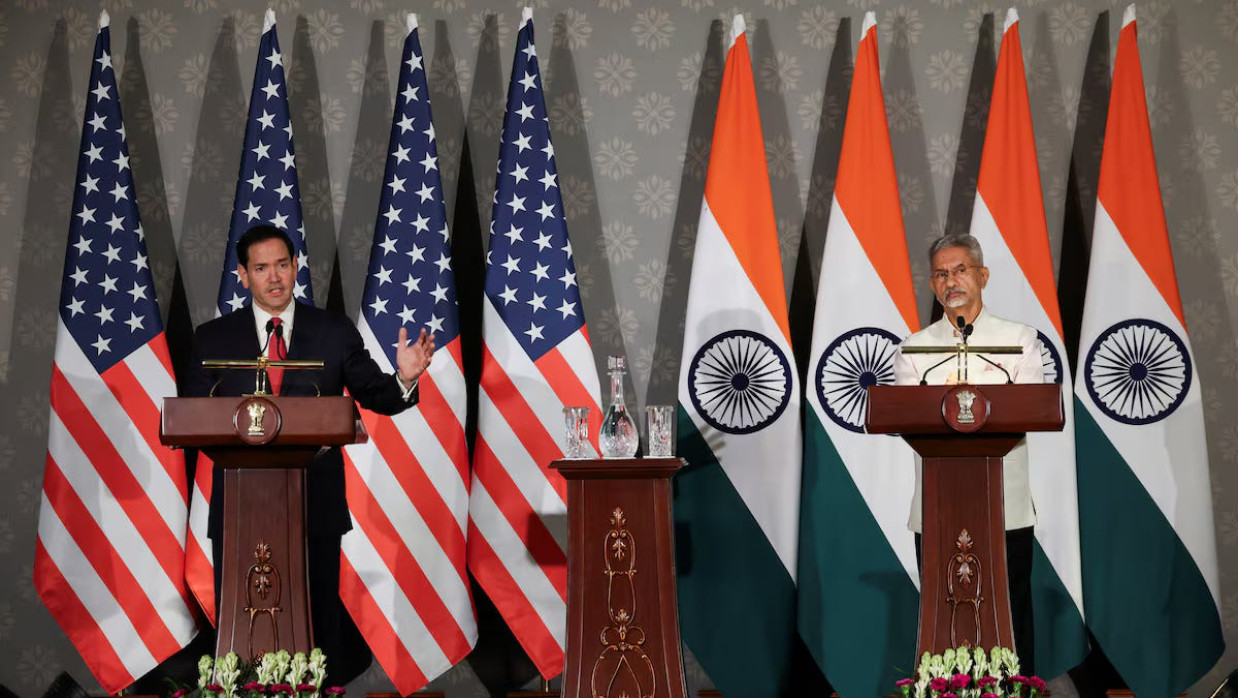
Earlier this week, U.S. Secretary of State Marco Rubio traveled to India, aiming to showcase stability and a fresh pace toward what has become one of the world’s most consequential partnerships. Rubio’s four-day visit included meetings with Indian Prime Minister Narendra Modi, participation in the 11th Quad Foreign Ministers’ Meeting in New Delhi, stops at tourist destinations in Jaipur and Agra, and calls for increased economic and strategic engagement. Rubio’s visit seemed, outwardly, a productive one. Partnerships were announced on maritime security, critical minerals, and even a multi-billion-dollar Pacific infrastructure initiative. But beyond the optics of Rubio’s trip is a growing, long-term problem: an erosion of trust between Washington and New Delhi.
One of the most significant outcomes of the Quad summit was the launch of the Indo-Pacific Maritime Surveillance Collaboration initiative. The framework seeks to improve maritime domain awareness and information sharing across the Indian Ocean and wider Indo-Pacific region. The Quad partners, India, the United States, Japan, and Australia, also unveiled plans for their first joint infrastructure project, a billion-dollar port initiative in Fiji. In addition, the grouping advanced cooperation on critical minerals, an increasingly strategic sector dominated by China. These measures reflect growing concerns among Quad members over China’s expanding geopolitical and economic influence.
India’s drawn-out stint as Quad chair, longer than originally planned, “symbolizes a lack of confidence in the club” and signals that the U.S. is looking elsewhere. India, Japan, and Australia have stayed the course with Quad, but “there are questions in New Delhi about whether Asia still occupies pole position in American strategic calculations.”
Much of India’s unease stems from the policies and rhetoric of the Trump administration. Early in Trump’s second term, relations between Washington and New Delhi deteriorated sharply due to tariffs, criticism of India’s economy, disputes over immigration, and anti-India commentary from sections of Trump’s political base. Although tensions have eased somewhat following a trade framework agreement and renewed diplomatic engagement, Indian policymakers remain wary of what they perceive as an increasingly transactional American approach toward India.
Another major source of concern for India is Trump’s overt warmth toward Pakistan. While New Delhi has historically tolerated limited U.S.-Pakistan cooperation, recent American gestures toward Islamabad have generated discomfort because they came shortly after India’s brief but intense conflict with Pakistan last year. Rubio’s comments describing Pakistan as a victim of terrorism were especially controversial in India, where officials continue to view cross-border militancy as a core national security threat.
Equally disturbing for Indian decision-makers is the potential for a broader accommodation between the U.S. and China. President Trump’s trip to China and his seeming willingness to dial back tensions with Beijing have sparked fears in New Delhi that the Trump Administration will ultimately choose great-power stability over its strategic rivalry with China. With China viewed as India’s top geopolitical threat, any hint of softening coming from Washington is understandably worrying for India’s strategic community.
If any example illustrated India’s sour mood, it was not actually a verbal or written rebuke, but rather who exactly greeted Rubio as he visited India. Rubio was welcomed by junior ministers in New Delhi and Mumbai rather than senior leadership. Indian analysts read the slight as a clear signal to Washington that greetings must be bilateral. India wants America to know that New Delhi stands ready to work with Washington, but if Washington continues to ignore India’s concerns or makes inflammatory statements against India, Washington cannot expect unlimited praise or gestures of friendship from India either.
All in all, Rubio’s trip made it clear that the Quad matters and that the U.S.-India relationship still has momentum in cooperation on issues of strategic value. But the visit also highlighted just how thin the veneer of trust is between the two democracies. New Delhi and Washington share significant strategic interests in countering China, ensuring the free flow of maritime trade, and shaping the Indo-Pacific narrative. India expects the U.S. to repair the trust deficit on issues such as Pakistan, trade, and strategic intent. The U.S.-India relationship will struggle to develop genuine trust.