The Daily Star
Recent developments in the Middle East have shown how the whole world is vulnerable to the closure of a choke-point like the Strait of Hormuz. A similar situation cannot be ruled out in the case of the Strait of Malacca. Bangladesh’s trade with China, Japan, South Korea and many other countries in the Pacific depends heavily on the Strait of Malacca. Trade with China, Bangladesh’s principal trade and investment partner, thus suffers from complete reliance on this strait.
In the last five years, Bangladesh’s imports from China have registered a growth of 45%, against a growth of total exports of 24%, reflecting Bangladesh’s growing dependence on China for industrial inputs, capital machinery as well as consumables. Imports from China increased by 1.45 times, from US$11.5 billion to US$16.65 billion over the last five-year period. Chinese data, however, shows exports at US$24 billion and imports from Bangladesh at about US$1 billion. China’s global exports increased by 2.14 times between 2010 and 2023, while exports to South Asia and Bangladesh increased by 2.91 and 3.38 times respectively. Given the trend, bilateral trade can safely be estimated to reach around US$30 billion by 2030 with the currently traded items.
Despite the unimpressive level of exports to China (only US$600 million), one should not overlook the immense potential for export growth if Bangladesh can diversify its production and manufacturing. This can be ascertained by analysing exports of some competitor countries to China. Notable among these competitors in the Chinese market are Vietnam (US$54 billion) and Thailand (US$13.9 billion). They export machinery and mechanical appliances, electrical equipment, televisions, sound recorders, manufactured items, textiles, plastic and rubber articles, as well as agricultural produce in large quantities. It is evident that geographical proximity to China has provided easier transport connectivity to some of Bangladesh’s competitor countries such as Vietnam and Thailand. Easier transport and smooth, seamless logistical arrangements have added to their competitive advantage, leading to a higher market share in the Chinese market.
If Bangladesh can develop its production capacities and diversify its exports, availing DFQF market access for 98% of Bangladeshi goods into the Chinese market, and succeeds in capturing even 5% of these market segments, exports may easily reach US$2–3 billion within a short period. The advantages of contiguity, land connectivity, as well as direct shipping links could make this target achievable. It is thus imperative for Bangladesh to reflect on options for creating a more efficient supply chain and logistical arrangement with China.

On its part, China has been focusing more on investments in Bangladesh, ranging from road and rail infrastructure to power system networks; from surface water treatment, water supply and sanitation to sewage treatment plants; from broadband networks to ICT infrastructure; from health facilities to oil and gas exploration, among others. Enhanced investments are expected in the Chinese Economic and Industrial Zone (CEIZ) in Chittagong and the Southern Integrated Development Initiative (SIDI). Chinese infrastructure and power projects, as well as companies in CEIZ, will add to the ever-increasing bilateral cargo traffic, which in turn will demand additional or faster connectivity.
Quest for easier connectivity with the land-locked territories of south-western China
Bangladesh–China relations have gained a stronger foundation for economic interaction and sectoral collaboration since the visit of President Xi Jinping to Bangladesh in 2016. Later, in 2025, both countries “agreed to promote high-quality Belt and Road cooperation, strengthen international cooperation on industrial and supply chains…”.
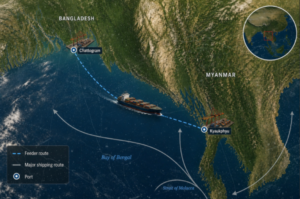
At present, bilateral trade is mostly conducted through shipping via the Strait of Malacca, with one or two ports of call for transhipment. The time required for a direct ocean journey from Hong Kong/Shenzhen/Guangzhou (in the Pearl River Delta) to Chittagong is about 7 days. The time required for containerised cargo to reach Chittagong from Xiamen (on the Fujian coast), Shanghai/Ningbo-Zhoushan/Suzhou (Yangtze Delta), and Qingdao (for the Shandong hinterland) and Tianjin (for the Beijing area) ports is estimated to be about 9, 14 and 15 days respectively. Transhipment during voyages will add to these travel times. An overland connectivity route via Kunming to Kyaukphyu to Chittagong is likely to take less time.
A closer look at bilateral trade in 2025 of the five provinces near Yunnan reveals imports of approximately US$400 million. Their exports to Bangladesh grew by 3.86 times, from US$112 million in 2019 to US$397 million, compared to overall trade growth with China, which is 1.45 times. This growth, despite their being landlocked, is impressive. If their isolation could be addressed, trade volume would increase even faster. It is thus important to explore options for mitigating the disadvantages of being landlocked.

Ideas to mitigate the Malacca dilemma and challenges thereof
China has, over the years, developed well-articulated transport connectivity with mainland countries of ASEAN. However, Chinese access to the Indian Ocean remains contingent upon passage through the Strait of Malacca—a chokepoint. In order to overcome this, China has advanced several ideas under its Maritime Silk Road, the sea leg of the Belt and Road Initiative (BRI). China has attempted to address its Malacca dilemma through: (a) connectivity involving Bangladesh, China, India and Myanmar, known as the BCIM initiative; (b) the Kra Canal across the Isthmus of Kra to connect the Gulf of Thailand to the Andaman Sea; and (c) connectivity to Kyaukphyu on the Rakhine coast from Kunming as part of the China–Myanmar Economic Corridor (CMEC).
Countries in the region have been discussing options for connectivity under BCIM for over a decade. However, it failed to gain traction as India developed indifference due to geopolitical reasons. Even if political understanding between Beijing and Delhi improves and the project regains traction, it will still face insecurity prevailing along both sides of the Myanmar–India border, beyond the hilly terrains along the route.
The Kra Canal was conceived to reduce shipping distance by about 1,200 nautical miles, thereby saving travel costs, reducing transit time and easing congestion in the Malacca Strait. The initial Kra Canal project would have cost about US$25 billion and required ten years to complete. However, Thailand has ultimately abandoned the project on environmental grounds and has instead commenced a land bridge project, the first phase of which is set to begin in 2026.
The remaining option, from Kunming to Kyaukphyu, is an integral part of the CMEC, which again forms part of the BRI. Its initial deliverables include the transportation of gas and oil. Plans for infrastructure development cover building road and rail links from Yunnan through Muse and Mandalay to the seaport at Kyaukphyu/Maday Island.

The Kyaukphyu deep-sea port was initially planned to have 10 berths, with an annual bulk cargo tonnage of 7.8 million tonnes per year and 4.9 million TEU initially. Given Myanmar’s concerns over prohibitive costs and the risk of a debt trap, its capacity has now been reduced significantly. The first phase of a deep-sea port on Maday Island is expected to cost US$1.3 billion, while the second phase will involve the construction of a port on the neighbouring Ramree Island. Its SEZ component remains dormant at this stage.
Given the conflicts in Rakhine between the Myanmar Army and the Arakan Army, the project will face significant uncertainty and intense debate. Regardless of the political future of Rakhine State, it is likely that the Arakan Army and the Myanmar government will eventually reach an understanding on the completion of the project. Furthermore, there are political risks arising from conflicts in Shan, Mandalay and Magwe, involving both ethnic groups and the Bamar ethnicity of Myanmar. As the project determines the future of the BRI segment through the CMEC, it is expected that China will seek to use its good offices to bring the rivals to an arrangement for early completion of the project.
However, the huge investments may not offer adequate returns from export and import cargo alone for China, as the chances of Myanmar using this port across the Arakan Yoma are very slim. Rakhine will primarily use the port at Sittwe, built by India as part of the Kaladan Multimodal Transport Project. That brings to the fore the question of whether the port could be used for bilateral trade between China and Bangladesh, in order to enhance its economic viability by handling higher volumes of cargo.
Additional cargo for Kunming–Kyaukphyu sector if Bangladesh is connected
The operationalisation of CEIZ and other projects in Bangladesh with Chinese funding, as well as a very impressive annual growth of bilateral trade of over 20–25% per annum, might significantly add to cargo volume. Faster connectivity via Kyaukphyu and Kunming would then make more non-traditional items part of the basket of tradable goods between Bangladesh and China. There will be strong possibilities of securing more items from Sichuan, Yunnan, Guizhou, Guangxi, Chongqing and Hunan. Landlocked provinces such as Hubei and Henan may also benefit.
Source: https://www.thedailystar.net/slow-reads/geopolitical-insights/news/why-bangladesh-and-china-need-new-connectivity-routes-4168181