
South Asia Journal
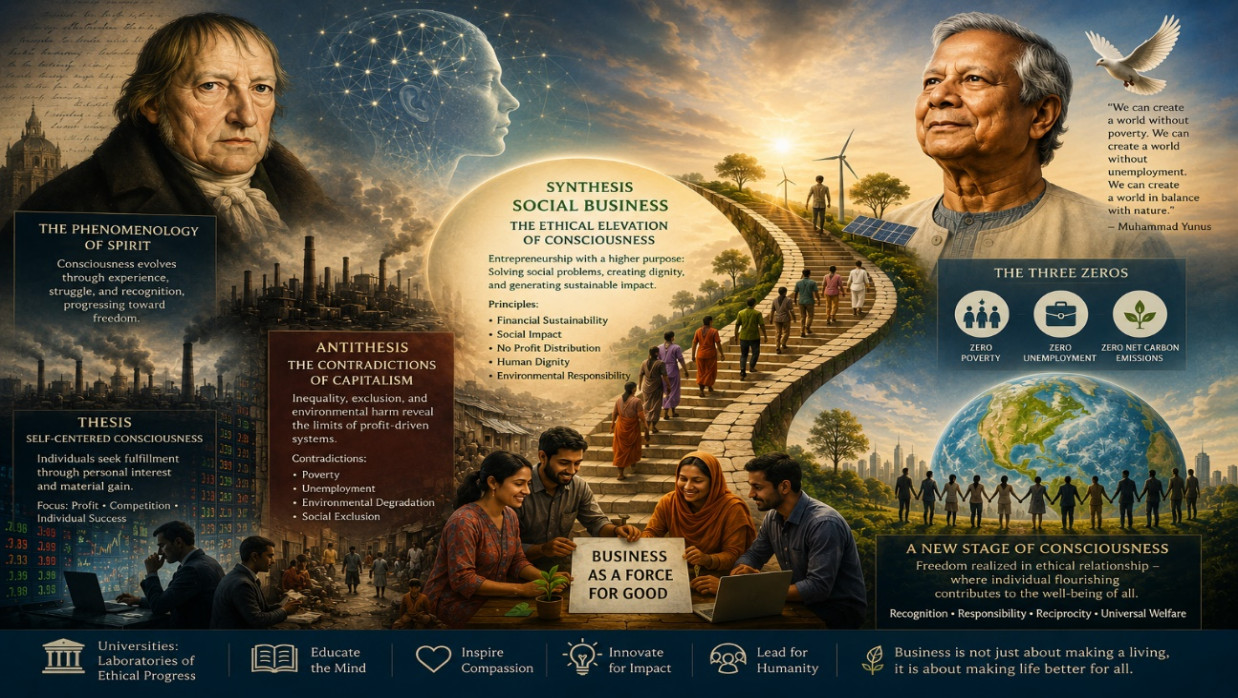
From self-interest to shared humanity, social business represents the evolution of economic consciousness—where entrepreneurship becomes a force for dignity, justice, and sustainable development, advancing Dr. Muhammad Yunus’ vision of a Three Zero World through the ethical ideals reflected in Hegel’s philosophy
“The history of the world is none other than the progress of the consciousness of freedom.” — G. W. F. Hegel
Economies are frequently judged on the basis of efficiency, productivity, profitability, and performance. Although these criteria remain relevant, they rarely address another philosophical question: what is the economy’s final aim? Is the economy only a tool that helps in earning money, or is it supposed to be a means to ensure the freedom and dignity of man and the prosperity of people?
The philosophy of Dr. Muhammad Yunus, the Nobel Peace Laureate, poses this very question. This is how his idea of social business goes beyond capitalism, suggesting that businesses need not be profitable for their owners to solve urgent social problems. The issues of poverty, unemployment, the environment, health care, and education translate into entrepreneurial challenges.
Remarkably, this vision resonates with one of the most profound philosophical works in modern history Hegel’s Phenomenology of Spirit. Although Hegel wrote more than two centuries before the emergence of modern social entrepreneurship, his theory of the historical evolution of consciousness provides a compelling framework for understanding why social business represents not merely an alternative business model but a higher stage in humanity’s moral and social development.
When seen within the framework of Hegelian thought, Social Business by Nobel laureate Dr. Yunus is a manifestation of man’s gradual evolution from egocentric existence to ethical consciousness.
Hegel’s Human Consciousness Journey
History, according to Hegel, is a progressive journey through which human consciousness moves towards a comprehensive realization of freedom. Human beings do not start with a full comprehension of all aspects of life. However, consciousness develops through the constant experience of contradictions. Each stage of knowledge is characterized by its own limitations, which lead to contradictions at some point. The latter drives the consciousness to overcome itself and develop into something greater. This developmental process often summarized as thesis, antithesis, and synthesis is not merely an intellectual exercise. It encompasses politics, culture, economics, ethics, and civilization itself. History for Hegel was the unfolding of man’s understanding that true freedom must necessarily not be isolated. It can only find meaning when people relate to each other ethically in recognition of their equality as members of the same human community.
Capitalism as a Necessary but Incomplete Stage
From a Hegelian standpoint, present-day capitalism is a significant historical success.
The competitive market produced innovations, increased production, created wealth, and raised millions out of abject poverty. There is, however, an inherent contradiction within capitalism.
Profit-driven capitalism often leads to widening inequalities, environmental destruction, economic instability, labor exploitation, and social marginalization. Capitalism has proven very good at resource allocation but poor at solving problems that do not yield immediate financial gain. This contradiction follows Hegel’s conception of historical progress. All systems have their inherent limitations, which call for a new synthesis. Limitations within profit-driven capitalism do not need to lead to its overthrow; rather, they point to its transformation.
Social Business as the Ethical Synthesis
Dr. Yunus’ concept of social business may be understood as precisely such a synthesis.
Instead of abolishing entrepreneurship, social business redirects entrepreneurial capacity toward solving human problems. Instead of eliminating markets, it harnesses market mechanisms for public benefit. Instead of rejecting financial sustainability, it insists that social enterprises remain economically viable while dedicating their surpluses to expanding social impact rather than enriching investors. This synthesis preserves capitalism’s strengths innovation, efficiency, accountability, and sustainability while overcoming many of its ethical limitations.
Hegel would likely recognize this movement as an example of Aufhebung, the dialectical process in which an existing system is simultaneously preserved, negated, and elevated to a higher form.
Social business does not abandon business; it transforms the purpose of business.
Recognition Beyond Profit
One of Hegel’s most influential ideas is the concept of recognition (Anerkennung).
Human beings seek more than material resources. They seek recognition of their dignity, capabilities, and humanity. Poverty is not just about lacking money. Often, poverty indicates that society has failed to recognize people as beings capable of contributing creatively to the economic and social processes of their lives.
Charity, while well-intentioned, often perpetuates a relationship of inequality between the giver and the receiver. Social business fundamentally changes this relationship. Microcredit, social entrepreneurship, and inclusive business models treat poor individuals not as passive beneficiaries but as entrepreneurs, producers, innovators, and decision-makers. This process marks the return of reciprocal recognition within the Hegelian sense. Agents gain autonomy.
Communities reclaim their dignity. Economic engagement assumes the nature of human emancipation.
From Individual Success to Universal Well-Being
Hegel believed that Sittlichkeit is the ultimate manifestation of freedom as individuals willingly subsume their individual goals into the common good. Social business exemplifies this ethic perfectly. Innovators keep innovating. Managers keep managing. Firms keep competing.
However, the ultimate goal shifts from increasing shareholder value to increasing human well-being. Profitability alone no longer serves as a gauge for success.
Instead, it is health, education, sustainability, women’s empowerment, employment for the young, and the alleviation of poverty that serve as the criteria. Business becomes an institution of ethical citizenship. Profit becomes a means rather than the end.
The Three Zeros as the Highest Stage of Ethical Consciousness
Dr. Yunus’ vision of a Three Zero World—Zero Poverty, Zero Unemployment, and Zero Net Carbon Emissions can also be interpreted through Hegel’s philosophy.
Each zero represents the transcendence of historical contradictions.
Zero Poverty overcomes economic exclusion.
Zero Unemployment restores productive human participation.
Zero Net Carbon Emissions reconciles economic development with environmental responsibility.
Collectively, these goals reflect an increasingly universal conception of freedom.
Human flourishing becomes inseparable from social justice and ecological sustainability.
This movement parallels Hegel’s description of Spirit gradually becoming conscious of its universal nature.
Universities as Laboratories of Ethical Progress
If social business represents a higher stage of ethical consciousness, universities occupy a uniquely important role in advancing this transformation. Higher education has traditionally emphasized technical competence, disciplinary specialization, and professional preparation.
These remain essential. However, universities must also cultivate moral imagination.
Students should learn not only how to maximize profits but also how to solve societal challenges through entrepreneurial innovation. Business education must integrate ethics, sustainability, inclusive development, and social responsibility into its core curriculum. Technology should be developed to address inequality. Healthcare should be developed in a way that is affordable.
Communication should enhance participatory democracy. Economics should judge wealth not only on efficiency but also on dignity. Thus, universities become institutions where consciousness shifts from self-interest to social responsibility.
Bangladesh and the Global Evolution of Social Consciousness
Bangladesh occupies a distinctive place within this philosophical narrative. Often portrayed internationally through the language of poverty and vulnerability, the country has emerged as the birthplace of several globally influential development innovations, including microcredit, social business, and the Three Zero movement. These contributions extend beyond economic experimentation. They represent new ways of thinking about development itself.
Rather than viewing disadvantaged populations as burdens, Bangladesh has demonstrated that they can become innovators, entrepreneurs, and active participants in sustainable development.
In Hegelian terms, ideas originating from historically marginalized societies can reshape the universal evolution of human consciousness. The Global South becomes not merely a recipient of development theories but a producer of new philosophical and economic paradigms.
Towards a New Spirit of Business
Humanity faces an array of challenges in the 21st Century. Challenges such as climate change, technological change, inequalities, demographic shifts, public health emergencies, and geopolitics reveal the shortcomings of existing economic systems. These crises also create opportunities for intellectual and institutional transformation. Social business offers more than practical solutions. It proposes a fundamentally different understanding of why economies exist.
Economic institutions should not just create wealth.
They should promote human liberty.
They should provide more chances.
They should empower communities.
They should safeguard the environment for future generations.
All these goals are highly consistent with Hegel’s views, who believed that history progresses through the achievement of ethical freedom.
Conclusion
Examined through the theoretical framework of Hegel’s Phenomenology of Spirit, Dr. Muhammad Yunus’ philosophy of social business emerges as far more than an innovative economic model. It represents a higher stage in humanity’s moral evolution a synthesis that reconciles entrepreneurial dynamism with ethical responsibility, individual initiative with collective well-being, and economic efficiency with social justice. Social business does not denounce the market but redefines its function. Rather than glorifying money for the mere purpose of accumulating it, it understands that economics is the means by which to increase human liberty and dignity. In this light, the future of business might lie less with those who generate the greatest profits and more with those who are most adept at bringing about the moral growth of humanity.
Just as Hegel saw history as the realization of freedom and Dr. Yunus sees business as a solution to humanity’s biggest problems, there emerges from this convergence of thought a compelling idea – that the greatest accomplishment of civilization lies not in the creation of wealth, but in the creation of structures which allow every individual to lead a life of dignity and promise.
Since both Hegel and Dr. Muhammad Yunus have seen history and business respectively as a process of realization of freedom, this means that their concepts can be brought together to formulate an idea which could be stated as follows: the supreme accomplishment of civilization lies not in the creation of wealth, but rather in establishing such institutions that allow every human being to exist with dignity and prospects. This is because the economic system is not fixed and unchangeable as it is a human invention. And Dr. Muhammad Yunus was right when he said the following:
“Poverty is not a result of poor people. Poverty is a result of our institutions and policies. If we change these institutions, there will be no poverty in the world.” — Dr. Muhammad Yunus

Dr. Serajul I. Bhuiyan
Dr. Serajul I. Bhuiyan is a Professor and former Chair of the Department of Journalism and Mass Communications at Savannah State University.