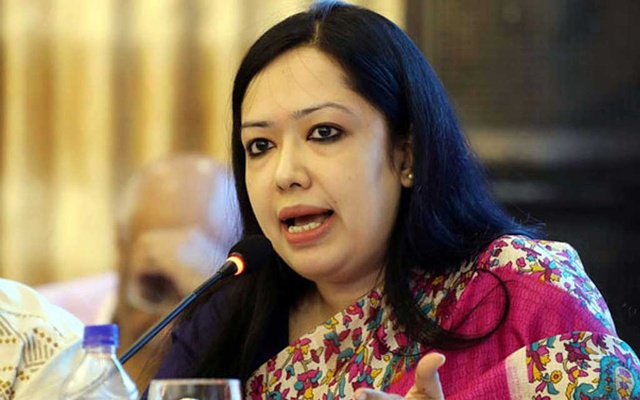

Prosecutor Gazi Hossain Tamim, Chief Prosecutor’s Office, International Crimes Tribunal (Bangladesh) Image credit: You tube
by Ghulam Suhrawardi
As Bangladesh reels from the crackdown in the post-uprising period, two short tweets by Prosecutor Gazi Hossain Tamim reverberate across the country with unusual moral and political import. “I vehemently reject the farcical verdict in favor of the Razakars that stands against the spirit of the Liberation War,” Tamim said. In another tweet, he added, “Much will depend on the fate awaiting Obaidul Quader and the other Awami League leaders.” Beyond their brevity, the remarks also mirror the larger reckoning that has been set in motion in Bangladesh.
Tamim’s first statement, wherein he vehemently rejected the Razakar-friendly verdict with contempt, touches upon the most sensitive nerve of our historical memory. The Liberation War of 1971 is the moral bedrock of modern Bangladesh. Every distortion of justice connected to that war, politically motivated trials, selective prosecutions, or rehabilitation of wartime collaborators, touches upon the nation’s identity at its core. For decades, the prosecutions of the 1971 crimes were tainted by political manipulation. Some were targeted for their politics, and some were protected for political expediency. Tamim’s denunciation of the “farcical” verdict is a moment of moral courage in a time of national cynicism.
Tamim’s second statement, a reference to the fate of Obaidul Quader and other Awami League leaders, points to a more profound, structural question: can those who, over the years, built such a degree of near-total impunity now be held accountable before the law? For more than a decade, the Awami League leadership has never wielded the degree of control and power over state institutions as it did in Bangladesh. Enforcement agencies were politicized, bureaucratic power was centralized, and judicial independence was weakened. The excessive show of force against the uprising of 2024, the use of helicopters, bullets, and live rounds against peaceful protesters, and widespread arrests of young people across the country were not an accident. On the contrary, the testimonies and evidence before the tribunal speak of a systematic, top-down response of state violence. Tamim’s public allusion to the future of political leaders as dependent on a national course of justice is an admission that the end of a long culture of impunity has begun.
Impunity has come and gone in Bangladesh in various forms over several decades. Governments change; state institutions can be half-heartedly reformed, but at a deeper structural level, accountability has persisted. Bangladesh has, in recent history, also been marked by multiple forms of institutional capture, the use of coercive force against political opponents, political violence, widespread corruption, partisanship, and the subjugation of public interest to party priorities.
Impunity, of course, has come in different forms and through different avenues. The list includes extra-judicial killings and enforced disappearances, of course, but also includes compromised elections, the co-opting of law enforcement to suppress dissent, and much more. The uprising of 2024 and the significant role played by the country’s youth in this moment was not just a movement against a government but a popular movement against the broader culture of impunity and unaccountability. Tamim’s words on deciding the fate of the ruling political class is, in that sense, a statement on that national exhaustion.
The end of certain political myths, long since dead in reality but lingering on in the public discourse, is also part of what lies at the heart of this moment. On the one hand, by invoking the legacy of the Liberation War, the former ruling party has long projected a mythology of moral superiority. On the other hand, it also staked a claim to a form of invincibility by hollowing out state institutions and then re-appropriating them. As the uprising of 2024 unfolded, both of these myths collapsed. The state machinery, which used to be at the complete political whim of the ruling elite, is being turned on itself to investigate, litigate, and decide on its own conduct. The tribunal is no longer being used as a tool for political messaging, and in fact is beginning to build a counter-narrative in which the very idea of truth-seeking is taking root. Tamim’s two statements are attacks on those broken myths. By ridiculing the Razakar verdict as farcical, Tamim punctured the political class’s mythology of moral superiority. By alluding to the fate of Awami League leaders, Tamim is also signalling that political invincibility is no longer a given.
This is a moment to begin the long, necessary work of rebuilding state institutions on a firmer, more democratic foundation. Justice must, of course, be delivered, but it cannot come in a vacuum. It is also essential to restore the independence of the courts, establish transparent governance, and strengthen parliamentary oversight. The hollowing out of public institutions in Bangladesh has been a decades-long project of relentless centralization of political power. As a new wave of justice both in courtrooms and in public opinion now makes its way across Bangladesh, it must also be ensured that no future government, of whatever ideology, can deploy state institutions to suppress popular will and political dissent. The rebuilding process will require institutional trust, the empowerment of civil society, respect for dissent, and an environment in which the law does not bow to political loyalty.
Tamim’s two short statements have the potential to capture the weight and meaning of a national mood. They reflect the collective yearning of millions to move beyond the authoritarian patterns that have characterized our political life in recent years. They speak to the nation and remind Bangladeshis that justice is not a matter of vengeance but of restoring moral balance. Farcical verdicts of the past must not define the future. Tactics of fear and coercion can no longer justify or preserve political authority. And the voices of those who played a key role in this uprising, Bangladesh’s youth, must not be written off as mere noise and distractions.
This is a very important moment in the history of Bangladesh. It is no longer just a matter for the courts. The issue before us is one of national renewal. The prosecutor is only one voice in a chorus of voices that must be heard at this time: a voice calling for accountability, transparency, and the return of true democratic governance. The road ahead will be long and hard. The direction, however, is clear: there can be no future in a society that allows its wounds to fester or its political crimes to go unpunished. Justice, however imperfectly it is served, however painful the methods by which it is delivered, is the only way to begin the healing process and restore the moral backbone of the republic. It is in that spirit that we must regard the words of Prosecutor Gazi Hossain Tamim. In giving voice to the hallowed words of justice and dignity, he has become the voice of the nation’s hopes.
The author is the publisher of the South Asia Journal.