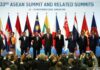
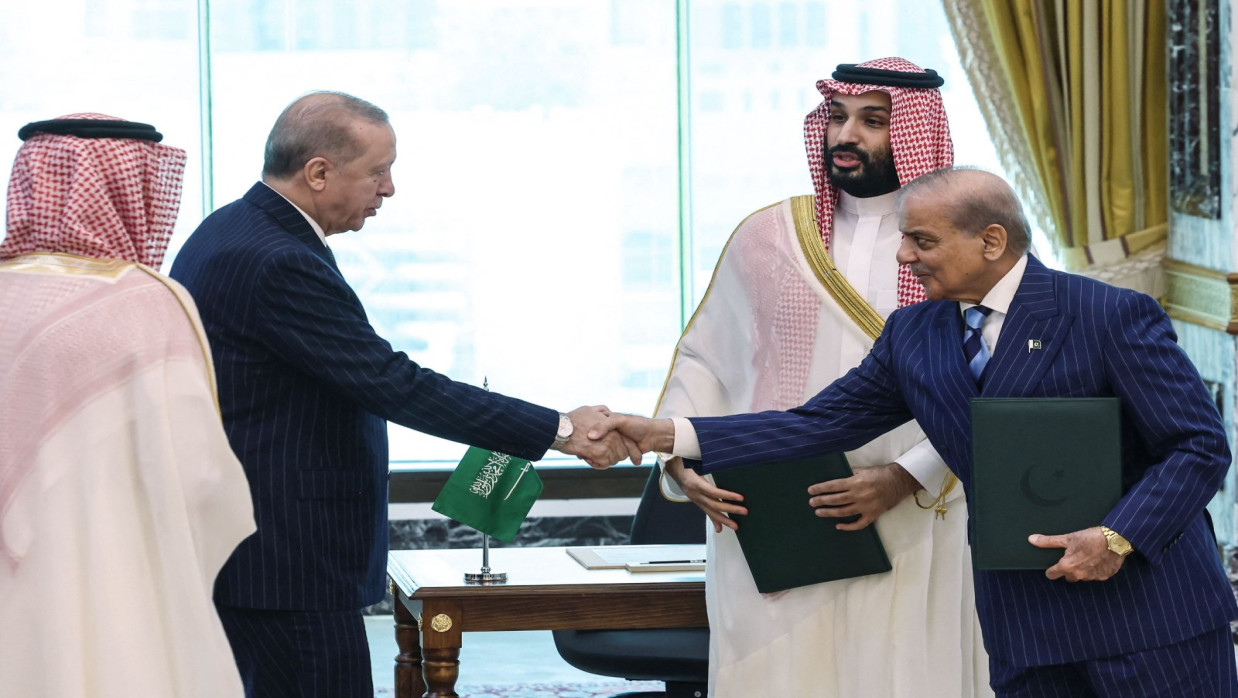
The new security agreement among Saudi Arabia, Pakistan and Türkiye, known as the Mecca Joint Defense Agreement and signed on August 7, 2026, has added a new dimension to the security landscape of South Asia and the Middle East. The provision that states an armed attack against one will be considered an attack against all has sparked comparisons to NATO’s Article 5. Islamabad and New Delhi, however, see the pact through very different lenses. Pakistan touts the agreement as another deterrent, while India sees it as another potential problem to navigate.
A close examination of the national speeches by Pakistan and India’s prime ministers, delivered almost 24 hours apart, reveals the dichotomy. Prime Minister Shehbaz Sharif was in India-focused rhetoric when discussing the pact in Islamabad. He touted last May’s conflict as proof of Pakistan’s military prowess, painted India’s suspension of the Indus Waters Treaty as a red line, and promised that future escalations would be met with an even tougher response.
Prime Minister Narendra Modi adopted a different posture. He did not mention Pakistan or Operation Sindoor. Instead, he spoke about the changing character of warfare, in which refineries, financial institutions, data centers and supply chains could be attacked alongside conventional military targets. His emphasis on drones, counter-drone systems, hypersonic weapons, infrastructure security and technological self-reliance reflected India’s broader concern with national resilience.
The speeches highlighted contrasting strategic philosophies. Pakistan focused on declared thresholds, external alliances and deterrence. India highlighted industrial capacity, staying power and responding to a multi-dimensional attack.
Symbolism, Structure and Perception
Pakistan’s political and military establishment portrays the pact as recognition of the country’s strategic importance. Islamabad is now formally aligned with Saudi Arabia, custodian of Islam’s holiest sites, and Türkiye, NATO’s second-largest military power. The arrangement also brings together Saudi financial resources, Turkish defense technology and Pakistan’s experienced armed forces and nuclear capability.
The agreement, however, should not yet be described as a Middle Eastern NATO. NATO possesses an integrated military command, permanent planning institutions, established rules of engagement, common standards and decades of operational experience. Although the Mecca Pact provides for political and military coordination, exercises and defense-industrial cooperation, it has not yet demonstrated comparable institutional depth.
The complete agreement has not been made public, so it’s hard to know exactly what military contribution each ally would be required to make. It’s an important distinction. NATO’s Article 5, for example, doesn’t necessarily mean each member automatically declares war on behalf of another. Each NATO ally is only required to do “such action as it deems necessary,” including with armed force. Article 5 has only been invoked once, in the wake of the Sept. 11, 2001 attacks against the United States.
Still, alliances don’t derive strength just from black-and-white treaty obligations. Perception plays a role, too. If Pakistan’s leaders feel the agreement gives them diplomatic support, or military access or assistance during a crisis, they may feel emboldened to pursue conflict with India. That could enhance deterrence, but it could also create risks if leaders take actions they otherwise wouldn’t, assuming backup that may not exist.
India’s More Complex Strategic Environment
From India’s perspective, the pact may be operationally limited but politically significant. Pakistan already enjoys extensive defense cooperation with China and Türkiye. The new arrangement could combine Chinese weapons platforms, Pakistani production capacity, Turkish technology and Gulf financing. Such cooperation may gradually improve Pakistan’s access to drones, electronic warfare, intelligence systems, precision weapons and advanced training.
The pact could also complicate the diplomatic termination of a future India-Pakistan conflict. Saudi Arabia would possess a formal interest in Pakistan’s security, while Türkiye would probably offer Islamabad political and informational support. More actors would therefore enter the crisis-management process, increasing pressure on India while making controlled de-escalation more difficult.
This helps explain why India is concentrating on the lessons of the 2025 conflict: intelligence integration, logistical replenishment, infrastructure protection, civil defense and the ability to sustain operations without losing control of escalation. New Delhi appears unwilling to exaggerate the pact publicly, but it cannot afford to disregard its longer-term implications.
The Gulf is no longer merely a source of energy, investment and remittances. It is becoming an increasingly active participant in the security order extending from the Red Sea to the western Indian Ocean. Saudi Arabia, in particular, appears determined to become a more autonomous security provider rather than remain dependent upon external guarantees.
Expansion Could Change the Equation
The pact’s significance going forward will hinge on three factors: creating a robust joint command, achieving substantive military interoperability, and expanding membership. Egypt has been discussed publicly as a potential member, while Bangladesh is said to be weighing an offer. Speculation surrounding Iran, Bahrain, or other nations should be taken with a grain of salt until confirmed.
Iran joining would change the pact from what many view as a Sunni coalition to a genuine regional security arrangement. It would also complicate matters for India. Tehran was historically New Delhi’s gateway to nurturing lucrative relations, though India’s burgeoning strategic partnership with Israel and the United Arab Emirates has strained that relationship.
India must consequently intensify its diplomacy with Saudi Arabia, Egypt, Qatar, Kuwait, Bahrain and Iran. It must also strengthen maritime surveillance in the Arabian Sea, where the pact’s geographic reach most directly intersects with Indian security.
In the short term, Pakistan has achieved at least strategic depth if not operational readiness. India has not confronted the emergence of a new NATO. But it does confront the development of a regional order whose significance is still unclear. The risk is either belittling it as mere pageantry or treating it as a military alliance already fully designed and institutionalized. The Mecca Pact matters because it could alter expectations, alignments, and calculations in times of crisis. Pakistan sees it as reassurance. India will need to factor it in as a variable whose significance could grow much larger in the years to come.

Ghulam M. Suhrawardi
Ghulam M. Suhrawardi is the Publisher of South Asia Journal.
Source: https://southasiajournal.net/post/india/61655/the-mecca-pact-deterrence-for-pakistan-strategic-complexity-for-india