JAHIDUL ISLAM
Published:
Agencies are groping in the dark in executing Family Card recipes as a huge sum is being handed out under this government‘s flagship social-protection programme sans designating real recipients amid data dearth, sources say.
This is also the ruling BNP’s key electoral pledge that went for rapid execution through disbursing cash assistance to insolvent families across Bangladesh after its election to power.
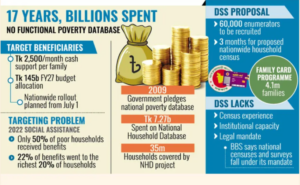
To bridge the data gaps, the Department of Social Services (DSS) has proposed conducting a nationwide census within three months by recruiting more than 60,000 enumerators to identify eligible beneficiaries of the Family Card charity.
Economists and government officials, however, have questioned the feasibility of the proposal, arguing that completing a nationwide census within such a short timeframe is unrealistic, particularly as the DSS lacks experienced personnel, institutional capacity to conduct a census or large-scale survey, and the legal mandate to undertake such an exercise.
A senior official at Bangladesh Bureau of Statistics (BBS) has said any public or private agency could conduct surveys only in areas where the BBS does not already have its reach.
The government has allocated Tk145.0 billion under the Annual Development Programme (ADP) for the current fiscal year to provide Family Card to 4.1 million families, with each beneficiary family set to receive Tk 2,500 per month.
The DSS has proposed revising the ongoing ‘Strengthening Social Protection for Improved Resilience, Inclusion and Targeting’ project to implement the Family Card programme, incorporating the proposed census and several other components.
The project documents reveal that the pilot phase of the Family Card programme, launched in March this year, has been implemented successfully over the past few months, and the government planned to formally roll out the programme nationwide from July 1st.
The documents also state that the Cabinet Committee assigned the Ministry of Social Welfare for conducting the census and data-entry activities for the programme.
Since proposed in Parliament, 17 years have elapsed but a poverty database remains elusive.
While presenting the national budget in Parliament, then finance minister Abul Maal Abdul Muhith pledged to prepare a comprehensive database of hardcore poor, vulnerable elderly citizens, and persons with disabilities to ensure targeted government assistance.
In the following year’s budget speech, he said the government had already started developing a database of social-safety-net beneficiaries to improve coordination among social-service programmes.
However, even after 17 years, Bangladesh has yet to establish an effective and functional poverty database.
The BBS’s Tk7.27-billion project fails to deliver. Following the commitment, the Bangladesh Bureau of Statistics (BBS) initiated a project in 2013 to develop the National Household Database (NHD) with an estimated cost of Tk3.29 billion, aiming to identify beneficiaries of social-safety-net programmes through a database of 35 million households.
The project, originally scheduled for completion in 2017, was finally completed in 2022 after costs surged to Tk7.27 billion. However, the database remains inaccessible due to the failure to develop a Management Information System (MIS).
In a revised project proposal in 2024, BBS acknowledged that the poverty database remained unusable due to the absence of an MIS and application-programming interface (API).
Database gap fuels targeting failures in social-safety-net delivery. The lack of a comprehensive database has contributed to persistent targeting failures in social-safety-net programmes, with inclusion and exclusion errors remaining high, according to the social-security budget report for the current fiscal year.
Evidence shows that social transfers are still not reaching the poorest effectively. Only about half of poor households received social assistance in 2022, while around 22 per cent of total social benefits went to the richest 20 per cent of households, highlighting continued exclusion, inclusion errors and leakages in programme delivery.
Economist Prof Mustafizur Rahman, Distinguished Fellow at the Centre for Policy Dialogue (CPD), terms unfortunate the absence of a comprehensive database of poor people even after so many years.
He has said, “The lack of such a database results in misallocation of funds, with a significant share of benefits going to affluent groups while many poor people remain excluded.”
He suggests creating a reliable database through a quality survey or census before launching the Family Card programme, noting that such exercises are usually conducted by the BBS and the DSS’s capacity in this area remains untested. He also recommends involving all relevant stakeholders in the census process.
Shah Mohammad Mahboob, Director-General at the DSS, has said that although BBS conducts various surveys, the data generated from those surveys would not be sufficient to accurately identify beneficiaries for the programme.
He said the ministry was, therefore, was given the responsibility of conducting a census under the DSR framework. To carry out the exercise, a nationwide workforce will be recruited and monitoring teams will be formed.
“The census and beneficiary-selection process will be completed within three months by covering all households across the country,” he said.
Md Firoz Sarker, secretary of the Statistics and Informatics Division, has said the DSS had not yet shared any plan to conduct a survey or census. “Instead, the department had shared a plan to conduct a Proxy Means Test (PMT) to assess people’s socioeconomic condition using proxy indicators that reflect income levels.”
He has expressed the hope the DSS would seek support from the BBS if it proceeds with any census or survey in the future.
Source: https://thefinancialexpress.com.bd/economy/billions-being-spent-in-annuity-sans-identifying-real-recipients