Presuming that risk of over-indebtedness of Bangladesh economy rising gradually, the French Development Agency (AFD) starts assessing the country’s sovereign risk and economic and financial vulnerabilities, officials said, pending its post-graduation assistance.
The development-financing agency of the European Union country says the risk of over-indebtedness in Bangladesh is increasing due mainly to higher debt servicing and dependence on domestic bank financing.
Also, the agency wants to assess the performance of the growth trajectory of the economy.
A monitoring mission of the AFD began Monday the four-day assessment in Dhaka with meetings with relevant top government officials, including Finance Division, Financial Institutions Division, Power Division, and Ministry of Environment, Forestry, and Climate Change.
The AFD team on the day had meetings with top officials from the Macroeconomic wing, SOE wing, Government Debt and Financial Asset wing, Management wing, and Planning, Development and Reform wing of the Finance Division.
A senior Finance Division official says the AFD conducts country-and sovereign-risk assessment of Bangladesh every four years.
The last country risk-analysis mission to Bangladesh took place in July 2021.
“The latest country assessment aims to find how the agency can provide financial support more effectively as the LDC graduation will bring significant changes in terms trade and economy of Bangladesh,” he said.
Since 2012, the AFD has made commitment of 2.0 billion euros in loans and 47.2 million euros in grants for Bangladesh. Of the released amount, 41 per cent was invested in the water and sanitation sector while 22 per cent in power and energy sector.
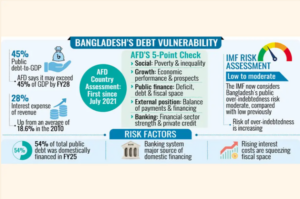
The AFD predicts Bangladesh’s public finance-deficit is fuelling the rise in the public-debt ratio, which could exceed 45 per cent of gross domestic product (GDP) in FY’28.
The domestic share, 54 per cent of total debt in FY’25, is largely financed by the banking system, which constitutes a major point of vulnerability given the ongoing banking crisis, it says, adding that interest expense exceeded 28 per cent of revenue in FY25, compared to 18.6 per cent on average in the 2010s.
The International Monetary Fund (IMF) now considers the risk of public over-indebtedness to be moderate, compared to previously rated low. “The risk of over-indebtedness is increasing, linked to higher debt service and dependence on domestic bank financing.”
The AFD is conducting the assessment based on the analysis of the five pillars of the method developed by the Department of Public Economic and Political Diagnostics of AFD focusing social situation, growth, public finance, external position, and banking sector.
During the spot appraisal, the mission will gather information on the social background and analyse the progress achieved in poverty-and inequality reduction, review the growth performance in order to assess the prospects for growth, and focus on the budget balance and the capacity to finance the necessary infrastructure and the level and structure of public indebtedness.
Moreover, the mission will analyse the structure of the balance of payments and the financing means, and assess the quality of the banking sector and its ability to provide sufficient credit to meet the development needs of the private sector.
The AFD says Bangladesh’s economy has slowed sharply during the last three years due to inflation, the fragility of the banking sector, and political uncertainties. The economic model, focused on textiles and migrant transfers, shows structural limits, including a lack of diversification.
The country is also highly vulnerable and exposed to climate change-induced risks with significant economic consequences.
“With government revenue averaging only 8.6 per cent of GDP in the 2010 decade, Bangladesh’s fiscal burden is among the lowest in the world and limits fiscal space,” it has said.
Source: https://thefinancialexpress.com.bd/economy/afd-launches-sovereign-risk-assessment